


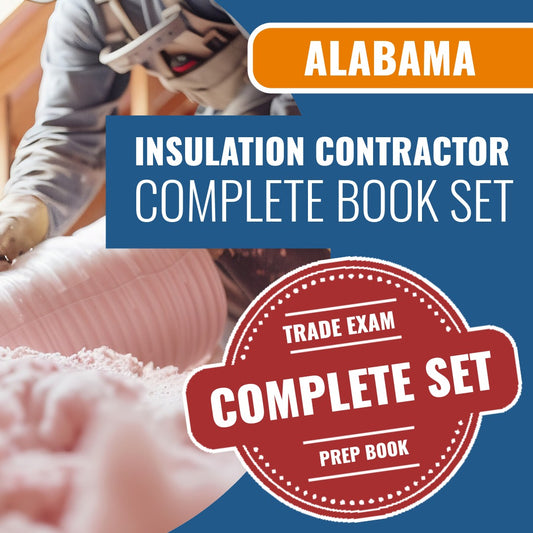
Alabama Insulation Contractor Exam Book Package
Alabama Insulation Contractor Exam Book Package
Precio regular
$495.00
Precio de venta
$495.00
Precio regular
$595.00
Precio unitario
por
Envío calculado a la salida.
No se pudo cargar la disponibilidad de recogida
CALL TO ASK ABOUT FINANCIAL ASSISTANCE


We also recommend
Venta Venta Venta Venta Venta Venta Venta Venta Venta Venta Venta Venta Venta Venta Venta
Alabama Insulation Contractor Exam Book Package
Precio regular
De $495.00
Precio de venta
De $495.00
Precio regular
$595.00
Precio unitario
por
Alabama Insulation Contractor Exam Book Package
Prepare for the Alabama Insulation Contractor examination with a focused set of technical references covering insulation materials, residential construction, building assemblies, safety, ventilation, estimating, and installation practices. The Alabama Insulation Contractor Exam Book Package brings together the core books used to study for this specialty contractor examination and gives candidates a practical reference library for both exam preparation and ongoing trade knowledge.
Insulation work involves much more than placing material inside walls and ceilings. Contractors need to understand how different insulation systems perform, how building assemblies affect installation, how moisture and ventilation influence thermal performance, and how jobsite safety requirements apply to insulation work. The Alabama examination reflects that range of knowledge through questions covering insulation theory, plan reading, materials, estimating, spray-on systems, batt and roll insulation, loose-fill products, rigid-board insulation, reflective systems, ventilation, vapor barriers and retarders, safety, and other insulation applications.
This package includes the International Residential Code for One- and Two-Family Dwellings, 2021, Code of Federal Regulations - 29 CFR Part 1926 (OSHA), Insulation Handbook, 2001, and Carpentry and Building Construction, 2016. Together, these references address the residential code, construction safety, insulation trade knowledge, and general building-construction principles represented across the examination.
Because the Alabama Insulation Contractor examination is open book, candidates should prepare by learning both the technical material and the organization of the books. Knowing where to find information can be just as important as understanding the subject itself. Practice with the table of contents, index, chapter headings, code sections, illustrations, and technical terminology can help candidates build a more efficient exam-day strategy.
The Alabama Insulation Contractor Exam Book Package is a strong choice for candidates who want the references needed to organize their preparation around the official examination outline. These books can also remain useful after testing as professional resources for insulation work, construction safety, residential assemblies, and building methods.
What You Get
-
International Residential Code for One- and Two-Family Dwellings, 2021
A residential code reference covering requirements for one- and two-family dwellings, including building assemblies, energy-related construction details, foundations, walls, floors, roofs, ventilation, and related residential systems. -
Code of Federal Regulations - 29 CFR Part 1926 (OSHA)
A federal construction safety reference covering OSHA requirements for employee protection, tools, ladders, scaffolds, fall protection, personal protective equipment, material handling, and other construction-site activities. -
Insulation Handbook, 2001
A trade-focused reference addressing insulation materials, applications, thermal performance, moisture considerations, vapor retarders, installation methods, and other technical insulation topics. -
Carpentry and Building Construction, 2016
A general building-construction reference covering framing, floors, walls, roof systems, materials, plans, and building assemblies that interact directly with insulation installation.
Exam Details
The Alabama Insulation Contractor examination is administered through PSI. The exam contains 50 questions, and candidates are allowed 120 minutes to complete the test. A minimum passing score of 70% is required, which equals 35 correct answers.
The examination outline includes the following subject areas:
- General Knowledge and Theory: 8 questions
- Plan Reading, Materials, Estimating, and Take-Offs: 5 questions
- Spray-On Application: 4 questions
- Batt/Roll Insulation: 4 questions
- Blown or Loose-Fill Insulation, Including Dense-Packing: 4 questions
- Rigid-Board and Reflective Insulation: 2 questions
- Ventilation: 5 questions
- Vapor Barriers and Retarders: 4 questions
- Safety and Employee Protection: 8 questions
- Other Insulation Applications: 6 questions
General knowledge and theory and safety and employee protection are the two largest individual categories, with eight questions each. Candidates should also spend meaningful study time on ventilation, estimating, plan reading, insulation applications, and moisture-control concepts.
The content distribution makes this a broad specialty examination. Candidates need to understand the insulation trade itself while also being comfortable with residential construction systems, worker safety, and the building conditions that affect insulation performance.
PSI permits candidates to use a silent, non-printing, non-programmable calculator during the examination.
Open Book Test
The Alabama Insulation Contractor examination is an open book test. Candidates may bring approved references into the examination center in accordance with PSI's testing rules. The books are not supplied at the testing location, so candidates are responsible for bringing the permitted materials they plan to use.
PSI permits approved reference materials to be highlighted, underlined, and indexed. Books must otherwise comply with the testing provider's reference rules and may not contain unauthorized loose papers or attachments. Permanent tabs may be used for indexing, while temporary tabs such as Post-it notes are not permitted.
With 50 questions and 120 minutes, candidates have an average of approximately 2.4 minutes per question. This makes reference familiarity important. Candidates who know which book is likely to contain the answer can move more efficiently than someone searching through an unfamiliar reference from the beginning.
A good open-book strategy is to practice identifying the subject before opening a book. For example, a question involving jobsite safety may direct the candidate toward OSHA, while a question about insulation types or vapor retarders may be better addressed through the Insulation Handbook. Residential building requirements may point toward the IRC, while framing and building-assembly questions may require Carpentry and Building Construction.
Regular reference-navigation practice helps candidates develop a repeatable process: identify the topic, choose the appropriate book, use the index or table of contents, locate the relevant section, and apply the information to the question.
Licensing Steps
The Alabama Licensing Board for General Contractors regulates qualifying general and specialty contracting work in the state. Candidates pursuing the Alabama Insulation Contractor classification must complete the applicable licensing process in addition to passing the required trade examination.
- Select the appropriate classification. Applicants should determine that the insulation specialty classification matches the work they intend to perform.
- Complete the appropriate contractor application. Applicants must submit the application required by the Alabama Licensing Board for General Contractors.
- Provide qualifying information. The Board requires applicants to submit the documentation applicable to the requested license and classification.
- Identify the qualifying party. Qualifying-party information must be provided as part of the licensing process.
- Complete the required examinations. Applicants must satisfy the applicable Insulation Contractor trade examination requirement and the Board's Business and Law examination requirement.
- Complete financial and business documentation requirements. Applicants must submit the financial, organizational, insurance, and supporting documents required by the Board.
- Complete Board review. Passing the exam is one part of the licensing process. Final approval is issued by the Alabama Licensing Board for General Contractors after the complete application requirements are satisfied.
Exam preparation and license application preparation should be handled as separate but related parts of the overall process. A passing trade exam score does not by itself create a contractor license.
State Requirements
Alabama contractor licensing requirements generally apply to qualifying construction work that falls under the jurisdiction of the Alabama Licensing Board for General Contractors. Insulation contracting is treated as a specialty area, and contractors must hold the appropriate classification when state licensing requirements apply to the work being performed.
Alabama's general contractor licensing law generally applies to qualifying projects when the total cost of the undertaking, including labor and materials, is $100,000 or more.
Applicants seeking an Alabama contractor license must complete the Board's application requirements and provide documentation supporting the license and classification requested. The process includes examination requirements along with other application materials required by the Board.
The Alabama Business and Law examination is also required for applicable contractor applicants. Candidates preparing for the Insulation Contractor trade exam should include that separate examination in their broader licensing plan.
Final licensing approval comes from the Alabama Licensing Board for General Contractors. Passing the trade examination is an important milestone, but applicants must satisfy all applicable state requirements before receiving the license.
Reference Books
-
International Residential Code for One- and Two-Family Dwellings, 2021
This residential code reference covers requirements that affect one- and two-family dwelling construction. For insulation candidates, it is useful for studying building assemblies, walls, floors, roofs, ceilings, ventilation-related requirements, crawl spaces, attics, fireblocking concepts, materials, definitions, and other residential provisions that interact with insulation systems. -
Code of Federal Regulations - 29 CFR Part 1926 (OSHA)
This federal construction safety reference covers worker-protection requirements applicable to construction sites. Topics may include personal protective equipment, ladders, scaffolding, fall protection, tools, material handling, hazard awareness, and other safety responsibilities that can affect insulation contractors. Safety and Employee Protection is one of the largest sections of the examination. -
Insulation Handbook, 2001
This insulation-specific technical reference supports study across multiple examination categories. It addresses insulation materials, thermal performance, installation practices, moisture control, vapor retarders, spray-applied products, batt and roll insulation, loose-fill systems, rigid products, reflective systems, and other insulation applications. -
Carpentry and Building Construction, 2016
This general construction reference helps candidates understand the building systems in which insulation is installed. Topics include wall framing, floors, roofs, ceilings, construction materials, plan interpretation, and building assemblies. Understanding these systems can help candidates recognize installation conditions and evaluate how insulation interacts with the structure.
Test Information and Study Materials
A productive Alabama Insulation Contractor exam study plan should begin with the official content outline. Instead of reading all four books from beginning to end, candidates can organize their study by exam category and learn which reference is most useful for each subject.
General Knowledge and Theory accounts for eight questions. Candidates should develop familiarity with insulation terminology, thermal performance concepts, material characteristics, heat flow, and the basic principles that influence insulation selection and installation.
Safety and Employee Protection also accounts for eight questions. OSHA study should therefore be a regular part of preparation. Candidates do not need to treat the entire regulation as a memorization exercise. Instead, they should practice finding key requirements efficiently by using headings, subparts, indexes, and familiar terminology.
Plan Reading, Materials, Estimating, and Take-Offs represents five questions. Candidates should be comfortable interpreting construction information, understanding basic building assemblies, and identifying the information needed to estimate insulation quantities.
Spray-On Application, Batt/Roll Insulation, and Blown or Loose-Fill Insulation each account for four questions. Candidates should understand how these insulation systems differ in installation method, application conditions, material behavior, and use.
Rigid-Board and Reflective Insulation contributes two questions. Although this is one of the smaller exam categories, it should still be included in preparation because a few questions can influence the final score.
Ventilation represents five questions. Insulation and ventilation are closely connected in residential construction, particularly in attics, roof assemblies, and enclosed building spaces. Candidates should understand how ventilation relates to insulation performance and building conditions.
Vapor Barriers and Retarders account for four questions. Candidates should review moisture-control principles and become familiar with the terminology used in the insulation and building-code references.
Other Insulation Applications account for another six questions. This category reinforces the importance of broad trade knowledge. Candidates should not assume that every question will focus on common fiberglass insulation or basic residential wall applications.
Reference navigation should be practiced throughout the study process. A useful exercise is to choose a random topic from the exam outline and locate the relevant information without using a memorized page number. This helps candidates become more comfortable with the structure of the books rather than relying on a single study path.
Timed practice is also valuable. With an average of approximately 2.4 minutes per question, candidates should learn when to continue searching and when to move on. Familiarity with the books can make that decision easier by helping candidates recognize whether an answer is likely to be found quickly.
How 1 Exam Prep Helps You Reach Your Goal
1 Exam Prep helps Alabama Insulation Contractor candidates organize preparation around the technical areas that matter most. Instead of approaching insulation, safety, code, and building construction as separate subjects, candidates can use an organized study structure that connects the topics to the actual exam outline.
Trade-focused review can help candidates work systematically through general insulation theory, estimating, plan reading, spray-applied systems, batt and roll products, loose-fill insulation, rigid-board systems, reflective insulation, ventilation, vapor retarders, safety, and other applications.
Practice-oriented preparation encourages active learning instead of passive reading. Candidates can work through questions, research answers in the books, identify unfamiliar topics, and return to those areas for additional review.
Reference navigation is an important part of 1 Exam Prep's approach for open-book contractor testing. Candidates can practice with the IRC, OSHA regulations, Insulation Handbook, and Carpentry and Building Construction so that choosing the right reference becomes faster and more natural.
The goal is to create a consistent study routine that combines trade knowledge, technical reference use, exam-style practice, and time management. This structured approach can help candidates build greater familiarity with the material and stronger confidence using the references under exam conditions.
What books are included in the Alabama Insulation Contractor Exam Book Package?
The package includes the International Residential Code for One- and Two-Family Dwellings, 2021; Code of Federal Regulations - 29 CFR Part 1926 (OSHA); Insulation Handbook, 2001; and Carpentry and Building Construction, 2016.
How many questions are on the Alabama Insulation Contractor exam?
The examination contains 50 questions and allows 120 minutes for completion.
What score is required to pass?
A minimum score of 70% is required, which equals 35 correct answers out of 50 questions.
Is the Alabama Insulation Contractor exam open book?
Yes. The examination is open book, and candidates may bring approved reference materials into the testing center according to PSI's rules.
Can I highlight and tab my books?
PSI permits approved references to be highlighted, underlined, and indexed. Permanent tabs are permitted, while temporary tabs such as Post-it notes are not allowed.
What are the largest sections of the exam?
General Knowledge and Theory and Safety and Employee Protection are the two largest individual categories, with eight questions each.
Does the exam include estimating and plan reading?
Yes. Plan Reading, Materials, Estimating, and Take-Offs is a dedicated exam category containing five questions.
Does the exam cover different types of insulation?
Yes. The outline includes spray-on insulation, batt and roll insulation, blown and loose-fill insulation, rigid-board and reflective insulation, and other insulation applications.
Does the examination cover ventilation and vapor retarders?
Yes. Ventilation accounts for five questions, and Vapor Barriers and Retarders account for four questions.
Does passing the trade exam automatically issue an Alabama contractor license?
No. Passing the trade examination is one part of the licensing process. Applicants must also satisfy the applicable application, examination, documentation, qualification, and approval requirements established by the Alabama Licensing Board for General Contractors.
- Al elegir una selección, se actualiza la página completa.
- Se abre en una nueva ventana.