


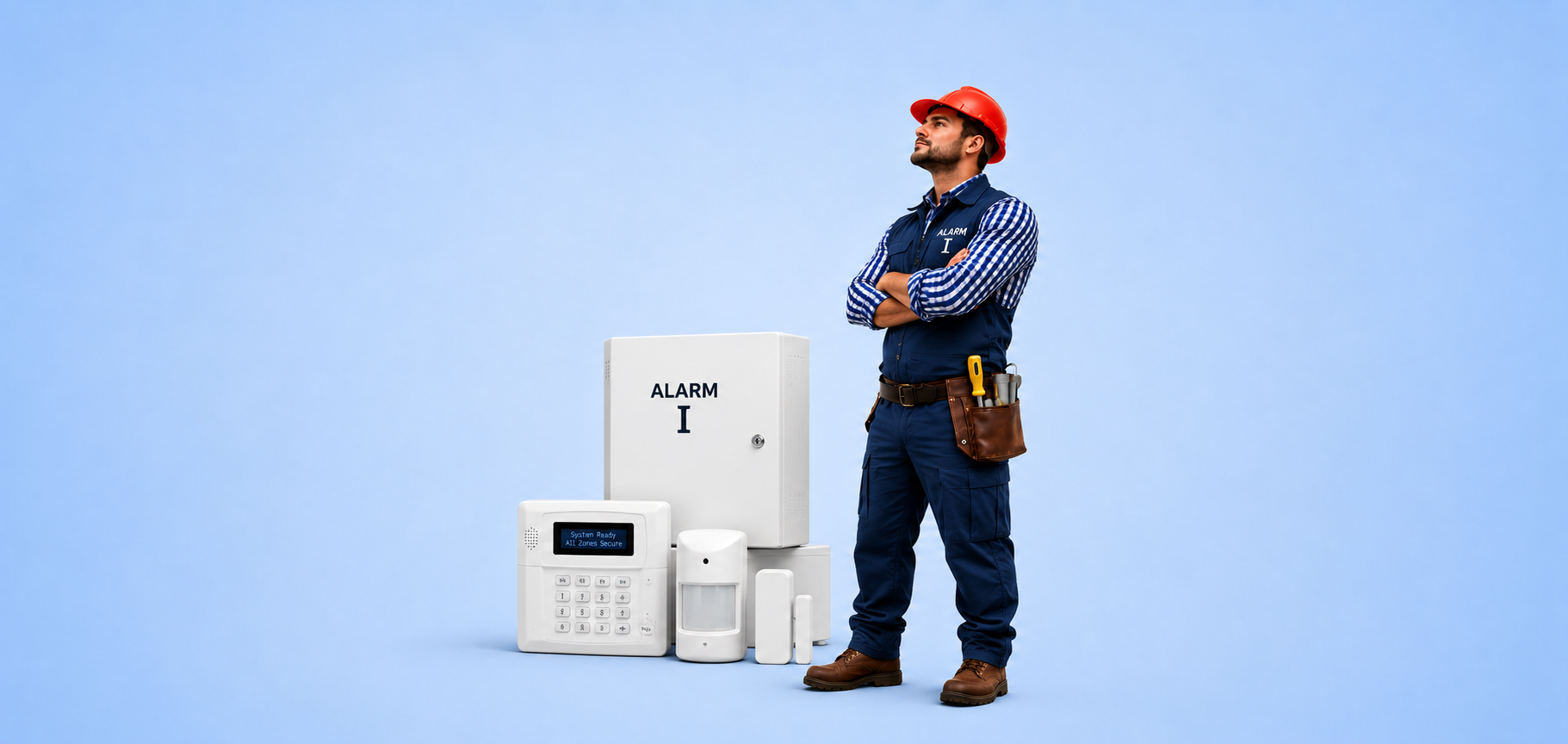
What Is a Florida Alarm System Contractor II License?
A Florida Alarm System Contractor II license is a state credential that authorizes you to perform alarm and low voltage security work. It is issued by the Florida Department of Business and Professional Regulation (DBPR) through the Electrical Contractors' Licensing Board (ECLB), and it is governed by Chapter 489, Part II of the Florida Statutes and Rule 61G6 of the Florida Administrative Code.
The certified version of this license carries the state class letters EG, which is why contractors call it the "EG license." Florida defines an Alarm System Contractor II as a contractor whose business includes all types of alarm systems other than fire, for all purposes. That phrase, "other than fire," is the entire point of the license and the main thing that separates it from Alarm System Contractor I.
The license comes at two levels:
- Certified (EG): a statewide license. You can contract in all 67 Florida counties. Prep for it in the Florida Alarm II Contractor collection.
- Registered (EZ, formerly EI): tied to a local competency card, so you can only work in the specific cities or counties where that card is registered.
Most contractors searching for this license want the certified statewide EG credential, and that is the focus of this guide. If your work includes commercial fire alarm systems, you need the Alarm I (EF) license instead, and the materials for that sit in the Florida Alarm I Contractor collection.
License Types: Choosing Your Alarm Scope
Florida issues two certified alarm contractor classifications. The right choice comes down to one question: do you need to do fire alarm work? Everything else, burglar alarms, access control, CCTV, monitoring, is covered by both.
Alarm System Contractor II (EG) ★ MOST POPULAR
Class LettersEG certified / EZ registered
ScopeAll alarm systems except fire
CoversBurglar, access control, CCTV, low voltage, monitoring, medical alarms
Fire AlarmNot included (residential smoke detectors only)
Exams Required2 exams (Alarm Systems II + Business & Finance)
Passing Score75% on each part, open book
Experience3–6 years by path, min 40% non-fire alarm work
Avg. Study Time6–10 weeks
CoverageAll 67 counties (certified)
Alarm System Contractor I (EF)
Class LettersEF certified / EY registered
ScopeAll alarm systems, including fire
CoversEverything Alarm II covers, plus commercial fire alarm systems
Fire AlarmIncluded
Exams Required2 exams (Alarm Systems I + Business & Finance)
Passing Score75% on each part, open book
Experience3–6 years by path
Avg. Study Time8–12 weeks
CoverageAll 67 counties (certified)
Which one fits you? If your business is security and low voltage, so burglar alarms, access control, CCTV, and monitoring, the EG (Alarm II) license covers your full scope and it is the faster path. Start with the Alarm II collection. If you also need to install commercial fire alarm systems, you want the EF (Alarm I) license instead, and the Alarm I collection has the materials for it.
Not sure which license to get?
Talk to one of our licensing advisors and we will help you pick the right classification and build a study plan around your timeline.
What a Florida EG License Lets You Do
The Alarm System Contractor II scope is broad on the security and low voltage side. Under the EG license you can contract to install, service, alter, monitor, and design:
- Burglar and intrusion alarm systems
- Access control systems, including door access, card readers, and keypads
- CCTV and video surveillance systems
- Intercom and low voltage communication systems tied to security
- Low voltage wiring associated with security and alarm systems
- Alarm monitoring and central station connections
- Medical and personal emergency alarms
- The work permitted under a Florida Limited Energy Systems specialty license
- Pull permits statewide once you hold the certified EG license
The one big limit: a Florida Alarm System Contractor II cannot install fire alarm systems. Fire alarm work requires the Alarm System Contractor I (EF) license or a Certified Electrical Contractor (EC) license. There is one narrow exception written into Florida statute: an EG contractor is permitted to install residential smoke detectors. That exception does not make the EG holder a fire alarm contractor for any other purpose.
If you are regularly walking away from commercial fire alarm bids, that is the signal to look at the Alarm I (EF) collection instead. If your work is all security and low voltage, the Alarm II (EG) collection covers you completely.
5 Steps to Your Florida EG Alarm License
Over 100,000 contractors have used this process to get licensed with 1 Exam Prep. Most candidates complete it in 3 to 6 months.
1
STEP 1: Verify Your Eligibility & ECLB Requirements
Before you spend a dollar on books, confirm you meet Florida's basic requirements for a certified alarm contractor. You must generally:
- Be at least 18 years old and of good moral character
- Meet an approved experience path (see the requirements table below)
- Have at least 40 percent of your experience in non-fire alarm work
- Submit a personal credit report and financial statement showing a positive net worth
- Show a business net worth of at least $10,000 if qualifying a company
- Meet the insurance requirements before your license is activated
Common paths: 3 to 6 years of qualifying alarm and low voltage experience, qualifying military or governmental technical experience, or an electrical professional engineer credential.
2
STEP 2: Prepare for Your Exams
The most important step. The Alarm Systems II exam is open book, which is not the same as easy. Passing depends on knowing which reference holds the answer and finding it before the clock runs out.
- Enroll in an Alarm Systems II exam prep course, online or instructor-led
- Get professionally highlighted and tabbed reference books
- Study both exam parts: Alarm Systems II technical and Business & Finance
- Take timed practice questions under real exam conditions
- Learn open-book test-taking strategy and book navigation drills
- Browse the Alarm II collection or the Alarm I collection for the full study system
Core EG topics include burglar and intrusion systems, access control, CCTV, low voltage wiring, the NEC, UL standards, and safety.
3
STEP 3: Register For and Pass Your Exams
Alarm licensing requires pre-approval from the Electrical Contractors' Licensing Board before you can schedule. Once approved, you test through Pearson VUE. Both parts are open book and computer based.
- Submit the DBPR exam application (form ECLB 8) for pre-approval
- Get your Candidate ID and schedule with Pearson VUE
- Take the Alarm Systems II technical exam and the Business & Finance exam
- Score 75 percent or higher to pass each part
- Use your passing scores within the three year score window
- Verify your book editions are current before test day. A complete set from the Alarm II collection removes the guesswork.
4
STEP 4: Submit Your Application to DBPR
After passing your exams, submit your licensure application to DBPR for ECLB review. Incomplete or poorly documented applications are the top cause of delays.
- Completed DBPR licensure application
- Experience documentation: W-2s, job lists (5 jobs per year), or employment verification forms
- Personal credit report dated within 12 months with the required public records statement
- Personal financial statement, plus business credit report and statement if qualifying a company
- Application fee and business qualification information
5
STEP 5: Complete Insurance Requirements
Once approved, you must meet the insurance requirements before your license is activated. Florida alarm contractors generally need:
- Public liability insurance
- Property damage insurance
- Workers' compensation if you have employees, or a valid exemption if eligible
- Proof submitted to DBPR
After DBPR accepts your final documentation, your license is activated and you can legally contract within the EG scope.
Requirements for a Florida Alarm System Contractor II License
The experience requirements are set by the ECLB and are uniform statewide for certified contractors. You qualify by meeting one of the approved paths below, and at least 40 percent of your experience must be in alarm systems other than fire.
| Path | Experience | Look-Back Window | Notes |
|---|---|---|---|
| Path 1 | 3 years of management experience in the trade | Within last 6 years | Qualifying alarm or electrical business |
| Path 2 | 4 years as a foreman, supervisor, or contractor in the trade | Within last 8 years | Hands-on supervisory work |
| Path 3 | 6 years of comprehensive training, technical education, or broad experience | Within last 12 years | Associated with an electrical or alarm business |
| Path 4 | 6 years of technical experience with the Armed Forces or a government entity | Within last 12 years | Military and governmental work counts |
| Path 5 | Licensed electrical professional engineer for 3 years | Within last 12 years | Provide PE license and transcripts |
| Path 6 | Approved combination of the above | Totaling 6 years | Mix of qualifying experience |
The 40 percent rule: at least 40 percent of your qualifying experience must be in non-fire alarm systems. As a guide, that is roughly 15 months on a 3 year path, about 20 months on a 4 year path, and about 29 months on a 6 year path. Out of state experience can count as long as the work was done legally where it was performed. If your credit does not meet the board's threshold, you may need to resolve liens or judgments before approval. Our Alarm II application assistance covers this documentation so a paperwork issue does not stall your file.
Inside the Florida Alarm Contractor Exams
Both classifications require two separate open-book exams, each with a 75 percent passing score. Knowing what is on each one, and which book holds the answer, is the whole game.
| Exam | Format | What It Covers | Prep Products |
|---|---|---|---|
| Alarm Systems II (EG) | Open-book, computer based, 75% to pass | Burglar and intrusion systems, access control, CCTV and video surveillance, low voltage wiring, the NEC, UL standards, safety | Alarm II books & course |
| Alarm Systems I (EF) | Open-book, computer based, 75% to pass | Everything on the Alarm II exam, plus fire alarm systems, NFPA 72, and fire detection and notification requirements | Alarm I books & course |
| Business & Finance | Open-book, computer based, 75% to pass | Florida Contractor Manual, Chapter 489 Part II, contract law, lien law, estimating, job costing, payroll, financial statements, risk management | Included in both Alarm II and Alarm I packages |
Candidates routinely underestimate Business & Finance because it is not the trade they know, and it is the exam most often failed on the first attempt. Every Ultimate package in both collections includes Business & Finance prep for exactly that reason.
Florida Alarm Exam Prep Products — Alarm I & Alarm II
Every product below is available for both classifications. Choose your license and the matching collection has the complete study system bundled and ready.
| Product | What's Included | Alarm II (EG) | Alarm I (EF) |
|---|---|---|---|
| Ultimate Exam Prep Package | Exam-ready books, online course, live virtual classes, and ECLB application support in one bundle | Shop Alarm II → | Shop Alarm I → |
| Highlighted & Tabbed Book Sets | Every approved reference pre-marked and exam-ready, legal to bring into the testing center | Shop Alarm II → | Shop Alarm I → |
| Complete Reference Book Sets | NEC, alarm and low voltage references, UL standards, OSHA, and the Florida Contractor Manual, shipped as one set | Shop Alarm II → | Shop Alarm I → |
| Online Self-Study Course | On-demand modules, timed practice questions, tabbing and highlighting instructions. From $79. | Shop Alarm II → | Shop Alarm I → |
| Live Virtual Class Upgrade | Instructor-led sessions, live Q&A, code walkthroughs, book navigation drills, session recordings | Shop Alarm II → | Shop Alarm I → |
| DBPR Application Assistance | ECLB application prep, experience documentation, credit report and net worth guidance | Shop Alarm II → | Shop Alarm I → |
How Much Does a Florida EG Alarm License Cost? (2026)
Costs vary based on your exam prep package, books, application support, and insurance. The figures below are estimates. Confirm current DBPR and vendor fees before you submit.
| Item | Estimated Cost | Notes |
|---|---|---|
| Exam prep course | From $79 | Online exam practice for Alarm Systems |
| Live class upgrade | Varies | Available with online course options |
| Reference book set | Varies | Approved Alarm Systems II references |
| Highlighted & tabbed books | Varies | Speeds up open-book exam navigation |
| Application assistance | Varies | ECLB application support |
| Exam vendor fee (Pearson VUE) | Approx $78.75 | Paid to the vendor when you schedule |
| DBPR application fee | Approx $300 active / $55 inactive | Confirm current amount on the application |
| Credit report | $30 – $50 | Must include the public records statement |
| Insurance | Varies | Public liability, property damage, WC or exemption |
| TOTAL ESTIMATED | Budget accordingly | Depends on package and business setup |
Save with a bundle: the Alarm Systems Ultimate Exam Prep Packages bring together exam-ready books, online courses, live virtual classes, and application support for less than buying each piece separately. Financing available. Compare bundles in the Alarm II collection or the Alarm I collection, or call 866-707-2733 for current pricing.
Certified vs. Registered: Going Statewide
Florida issues alarm licenses at two levels. For most contractors, certified is the better long-term choice because it allows statewide work.
| Feature | Certified Alarm II (EG) | Registered Alarm II (EZ) |
|---|---|---|
| Issued By | State ECLB | Local competency card |
| Coverage | All 67 Florida counties | Issuing local jurisdiction only |
| Exam | State exam path via Pearson VUE | Local competency exam |
| Flexibility | Work anywhere in Florida | Separate registration per jurisdiction |
| Growth | Best for statewide contracting | Limited to the local market |
| Commercial Work | Stronger for commercial expansion | Limited local flexibility |
| Multi-County Companies | One statewide credential | Best for contractors staying local |
Recommendation: choose the certified EG license if you want to work statewide, bid larger jobs, and grow beyond one county or city. Note that EH and EI are legacy class letters that can still be renewed but are no longer issued. EY and EZ are the current registered alarm class letters. Start with the Alarm II exam prep collection.
Florida Statute 489: Penalties for Unlicensed Alarm Contracting
Contracting alarm or security work without the proper Florida license can lead to serious penalties, including:
· Criminal charges and fines
· Inability to enforce contracts in court or legally collect payment
· Loss of lien rights and stop-work orders
· Disciplinary action and lasting damage to your business reputation
Get licensed the right way before you advertise, bid, pull permits, or perform alarm contracting work in Florida. Our 98.7% pass rate means you get licensed fast and stay protected.
Florida Alarm System Contractor II (EG) License FAQ
It is a state credential issued by the Florida DBPR through the Electrical Contractors' Licensing Board. The certified version carries the class letters EG and authorizes work on all types of alarm systems other than fire, statewide, under Chapter 489 Part II of the Florida Statutes. Prep for it in the Alarm II collection.
Alarm System Contractor I (EF) covers all alarm systems including fire. Alarm System Contractor II (EG) covers all alarm systems except fire. That single difference, fire alarm work, is the main thing that separates the two licenses. Compare the Alarm II collection and the Alarm I collection.
No. Fire alarm systems are excluded from the EG license. Fire alarm work requires the Alarm System Contractor I (EF) license or a Certified Electrical Contractor (EC) license. The one narrow exception is that an EG holder may install residential smoke detectors. If you need fire scope, go to the Alarm I collection.
Yes. CCTV, video surveillance, access control, door access, intercoms, and the associated low voltage wiring are all within the EG scope, along with burglar and intrusion alarms, monitoring, and medical alarms.
Confirm your eligibility, prepare for the exams, get pre-approval from the ECLB, pass the Alarm Systems II technical exam and the Business & Finance exam, submit your DBPR application with experience and credit documentation, and meet the insurance requirements before activation. Most candidates finish in 3 to 6 months.
Common paths are 3 years of management experience within 6 years, 4 years as a foreman or supervisor within 8 years, or 6 years of comprehensive experience within 12 years, or an approved combination. At least 40 percent of the experience must be in alarm systems other than fire.
Passing scores are valid for three years from the exam date. You must pass both parts and apply for licensure within three years of passing the first part.
Yes. EG candidates must pass both the Alarm Systems II technical exam and the Business & Finance exam, unless you already hold a current active Florida electrical, alarm, or electrical specialty license. It is included in every Ultimate package.
The Alarm Systems II exam draws from the adopted National Electrical Code, alarm and low voltage systems references covering burglar alarms, access control and CCTV, applicable UL standards, OSHA construction safety, and the Florida Contractor Manual plus Chapter 489 Part II. Complete tabbed and highlighted sets are available in the Florida Alarm II Contractor collection.
Most candidates study 6 to 10 weeks at roughly 8 to 12 hours per week. Candidates using pre-tabbed and pre-highlighted books usually shorten that timeline because their study hours go into practice questions instead of marking up books.
You must show a positive net worth and submit a credit report dated within 12 months that states public records were searched at the county, state, and federal levels. The EG category requires a business net worth of at least $10,000 when qualifying a business.
Yes. The certified EG license lets you work in all 67 Florida counties. The registered version, EZ, only allows work in the local jurisdictions where the competency card is registered.
Yes. A certified EG holder can serve as the qualifying agent for an alarm or security company and can qualify additional businesses through the appropriate ECLB application.
How to Get Your Florida Alarm Contractor License in 2026
Ready to Start Your Licensing Journey?
Join 100,000+ contractors who prepared with 1 Exam Prep. We guide you through the books, the exams, the ECLB application, and the insurance step. Pick your classification and shop the collection built for it.
Questions? Call 866-707-2733
or email sales@1examprep.com
- Choosing a selection results in a full page refresh.
- Opens in a new window.