


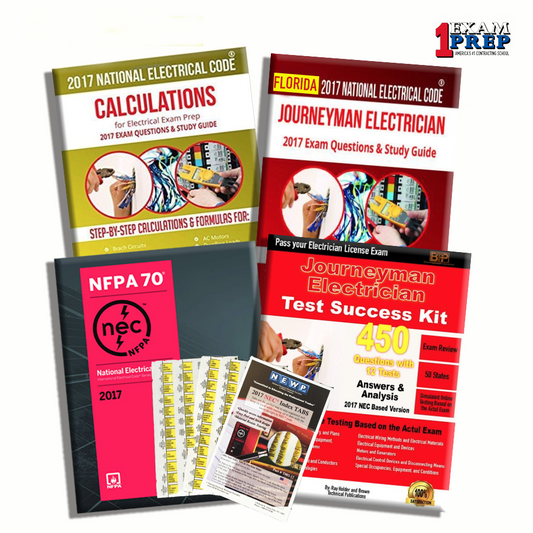


2017 Electrician Exam Prep: NEC Study Guide, Code Book Tips, and Practice Plan
The 2017 National Electrical Code remains important for electricians preparing for an examination that specifically names that edition, reviewing older installations, or comparing code cycles. But there is no single national “2017 electrician license.” The governing board determines the exam, required references, and licensing path. This guide explains how to use 2017 NEC study resources wisely, review the major electrical subjects, practice calculations, and avoid showing up with a perfectly good book that the test center does not allow.
Explore the 2017 Electrician collection as a shopping resource, and use the official references at the end of this guide to confirm what actually applies to your examination and license.
Understand what “2017 Electrician” means
The phrase 2017 Electrician usually points to study resources based on the 2017 edition of NFPA 70, the National Electrical Code, rather than one nationwide electrician license. Electrical licensing in the United States depends on the responsible state or local jurisdiction. Before studying, confirm whether your particular exam still tests the 2017 NEC and which credential you intend to earn.
Start with the 2017 Electrician collection to explore edition-focused resources. Then compare the listing with the official exam bulletin. If the exam uses a newer NEC edition, an older book can still help with fundamentals, but it may be the wrong permitted testing reference.
Why the NEC edition matters
The NEC changes across code cycles. Requirements, article locations, definitions, exceptions, and tables can be revised. A question answered from a 2017 edition may not have the same location or result in a later edition. Even when two books seem nearly identical, using the wrong code cycle on a timed exam wastes effort and can mislead you.
Write the exam name, the approved NEC edition, and the date of your appointment at the top of your study plan. Confirm those details with the licensing board or testing company. Treat the 2017 book as edition-specific, not automatically current simply because the cover looks professional.
Distinguish exam rules from jobsite enforcement
A testing agency may use one NEC edition while a municipality enforces another, depending on its adoption and transition schedule. An exam outline answers what material will be tested; an adopted code and local amendments govern actual installations. Neither should be guessed from the date on a social media post or old coworker notes.
Keep two folders: one for examination rules and one for current field compliance. When solving practice problems, label the edition you used. On a real installation, verify the adopted code, permit requirements, and local interpretations with the authority having jurisdiction before doing the work.
Learn NEC organization before memorizing tables
The NEC arranges material into chapters, articles, sections, and tables, with definitions and general rules that affect many installations. It is easier to find a technical answer once you understand the code's structure. Memorizing isolated numbers without context can cause mistakes when an exception or condition changes the rule.
Practice turning a question into index terms. For instance, separate the topic of conductor protection from conductor installation and equipment grounding. Record where you found the answer and why that section applies. Good navigation is a skill, not a race to see who can flip pages fastest.
Master definitions and general installation rules
Electrical questions often turn on the meaning of a familiar word. Definitions and general requirements shape how wiring, equipment, spaces, and workmanship must be evaluated. If a problem uses a technical term precisely, your everyday definition may not be enough. Small wording changes can point to very different code responsibilities.
Make flash cards for terms you confuse, and add a practical installation example to each one. Find the definition and its related requirement rather than memorizing a sentence in isolation. That method helps you recognize when a question is testing terminology instead of calculation.
Study branch circuits and dwelling loads
Branch-circuit questions connect outlet requirements, conductor sizing, protective devices, and load calculations. Work through examples with different equipment and occupancy conditions so you understand how the rules interact. A single branch circuit can seem simple until a question introduces continuous loading or a special appliance requirement.
Draw a small panel schedule and label what each circuit serves. Solve one problem at a time, keeping units and assumptions visible. When you get an answer, check whether the question asks for a minimum, maximum, allowed condition, or actual installed size.
Review feeders and service equipment
Feeders and services require attention to load calculations, conductor choices, overcurrent protection, grounding, bonding, disconnects, and installation conditions. A feeder is not automatically treated the same way as a branch circuit, even if both use copper conductors. Recognizing the system boundary is part of solving the problem correctly.
Sketch the path from utility service to panelboard and branch circuits. Label equipment locations, conductors, disconnect points, and protective devices. Then ask which part of the NEC governs each decision. This builds understanding instead of relying on the last service you saw in the field.
Practice conductor ampacity and adjustments
Conductor questions depend on material, insulation, temperature ratings, terminal limitations, installation conditions, and adjustment or correction factors. Looking up a table value is only part of the work. A question may require several checks before a final conductor selection is appropriate. It is easy to forget a condition and produce a very confident wrong answer.
Create worksheets with the given ambient temperature, raceway fill situation, insulation type, and equipment termination details. Work the calculation in a clear order. Always read the table notes and applicable sections because the nearest number is not automatically the right number.
Understand overcurrent protection
Fuses and circuit breakers protect wiring and equipment under specified conditions, but the selection is not always a simple match to the next familiar rating. Some equipment has special protection rules, and some situations distinguish overload protection from short-circuit or ground-fault protection. These details appear often in exam practice.
Draw a basic circuit with supply, conductor, protective device, and load. Explain what each device is intended to protect. When a scenario involves a motor or another special system, find the specific article instead of forcing a general rule onto every installation.
Make grounding and bonding less mysterious
Grounding and bonding are connected but different ideas. Equipment grounding, grounding electrodes, bonding jumpers, and fault-current paths have distinct functions. Exam questions may ask about sizing, connection, continuity, or a particular location. Knowing the purpose of a path helps you avoid mixing up similarly named components.
Trace a simple service diagram with different colors on your personal notes, not on the actual test book unless allowed. Label the paths and their functions. Practice explaining how the system responds to a fault, then confirm the applicable NEC requirement for the specific installation.
Study raceways, boxes, and cable methods
Wiring methods include raceways, cable assemblies, fittings, supports, boxes, and installation limitations. Different environments and uses may change what is permitted. Box fill and conduit-related calculations require careful attention to units and counted components. A drawing that looks tidy can still ignore an important rule.
Work a box-fill problem with conductor sizes, devices, and equipment grounds clearly listed. Compare several raceway and cable methods and ask why one is suitable in a damp, dry, or exposed location. Use the code's conditions rather than picking a material because it is popular on your crew.
Review wiring devices and equipment for general use
Switches, receptacles, luminaires, appliances, transformers, and panelboards can have equipment-specific rules. A question may describe a location or load that triggers a different requirement. Pay attention to the difference between a product's listing, installation instructions, and general code provisions. All three can matter.
Choose a practical scene, such as a commercial break room or residential garage, and identify the electrical equipment present. Look up each relevant topic, then ask what would change if the location were outdoors or exposed to moisture. Scenario practice is more reliable than isolated definitions.
Understand motors and motor circuits
Motor questions can involve full-load current, conductor requirements, overload protection, branch-circuit protection, disconnects, controllers, and multiple motors. These subjects use different rules for different purposes, which is why a single memorized percentage rarely solves every question. The objective is to identify the decision being made before using a table.
Build a motor worksheet that lists nameplate details, table values, conductor selection, overload information, and protective-device selection separately. Read the exact question twice. Is it asking about conductor ampacity, short-circuit protection, or the disconnect? Each calls for its own reasoning.
Prepare for special occupancies and equipment
Garages, healthcare spaces, hazardous locations, pools, and other special installations can involve requirements beyond ordinary wiring methods. The correct rule depends on how the location is classified and what equipment is present. You do not need to memorize every subsection at once, but you should recognize when the general chapter is not enough.
Make a chart of special locations and the questions that identify them, such as exposure, occupancy, or equipment type. Practice finding the relevant article. If the problem introduces a special condition, pause before using your favorite general rule.
Review electrical theory and calculations
Ohm's law, power relationships, voltage drop, series and parallel circuits, and basic transformer concepts support many electrician examinations. Working field experience helps, but written tests require clear steps that another person can follow. A unit conversion or arithmetic slip can send an otherwise correct approach off course.
Solve a small set of problems without the code book first, then check whether a code-specific requirement changes the result. Keep units beside every number and make a quick reasonableness check. If a simple room circuit suddenly needs a fantastic amount of power, recalculate before celebrating.
Practice interpreting plans and diagrams
Electrical drawings use symbols, panel schedules, one-line diagrams, notes, and specifications to describe a project. A test question might ask what a symbol represents or how the circuit should be organized. Workplace habits are helpful, but the drawing and stated conditions control the answer in an examination scenario.
Take a basic floor plan and trace a circuit from source to equipment. List the details that are given and the information that would still be needed. Do not invent missing field conditions just because you have seen a similar installation before.
Understand open-book and closed-book differences
Not every electrical test allows reference books, and permitted materials differ by jurisdiction. Some testing providers allow only a specified code edition with limited highlighting or permanent tabs. Others restrict all outside materials. A course designed for open-book navigation should not be mistaken for permission to bring anything you want.
Read the official candidate bulletin line by line before your final practice week. Rehearse under its actual conditions. If your exam is closed book, spend time retrieving key ideas from memory. If it is open book, practice fast and accurate source selection.
Choose the right learning tools
A 2017 NEC study guide, video course, flash card set, and question bank can each serve a different purpose. The best combination depends on your background and the exam's current reference cycle. A large bundle is not automatically better if half its materials address an edition you will not use.
Compare each resource with the exam outline and note whether the code book itself is included. Read product details for access periods, digital versus printed content, and update policies. An old edition can be useful for historical work or a specific approved exam, but the purchase should be intentional.
Use timed practice and correct your errors
Practice questions help identify gaps in theory, calculations, code navigation, and question reading. The value comes from reviewing why you missed an answer, not from memorizing where the correct option appears on the screen. Repeated guessing can feel like progress while building very little skill.
Keep a mistake log with the NEC article, the reason for the error, and a short explanation in your own words. Return to those items after several days. Mix calculations and code searches in the same timed session so test day feels like a familiar challenge.
Plan for testing and licensing after study
Passing an electrician examination may be only one part of receiving a credential. Boards can require employment experience, education, apprenticeship records, fees, background information, or contractor-business licensing. In some places, an electrician's personal license is different from an electrical contractor's license. The rules are local, not national.
Before scheduling, confirm eligibility and the specific exam name. After passing, follow the issuing authority's application and renewal instructions. A 2017-code study resource helps you prepare for a particular knowledge base; it does not grant permission to perform regulated electrical work.
Recommended references and official resources
Check official examination and licensing instructions before relying on a course description, code edition, or older exam bulletin. The shop links help you compare study materials; the responsible agencies make the licensing rules.
Your practical preparation checklist
- Confirm the exact exam, credential, and responsible authority.
- Download the latest official examination and reference-book instructions.
- Check eligibility, registration, fees, and document requirements.
- Compare course options and buy only materials that match the approved edition.
- Study technical or business topics with timed mixed practice.
- Verify approved test-day identification, references, and testing-center rules.
- Complete every remaining certification or licensing step after passing.
Frequently Asked Questions
Conclusion
The smartest way to approach 2017 Electrician is to divide a big professional goal into smaller, testable skills. Start by confirming the correct credential, reference edition, testing rules, and regulator. “2017 Electrician” describes an edition-focused collection, not a single official exam. Question counts, testing time, approved references, and licensing eligibility depend on the jurisdiction. That makes it easier to adapt when an exam bulletin changes, rather than learning about a new requirement after you have paid for books or reserved a test appointment.
Next, connect the subjects you read with the kind of work the examination describes. Focus on NEC navigation, definitions, branch circuits, feeders, services, conductors, overcurrent protection, grounding and bonding, motors, wiring methods, and calculations. These topics are not isolated vocabulary lists. They describe decisions made by working professionals: choosing the correct reference, measuring a condition, planning a sequence, and explaining the reason for a safe or compliant result. Use diagrams and short job scenarios whenever you can. Memorized examples are useful, but they are not a substitute for reasoning.
Your study resources also need a practical review. A collection page is useful for finding packages and course options, but it is not an official testing bulletin. Check exactly which books, editions, online modules, practice questions, and access periods are included before you purchase. Look at the exam's current reference list separately and make sure the materials serve your objective. Consistent, focused practice usually produces better habits than an expensive stack that stays closed.
Build a weekly routine around learning, retrieval, and correction. Read one subject carefully, solve practice problems from memory or within the permitted reference conditions, and review the reasons behind missed answers. Keep an error log that separates technical gaps, incorrect reference choices, arithmetic errors, and rushed reading. Repeat the weak subjects after a few days so you know whether the improvement lasts. During final practice, use a timer and the same allowed materials as the real examination. The best preparation is both technically sound and administratively organized.
Remember the boundary between a passing examination and a legal credential. In this pathway, the licensing or inspection authority specifies which NEC edition applies to an examination or to work in its jurisdiction. That means eligibility, supervision, application documents, fees, and business obligations cannot be inferred from the existence of a course or passing score. You should not advertise services or assume permission to perform regulated work until the responsible authority has actually granted the required license or certification.
Finally, think beyond test day. Confirm your own licensing pathway and current code adoption; keep the 2017 reference for the approved use, but use the exact edition and rules required for your specific exam or project. The most useful action you can take now is simple: verify the official rules, write down the reference list, pick one difficult subject, and complete a short practice session. Tomorrow, correct what you missed. You need reliable judgment, the right sources, and a plan you can keep following until the credential is properly issued.
Key Takeaways
- A 2017 NEC study resource is edition-specific and is not itself an electrician licensing credential.
- Always verify the code edition approved by your testing provider and local jurisdiction.
- Practice NEC navigation, conductor calculations, circuits, grounding, motors, and wiring methods.
- Follow the official rules for open-book materials, tabs, highlighting, and identification.
- Match study products to your exact exam rather than assuming older references remain approved.
Plain-Language Summary
Here is the easy version of the 2017 Electrician guide. First, find out exactly what you are trying to earn or study. The product or course name gives you a starting point, but the official licensing agency and testing provider set the real requirements. “2017 Electrician” describes an edition-focused collection, not a single official exam. Question counts, testing time, approved references, and licensing eligibility depend on the jurisdiction. Look for the latest official instructions and save a copy before spending money or booking a test.
Second, choose study resources that match the exam you will actually take. Use the 2017 Electrician collection to compare offerings, but read every product description carefully. Check whether books are included, which editions are named, whether you receive videos or questions, and how long online access lasts. You may find that a smaller set matches your needs better than a big package. The important thing is not how crowded your desk looks. It is whether your materials help you practice the right information under the right rules.
Third, work through the important subjects in plain language. For this topic, they include NEC navigation, definitions, branch circuits, feeders, services, conductors, overcurrent protection, grounding and bonding, motors, wiring methods, and calculations. Try a small problem or job example for each area. Ask what facts the question provides, which rule or idea applies, and why a different answer would be wrong. Draw pictures, label steps, and explain your thinking out loud. That method helps the information stick better than reading the same paragraph over and over without testing yourself.
Fourth, use a weekly routine that fits your life. A short session on several days is often easier to maintain than one giant weekend of studying. Begin with the weakest subject, then review a more familiar one. Practice a mix of questions under a time limit. Record mistakes in a notebook with the topic, correct reference, and a simple explanation. Remember to practice using only the reference books and markings that the official test rules allow.
Fifth, keep studying and licensing paperwork separate. The licensing or inspection authority specifies which nec edition applies to an examination or to work in its jurisdiction. That may mean proving experience, completing an apprenticeship, getting a required score report, paying a fee, or filing business documents. One person's path may be different from another's, even if they take similar exams. A course provider can explain the materials it sells, but it cannot promise you a license that a government board has not approved.
Last, make a plan for after the examination. Confirm your own licensing pathway and current code adoption; keep the 2017 reference for the approved use, but use the exact edition and rules required for your specific exam or project. Keep the exam result, approval letters, application receipts, and other important records together. Put deadlines and renewals on a calendar when they apply. The goal is not simply to feel ready or to collect books. Small steps repeated consistently can take you a surprisingly long way.