Journeyman Electrician License: Exam Prep, NEC Study, and Licensing Guide

Becoming a Journeyman Electrician is one of the biggest steps in an electrician's career. It usually means moving beyond apprentice-level work and proving that you can install, troubleshoot, calculate, and apply electrical code requirements with much greater independence. The catch is that there is no single Journeyman Electrician license or exam that works exactly the same everywhere.

States, counties, cities, and licensing boards can set their own experience requirements, application procedures, code editions, exam formats, fees, and renewal rules. That makes the first step surprisingly simple: identify the exact license before deciding which book belongs on your desk.

Start with the Journeyman Electrician License collection from 1ExamPrep. The collection includes current study guides, National Electrical Code packages, electrical calculation resources, flash cards, online practice testing, and larger exam-prep combinations for electricians preparing for state and local licensing examinations.

There Is No Single National Journeyman Electrician License

The words "Journeyman Electrician" sound like one standard license, but licensing in the United States is handled by different government authorities.

Some states issue journeyman licenses at the state level. Other locations use counties, municipalities, electrical boards, or other local authorities. A few jurisdictions use different titles such as journeyworker electrician.

Never assume that another electrician's exam is the same as yours. Question count, testing time, code edition, approved books, experience hours, and passing scores can all change by jurisdiction.

What Does a Journeyman Electrician Do?

Exact legal scope varies by licensing authority, but journeyman-level electricians generally perform electrical installation, alteration, maintenance, troubleshooting, and repair work within the limits of local law.

Typical work can include:

  • Branch circuits
  • Feeders
  • Services
  • Lighting systems
  • Receptacles
  • Raceways
  • Conductors
  • Motors
  • Transformers
  • Panelboards
  • Grounding and bonding
  • Troubleshooting and repair

Journeyman status does not automatically mean you can operate an independent electrical contracting business. Some jurisdictions require a separate Master Electrician, Electrical Contractor, or business license for contracting with the public.

Experience Usually Comes Before the Exam

Most licensing authorities expect applicants to build substantial field experience before qualifying for the Journeyman examination.

The exact amount varies. Some authorities measure experience in years. Others use documented hours or months. Apprenticeship classroom education may receive credit in some jurisdictions but not others.

Qualifying experience commonly involves:

  • Installing conductors and raceways
  • Installing electrical equipment
  • Branch-circuit work
  • Feeder work
  • Service installations
  • Motor and equipment connections
  • Maintenance and repair
  • Work under appropriately licensed supervision

Save employment records early. Years of electrical experience are much easier to document while supervisors still remember who you are.

Apprenticeship Can Be a Major Part of the Path

Many electricians build their Journeyman qualifications through an apprenticeship program that combines classroom instruction with paid on-the-job training.

Apprenticeship can teach electrical theory, blueprint reading, safety, National Electrical Code requirements, calculations, conduit work, controls, motors, and troubleshooting while the apprentice builds supervised field experience.

Completing an apprenticeship and receiving a Journeyman license are not always the same event. The licensing authority still decides whether you meet its examination and application requirements.

The National Electrical Code Is Central to Exam Prep

The National Electrical Code, commonly called the NEC, is one of the most important resources in electrician licensing.

The current NFPA edition is the 2026 National Electrical Code. However, licensing boards do not all adopt new NEC editions at the same time. Depending on your jurisdiction, your exam could still be based on an older edition.

Do not automatically buy the newest NEC because it is the newest. Buy the edition identified by your official exam bulletin.

If your jurisdiction does use the 2026 edition, review the 2026 Journeyman Electrician Study Guide and National Electrical Code Combo with Tabs.

The 2026 NEC Has Important Organizational Changes

Electricians familiar with an older code should not assume every major section stayed in the same place.

The 2026 NEC continues a significant reorganization of the code. That makes code-navigation practice especially important for electricians moving from an older edition.

The 2026 NEC organization includes:

  • Chapter 1: Definitions and General Requirements
  • Chapter 2: Wiring and Protection
  • Chapter 3: Wiring Methods and Materials
  • Chapter 4: Equipment for General Wiring
  • Chapter 5: Special Occupancies
  • Chapter 6: Special Equipment
  • Chapter 7: Special Conditions
  • Chapter 8: Communication Systems
  • Chapter 9: Tables

If your exam uses 2026, spend time learning the new organization rather than assuming your memory of an older NEC index will carry the entire test.

What Is Usually on a Journeyman Electrician Exam?

Exact blueprints vary, but Journeyman exams commonly test the same broad families of electrical knowledge.

Code Knowledge

Definitions, general requirements, wiring methods, protection, special occupancies, equipment, and installation rules.

Electrical Calculations

Loads, conductors, services, feeders, motors, transformers, raceways, boxes, and overcurrent protection.

Grounding and Bonding

Grounding electrodes, bonding paths, equipment grounding, separately derived systems, services, and fault-current paths.

Field Applications

Practical scenarios involving electrical equipment, conductors, installation conditions, protection, and troubleshooting.

Branch Circuits Are a Foundation Topic

Branch circuits appear everywhere in electrical work, so they deserve serious study time.

Review:

  • Branch-circuit ratings
  • Conductor sizing
  • Overcurrent protection
  • Required outlets
  • Receptacle requirements
  • Lighting loads
  • Continuous loads
  • Appliance circuits
  • GFCI requirements
  • AFCI requirements

Questions often combine several rules. You may need to determine the load, size a conductor, choose protection, and identify a location-specific requirement in one problem.

Feeders and Services Need Calculation Practice

Feeder and service questions can involve both code navigation and math.

Practice:

  • Calculated loads
  • Demand factors
  • Conductor ampacity
  • Neutral calculations
  • Service equipment
  • Disconnecting means
  • Overcurrent protection
  • Grounding electrode conductors
  • Dwelling calculations
  • Commercial load calculations

The calculation itself may not be the hardest part. The tricky part is usually identifying which loads, demand factors, exceptions, and code rules belong in the calculation.

Grounding and Bonding Can Eat Study Time for Breakfast

Grounding and bonding is one of the subjects that seems simple until five different conductors with similar names appear in the same question.

Know the difference between:

  • Grounded conductors
  • Equipment grounding conductors
  • Grounding electrode conductors
  • Main bonding jumpers
  • System bonding jumpers
  • Supply-side bonding jumpers
  • Grounding electrodes

Learn what each part does instead of memorizing names alone. Once you understand the fault-current path, many grounding questions stop looking like a family reunion of nearly identical terms.

Wiring Methods and Materials Are Core Exam Topics

Journeyman candidates need to understand how wiring can be installed in different buildings and environments.

Review:

  • Raceway systems
  • Metallic and nonmetallic conduit
  • Flexible raceways
  • Cable assemblies
  • Boxes and enclosures
  • Conductor insulation
  • Supports and securing
  • Wet and damp locations
  • Physical protection
  • Conduit and raceway fill

Pay attention to words such as permitted, prohibited, exposed, concealed, wet, damp, accessible, and subject to physical damage. Those words can completely change the correct answer.

Motors and Motor Circuits Deserve Their Own Study Sessions

Motor questions can combine calculations, tables, overcurrent protection, overload protection, disconnects, conductor sizing, and controller rules.

Practice:

  • Motor full-load current
  • Branch-circuit conductors
  • Short-circuit and ground-fault protection
  • Overload protection
  • Disconnecting means
  • Motor controllers
  • Multiple-motor feeders
  • Motor nameplates

Do not automatically use one current value for every part of a motor problem. Motor calculations frequently use different values for different purposes.

Conduit Fill and Box Fill Are Great Practice Problems

These calculations are useful because they force you to combine code tables with careful counting.

Practice problems involving:

  • Number of conductors
  • Conductor size
  • Raceway type
  • Permitted percentage fill
  • Equipment grounding conductors
  • Internal clamps
  • Devices
  • Box-volume allowances

Slow down enough to count correctly. Losing a calculation because one conductor disappeared during arithmetic is a very electrician-specific way to lose a point.

Special Occupancies and Equipment Matter

Many licensing exams include questions beyond ordinary residential wiring.

Depending on the exam, review topics such as:

  • Hazardous locations
  • Health care facilities
  • Assembly occupancies
  • Commercial garages
  • Electric signs
  • Elevators
  • Cranes and hoists
  • Swimming pools
  • Solar photovoltaic systems
  • Energy storage systems
  • Emergency systems
  • Standby systems

Use the official exam outline to decide how deeply to study each special topic.

Open Book Does Not Mean Easy

Many Journeyman examinations allow an approved NEC book. Other exams are closed book or combine code-book questions with no-book portions.

An open-book exam still requires speed. If you need five minutes to locate every rule, the NEC can become a very large paperweight with excellent electrical information inside it.

For an open-book exam:

  • Learn the code structure
  • Practice using the index
  • Know common article locations
  • Practice table navigation
  • Use only tabs allowed by your testing authority
  • Practice timed code lookups

Closed-Book Preparation Needs a Different Strategy

If your exam does not allow the code book, memorizing every section number is usually not the best use of study time.

Focus on commonly tested rules, calculations, concepts, definitions, and relationships between electrical systems.

  1. Study one subject with the code open.
  2. Close the book.
  3. Explain the rule in plain language.
  4. Work several questions from memory.
  5. Check every missed answer in the code.
  6. Repeat the weak subject later.

Use Electrical Calculations as a Separate Study Track

Calculations improve through repetition. A candidate can understand a formula perfectly and still struggle when a question combines several code rules.

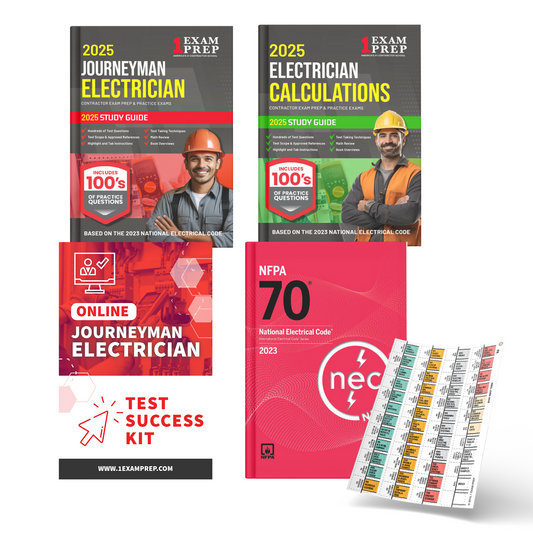
The 2026 Journeyman Electrician and Electrician Calculations Study Guides with NEC Combo combines Journeyman exam study with additional calculation practice for candidates whose exam uses the 2026 NEC.

Build speed with:

  • Ohm's law
  • Power calculations
  • Voltage drop
  • Conductor sizing
  • Service calculations
  • Feeder calculations
  • Motor calculations
  • Transformer calculations
  • Conduit fill
  • Box fill

Practice Questions Should Be Timed

Reading explanations is useful, but eventually you need to answer questions while the clock is moving.

The current 2026 Journeyman Electrician Exam Prep and Study Guide contains more than 400 practice questions built around the 2026 National Electrical Code.

For candidates who prefer computer-based practice, the 2026 Journeyman Electrician Online Test Success Kit includes timed testing and practice material designed to build exam speed.

Flash Cards Work Best for Fast Recall

Flash cards are useful for rules, definitions, formulas, common code concepts, conductor information, and topics you want to review in short study sessions.

They should supplement code study rather than replace it.

Candidates can review the 2026 Journeyman Electrician Exam Flash Cards for additional recall practice.

Use the Exam Bulletin Before Buying Your Books

This is one of the easiest ways to avoid wasting money.

Check the bulletin for:

  • Exact license name
  • Exam provider
  • Number of questions
  • Testing time
  • Passing score
  • Open-book or closed-book rules
  • NEC edition
  • Local electrical code amendments
  • Approved reference books
  • Calculator policy
  • Tabbing and highlighting rules
A beautiful 2026 NEC package will not help if your licensing exam is still based on the 2023 or 2020 NEC and tests local amendments that are not in the national book.

Journeyman Requirements Can Be Very Different by State

One jurisdiction may require four years of experience. Another may measure qualification in thousands of hours. Some award education credit. Others require specific types of work experience.

Minnesota is a good example. Its Class A journeyworker path currently requires 48 months of qualifying experience, with rules controlling how much credit can come from different categories of electrical work.

That example is useful because it shows why candidates should never copy an experience requirement from a national blog and assume it applies to their own application.

Do Not Confuse Certification With a Local License

National testing or certification programs can be useful, and some jurisdictions may recognize particular examinations. However, passing a national-standard examination does not automatically grant legal permission to perform Journeyman electrical work everywhere in the United States.

Always check whether the government authority where you intend to work requires its own license, registration, application, experience verification, or reciprocal credential.

Reciprocity Does Not Mean Automatic Nationwide Licensing

Some electrical licensing jurisdictions have reciprocal agreements with other jurisdictions.

Reciprocity may allow a qualified electrician to obtain another license without repeating the entire examination process, but eligibility rules can include the original license type, exam used, years licensed, good standing, experience, residency history, or other conditions.

Apply for reciprocity before assuming your existing Journeyman card lets you begin work in another state.

Choose the Right Exam Prep Package

Study Need Useful Type of Resource
Need practice questions Journeyman Electrician study guide
Need the NEC too Study guide plus National Electrical Code combo
Need faster code navigation NEC combo with approved tabs
Struggle with math Journeyman plus electrical calculations study package
Need short daily review Journeyman exam flash cards
Need computer-based practice Online Test Success Kit
Want a larger all-in-one system Ultimate exam-prep combo

Candidates looking for a larger study system can review the 2026 Journeyman Electrician Ultimate Exam Prep Combo.

A Practical Journeyman Electrician Study Plan

  1. Verify your exam first. Confirm the jurisdiction, exam provider, NEC edition, and allowed books.
  2. Take a diagnostic practice exam. Find out whether calculations, grounding, motors, or code navigation are your biggest weakness.
  3. Study one major topic at a time. Avoid randomly bouncing through hundreds of code pages.
  4. Practice calculations every week. Electrical math improves when you actually work the problems.
  5. Learn code navigation. If your exam is open book, lookup speed matters.
  6. Review missed questions. The wrong answer is useful when you figure out exactly why it was wrong.
  7. Take timed practice exams. Train your pacing under realistic conditions.
  8. Repeat weak areas. Do not spend the final week studying only the subjects you already enjoy.

Prepare for the Work, Not Just the Test

The best Journeyman exam preparation builds knowledge that still matters after the score report arrives.

When you study branch circuits, think about real conductor sizes, receptacles, loads, and protection. When you study grounding and bonding, picture the fault-current path. When you study motors, connect the conductor, protection, controller, disconnect, and equipment grounding requirements.

Practice reading drawings. Practice identifying equipment. Practice calculations without looking at the answer first. If your exam is open book, learn where information lives in the code. If it is closed book, practice recalling the rules without your NEC sitting beside you like a very thick security blanket.

Keep the licensing side organized too. Save apprenticeship records, employment verification, work-experience forms, training certificates, and supervisor information. Passing the test is much more exciting when the application paperwork is already under control.

Start with the Journeyman Electrician License collection at 1ExamPrep to compare current study guides, NEC packages, calculation resources, flash cards, online tests, and complete exam-prep systems.

If your licensing authority requires a formal application and you need help organizing it, review 1ExamPrep application services.

For exam materials, code books, application expenses, and licensing costs, you can also review 1ExamPrep financing options.