





1 Exam Prep · Licensing Exam Study Guide
2026 Electrician Exam Prep: NEC Study Guides, Practice Questions, Books and Courses
Getting ready for an electrician licensing exam can feel like two jobs at once. During the day you may be installing circuits, checking equipment, or solving problems on a jobsite. After work, the exam asks you to review code rules, calculations, grounding, bonding, motors, safety, and the details that do not always come up on an ordinary Tuesday. The good news is that a clear plan can make study time useful without taking over your life.
The 2026 Electrician Exam Prep collection offers resources for different levels of electrical candidates. It includes journeyman and master-oriented guides, NEC codebook combinations, calculation practice, flash cards, and digital test options. This article explains how those tools fit together and how to pick a sensible starting point.
First, check your licensing authority. The current NEC edition is 2026, but that does not mean every examination uses it. A well-matched study plan begins with the code edition and subject outline assigned to your specific test.
Start With the Exact Electrician License
Electrician licensing is controlled by states and sometimes local jurisdictions. A journeyman exam, master electrician exam, residential exam, and electrical contractor exam may test different knowledge or require different applications. Even when they all refer to the National Electrical Code, their questions may focus on different tasks.
Write down the license name, exam provider, passing standard, required experience, application process, and code edition before selecting materials. Check the current candidate bulletin for topics and permitted references.
This step is not very exciting, but it prevents an expensive error. Studying advanced motor calculations for an exam that primarily tests basic residential installations may not be the smartest use of limited evening time.
What the 2026 National Electrical Code Means
The National Fire Protection Association identifies 2026 as the current edition of NFPA 70, the National Electrical Code. That edition provides an important reference for modern electrical study materials and reflects code-cycle revisions. But electrical licensing authorities decide when a particular exam adopts a new edition.
Your test may require 2026, 2023, or another explicitly listed edition. Article organization and wording can change. If a question guide and codebook use different editions, lookups may become confusing even when the general concept seems familiar.
Check your exam bulletin, then keep your guide, codebook, and tab references aligned. Do not assume the newest edition is the one permitted in your testing room.
Journeyman Electrician Versus Master Electrician Preparation
Journeyman exam preparation often emphasizes safe installation practices, wiring methods, conductor sizing, circuits, protection, grounding, and calculations. Master-level preparation may demand broader judgment on services, feeders, motors, advanced calculations, and equipment. Those are general tendencies, not a universal national exam outline.
The 2026 Journeyman Exam Prep Guide and 2026 Master Electrician Exam Prep Guide reflect different study goals. Look closely at your license classification before deciding which is relevant.
If you are unsure which level to target, contact your licensing agency rather than guessing from the title of a book. The difference matters to both eligibility and exam content.
2026 NEC Study Guide and Codebook Combos
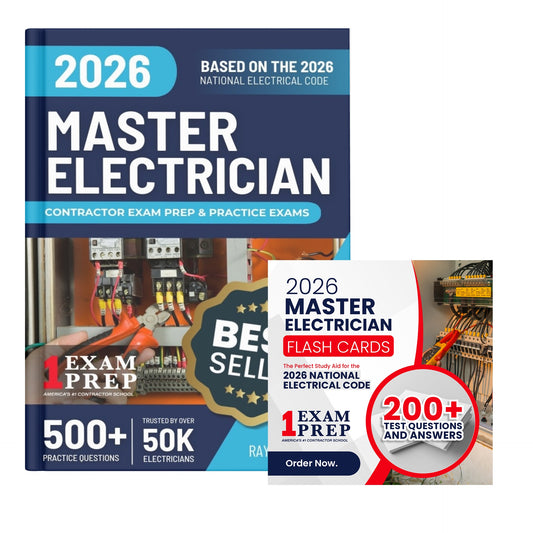
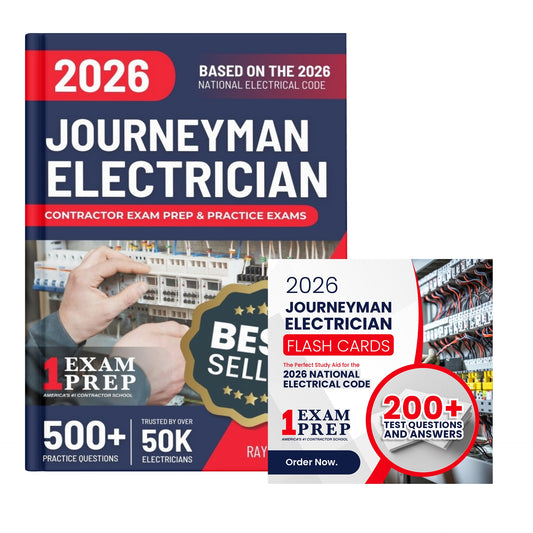
Combos pair a practice guide with the National Electrical Code so you can work through questions and check the source material in the same study session. The Journeyman Study Guide and NEC Combo and Master Study Guide and NEC Combo are examples tailored to different candidates.
A codebook combo works well for readers who like checking the reason behind every answer. Read a question, solve it, find the governing topic, and confirm conditions or exceptions. Keep a note of the rule you missed rather than copying pages of text.
Remember that a package is an aid, not an official approval of your exam references. Your testing provider decides which book, edition, and markings are acceptable during an open-book test.
Practice Question Books and Full Exams
Practice tests help you recognize question patterns, manage time, and identify subjects that need more attention. The journeyman guide advertises 400+ practice questions, while the master guide lists twelve practice exams and two full final exams. These are study products, not actual questions copied from an official licensing examination.
Begin with shorter sets to learn accurately, then move toward timed practice. Review the reasoning for every missed answer. If you got one correct by guessing, review that one too. A lucky guess can hide a knowledge gap.
Keep scores by topic. Overall percentages are useful, but a record showing repeated grounding or calculation errors gives you a much clearer plan for tomorrow's study session.
Online Electrician Test Success Kits
Online exam prep can make practice more flexible for people who work changing shifts or travel between job sites. The Journeyman Online Test Success Kit and Master Online Test Success Kit list digital practice options connected to the 2026 NEC.
Some candidates learn well by trying questions, reading explanations, and repeating difficult topics on a computer or phone. Others prefer a printed guide. Neither format is automatically better for everyone.
Check the live product pages for course access, device requirements, available practice material, and whether printed books are included. Use timed quizzes as a way to diagnose problems, not as proof that the real exam will use the same questions.
Ultimate Electrician Study Packages
The 2026 Journeyman Ultimate Combo and 2026 Master Ultimate Combo bring several study formats into broader preparation packages. Their listings describe combinations of guidebooks, an NEC reference, calculations resources, tabs, flash cards, and online learning components.
This type of bundle can help if you need a structured toolkit and do not own the necessary materials. However, candidates who already own the correct codebook might prefer a smaller practice guide or online option.
Make an inventory of your study materials before purchasing. A bigger package can be convenient, but it is not a shortcut around reviewing mistakes and practicing calculations.
Use NEC Tabs the Right Way
Codebook tabs can make important chapters easier to locate during study. They are most useful when you also understand the NEC index and its organization. If you rely on a colored tab without knowing why the answer is there, a question worded differently may still stop you.
Check the test provider's current policy before bringing a tabbed or highlighted book to an examination center. Some exams are closed-book. Others allow specific permanent tabs but restrict additional writing or loose sheets.
In practice, identify the topic first, use the index or approved navigation tool second, and read the full rule third. If a question includes an exception, the surrounding text may matter more than the bold heading you spotted.
Electrical Calculations Without the Panic
Calculations often separate casual reading from exam readiness. Depending on the test, you may need to work with circuit relationships, load calculations, voltage drop concepts, feeders, service equipment, or motors. The correct method depends on the scenario and the NEC rules assigned to the exam.
Write down what is given, label units, choose the method, and solve step by step. When a question goes wrong, determine whether the trouble came from arithmetic or the rule you chose. Those two mistakes need different kinds of practice.
Use a small notebook for formulas and worked examples you understand. Redo difficult problems later from scratch. Knowing which buttons to press is not enough if you cannot explain why you pressed them.
Grounding, Bonding, and Protection
Grounding, bonding, and overcurrent protection are foundational electrical safety subjects. Exams can ask you to identify a compliant installation or choose a protection approach based on specific conditions. Similar-looking terms can lead to different answers if you ignore what the question is actually describing.
Connect your study to simple drawings. Label the equipment, conductors, connections, and protective devices. Then use the correct NEC edition to confirm the requirement. When a rule depends on a special circumstance, write down that trigger.
A good study test is whether you can explain the result to someone else without reciting the answer key. If the explanation is unclear, revisit the section before moving on.
Motors, Services, Feeders, and Special Locations
Some electrician exams give substantial attention to motors, equipment, services, feeders, generators, or special occupancies. Others spend less time on those subjects. Use the official content outline to set your priorities rather than assuming every page of the NEC will receive equal attention.
Build practice around scenarios. A motor problem may involve protection, equipment ratings, or an installation condition. A special-location question may change the applicable rule. Learn which fact in the question points toward the right section.
Do not skip unfamiliar topics because they are not common on your projects. A written licensing exam may still ask about areas you rarely encounter in daily work.
Flash Cards for Quick Daily Review
The Journeyman Flash Cards and Master Flash Cards provide ways to practice active recall in small sessions. They are useful for vocabulary, basic relationships, formulas, and subjects you keep forgetting.
Read the prompt and answer from memory before checking the back. Separate difficult cards and review them more often. When a card asks about a calculation, take time to work the steps on paper instead of only glancing at the result.
Flash cards work best alongside complete problems. They can remind you what an idea means, but a longer question shows whether you can use that idea when several conditions appear at once.
Open-Book and Closed-Book Electrician Tests
There is no single book policy for every electrician exam. Some jurisdictions allow specified references, while others restrict books or test from memory. A preparation product may include practice for both formats, but it cannot set the rules for your examination center.
For an open-book test, practice finding the controlling provision quickly and reading it completely. For closed-book questions, work without looking up the answer immediately, then check afterward. Match your final timed rehearsal to the real testing format.
Read the candidate bulletin for books, tabs, calculators, identification, and exam timing. The most beautifully tabbed NEC on Earth will not help during a closed-book test.
Choose Materials That Fit Your Learning Style
If you like working from printed pages, a guide with a matching codebook may be your best starting point. If time is limited and you prefer screen-based drills, online practice can help. If definitions slip away, flash cards may be useful. If your math is weak, devote more resources and study time to calculations.
Compare product contents instead of shopping by name alone. “Ultimate” may mean several books and learning formats, while another product may contain only a guide. Read descriptions and access terms before deciding.
The 2026 Electrician Exam Prep collection is a good place to compare the different formats. Make your decision using your examination outline, existing materials, and actual study habits.
A Practical Six-Week Electrician Exam Plan
Week one is for verifying the exam, code edition, and materials, then taking a baseline quiz. Week two can focus on wiring methods and conductors. Week three can cover grounding, bonding, and circuit protection. Week four may emphasize electrical calculations, services, motors, and other high-priority topics from your outline.
During week five, take mixed timed practice sets and revisit weak areas. Use week six for final exams, code navigation if allowed, and test-day preparation. Adjust the timeline based on how many hours you can realistically study.
Consistency makes progress visible. Put short sessions on your calendar and write down what you finished. A good twenty-minute session beats a huge study plan that never survives past Monday.
Exam Day, Licensing Steps, and Final Review
Before exam day, confirm the testing location, start time, identification, allowed calculator, and reference rules. You should also know what happens after you pass. Your board may require experience verification, application fees, additional documentation, or other steps before issuing a credential.
Avoid beginning a brand-new subject the night before your appointment unless it is truly essential. Review your mistake log, organize what you are allowed to bring, and get enough rest to read questions carefully.
Passing comes from preparation and clear thinking. No course guarantees a license, but a well-organized study routine can give you a much better understanding of the skills being tested.
Your 2026 Electrician Exam Prep Checklist
- Choose the correct exam level and verify the NEC edition assigned by the licensing authority.
- Use practice questions to identify weak topics, then read the relevant code requirement.
- Make time for calculation drills, grounding, bonding, services, and wiring questions.
- Check whether tabs, books, calculators, or other references are allowed during the test.
- Confirm test-day details and any application steps that remain after the examination.
Use this as a working checklist, not a substitute for your licensing board’s current candidate bulletin. The bulletin always controls.
Frequently Asked Questions
Choose any question to expand the answer. You can open more than one at a time.
Conclusion
Choosing the right electrician exam prep materials begins with understanding the exam, not with buying the biggest package. Electrical licenses come in different levels, and states or local boards may use different reference editions and testing rules. A journeyman exam may emphasize core installation decisions, while a master-level exam may demand more advanced calculations and a broader view of electrical systems. These are general patterns, not a replacement for the official candidate bulletin. Before you open your first workbook, identify the exact test, licensing authority, subject list, and NEC edition.
The 2026 National Electrical Code is the current NFPA edition, but not every jurisdiction has adopted it for testing. This matters because the words and location of code requirements can change between editions. Matching your practice guide to the exam's reference list helps prevent avoidable confusion. It also keeps you from spending valuable evenings learning a book that your testing center does not use. Even a new, well-designed resource should be checked against the official requirements before you order.
Once you know what to study, choose tools that support different skills. Printed practice guides let you work through exam-style problems and review answers. NEC combos connect those problems to the code itself. Tabs may help you practice navigating a codebook, but they are useful in the test room only when the rules allow them. Online practice can give you a repeatable timed routine. Flash cards help with terms and formulas, and larger packages can combine several formats. There is no one perfect package for every candidate.
What matters most is how you use the materials. Read the question slowly, identify the actual problem, apply the correct method, and check your result. For calculations, write down units and the steps you take. For code questions, look for conditions and exceptions instead of stopping at the first promising sentence. When you miss a question, write down why. An error caused by rushing is different from one caused by choosing the wrong rule. Knowing that difference makes tomorrow's practice more useful.
A six-week study schedule can help organize your work, but you may need more time. Work through the topics in your exam outline, including wiring, conductors, grounding, bonding, protection, services, motors, and calculations as applicable. Add mixed timed practice during the final weeks. Train for the real open-book or closed-book format rather than assuming every test allows references. Check exam location, identification, calculators, and the remaining licensing steps before the appointment.
The 2026 Electrician Exam Prep collection offers a range of study formats to consider. Choose the ones you will actually use, practice regularly, and learn from mistakes. A licensing test is meant to evaluate your knowledge, not the size of your bookshelf. Build the habits that help you think through an unfamiliar electrical problem, and that preparation can stay useful even after you finish the test.
Try to make the final week calmer than the first. Organize your references, redo a small number of difficult questions, and leave time for rest. You want a clear head when reading long exam scenarios, not a tired brain stuffed with formulas you learned at midnight.
Key Takeaways
- Verify exam level, licensing rules, and the correct NEC edition before choosing 2026 materials.
- Use question guides and codebook combos to connect practice answers with code requirements.
- Practice calculations, grounding, bonding, circuits, services, and other official exam topics.
- Choose online kits, flash cards, tabs, and ultimate combos only when they address your needs.
- Plan regular timed review and confirm exam-day reference and licensing rules.
Plain-Language Summary
The 2026 Electrician Exam Prep collection includes study materials for people preparing for electrical licensing exams. Different products support journeyman or master electrician candidates. They may include printed question guides, National Electrical Code books, calculation exercises, tabs, flash cards, online practice, or larger combinations of these tools. The best materials depend on the exact exam you will take and the way you prefer to study.
Your first task is to read the official candidate bulletin from your licensing authority. Find the exam level, topic outline, code edition, testing format, and rules for using reference books. The National Fire Protection Association identifies 2026 as the current edition of the National Electrical Code. However, states and local boards may still test an earlier edition. Do not buy 2026 materials simply because the exam is happening in 2026. Check the required edition first.
Journeyman and master exams can overlap, but the subjects and difficulty depend on local requirements. Both may involve conductor sizing, wiring methods, grounding, bonding, overcurrent protection, and electrical calculations. Master preparation may give more attention to complex services, feeders, motors, or advanced problems. Review the official outline so you spend enough time on subjects that matter for your test.
A printed study guide can help you understand exam questions and find weak areas. A guide with an NEC codebook makes it easier to check where the answers come from. Tabs may make codebook navigation faster, but your testing provider decides whether marked or tabbed books are allowed. A digital practice kit can help with timed sets. Flash cards are useful for short review sessions, especially for terms and formulas. Larger packages may contain several of these items in one order.
Good preparation includes active problem solving. Read a question, decide what it asks, write down the needed facts, and apply the right method. For math, check every unit and calculation step. For code questions, read exceptions and conditions carefully. Keep a record of missed problems and redo them later. A correct answer that you guessed should also be reviewed. The point is to understand why an answer works rather than memorize its letter.
A possible six-week plan begins with verifying the exam and taking a short baseline quiz. Then study wiring methods, conductors, grounding, bonding, protection, calculations, motors, and other required subjects. In the later weeks, use mixed timed questions and review the topics that still cause trouble. Extend the schedule if you work long shifts or need more math practice.
Before the examination, confirm your appointment, identification, permitted books, tabs, and calculators. Remember that passing an exam may not complete every licensing requirement. The licensing board decides what happens next. Browse the 2026 Electrician Exam Prep collection after checking these details. Choose a manageable set of tools, follow a steady routine, and focus on skills you can explain and apply. That is a much better plan than hoping to recognize all the answers at the last minute.
If a product description is unclear, compare it with the official exam requirements before purchasing. A suitable course should match your actual test, not merely sound impressive in its title.