



NASCLA Business and Law Exam Prep: Contractor Guide, Books, and Study Strategy
Running a contracting business means more than knowing how to build something. You also have to estimate work, manage a crew, protect cash flow, understand contracts, and follow the laws that apply to your license. That is why business-and-law preparation matters. This guide walks through the major topics in plain language and shows how to choose study materials without getting tangled in similar-looking editions.
Explore the NASCLA Business collection at 1 Exam Prep. Note that the collection URL was supplied for this guide, but its current collection inventory could not be independently confirmed. Use official testing instructions to determine your exam and the exact reference edition.
Start with the correct exam, not a book cover
NASCLA Business is a study category, not one nationwide license. Contractor business-and-law tests are usually administered through a state authority or its testing provider. The exact reference can be a Basic NASCLA guide, a state-specific version, or another approved text. Mixing those options is an easy way to spend money twice.
Write down your state, license classification, examination name, and testing bulletin before choosing a product. Compare all four details with the NASCLA Business collection. If your bulletin identifies a different reference edition, ask about it before purchasing a package.
Understand what the NASCLA business guide actually teaches
The NASCLA Contractors' Guide to Business, Law and Project Management covers the side of contracting that a tape measure cannot solve: business planning, contracts, estimating, risk, bookkeeping, employees, taxes, and project organization. It is designed to help candidates understand how contractors operate responsibly while keeping work and records in order.
Expect to connect the material to real decisions. When you see a contract question, think about notices, payment terms, and scope changes. When you see a payroll question, identify the responsible employer and the records required. Learning these connections builds stronger answers than memorizing chapter names.
Basic edition versus a state-specific edition
The Basic guide provides broad contractor-business concepts. State-specific editions may include local laws, licensing structures, or special obligations. Those differences matter because business-and-law tests often ask what a particular contractor must do in a particular jurisdiction, not what a generic textbook recommends.
Use the official reference list to decide which book belongs on your desk. The Basic NASCLA Contractors' Guide, 14th Edition is a resource to compare, not proof that every state tests from that edition.
Map licensing and business roles
Owners, qualifying agents, responsible managing employees, supervisors, and individual tradespeople can have different duties under a licensing program. One person may meet an exam requirement while the business still needs registration, insurance, or authorization before signing a contract. A company name on an estimate is not a substitute for the required license.
Make a two-column study sheet headed 'person' and 'business.' Place each requirement where it belongs. This quick sorting exercise is helpful whenever a practice question mentions a qualified individual and a contracting company in the same sentence.
Practice choosing a business structure
Sole proprietorships, partnerships, limited liability companies, and corporations differ in paperwork, ownership, management, and legal implications. A business-law test may ask candidates to recognize what a structure is or how business decisions affect liability and operations. The details can vary by state.
Do not turn an exam-prep explanation into tax or legal advice for your own company. For study, define each type and recognize typical features. For an actual formation decision, review your state filing requirements and consult appropriate professional advisers.
Learn estimating before worrying about profit
Estimating combines quantity takeoffs, labor, material, equipment, subcontractor pricing, overhead, and a margin for the job. A low bid can still lose money if a crew needs more hours than planned or a subcontractor's work was left out. The test may reward attention to what a number includes.
Create a sample project with a clear scope. Write direct costs separately from overhead and expected profit. Then change one assumption, such as labor hours or delivery cost. Watch how the total moves and identify which part of your estimate changed.
Understand bids and contract formation
A bid describes what a contractor offers to do and on what terms. The agreement should define the parties, project scope, price, schedule, changes, and responsibilities. When a question describes a disagreement, the missing detail may be a written change order or an unclear contract condition.
Practice reading a short imaginary contract. Underline the start date, completion terms, payment schedule, allowance language, and change procedure. Ask what documentation would help if an owner requests extra work halfway through the job.
Plan progress payments and cash flow
A profitable project can still create a cash shortage when payments arrive after payroll and materials are due. Business questions may distinguish income, expenses, receivables, payables, retainage, and cash available today. Those are related terms, but they are not interchangeable.
Draw a simple timeline showing deposit, material purchase, weekly labor cost, progress billing, and final payment. Explain what happens if one invoice is late. The goal is to understand why project cash flow needs active management.
Keep job costing and accounting records
Job costing tracks what each project really spends, instead of dumping every invoice into one company-wide pile. Accurate records also support tax reporting, payment claims, insurance, budgeting, and future estimates. A contractor needs useful numbers, not a cardboard box that rattles with receipts.
Study the difference between a balance sheet, income statement, and cash-flow statement. Next, assign sample expenses to a project and a cost category. When you can explain where a payment belongs, accounting questions become less mysterious.
Know the essentials of insurance and bonding
General liability, workers' compensation, vehicle insurance, and surety bonds serve different purposes. A bond is not automatically the same as an insurance policy, and an insurance certificate does not replace the terms of coverage. States may prescribe coverage amounts or forms for particular license classes.
Make a comparison chart showing what each instrument is intended to address. When you review a sample scenario, identify who is protected, which risk is involved, and whether a regulator is asking for proof of coverage or proof of financial assurance.
Understand hiring, payroll, and labor responsibilities
Contractors manage people as well as projects. Worker classification, wage records, withholding, onboarding, training, and workplace rules can all appear in business-law preparation. Requirements change with jurisdiction and employment situation, so the most useful skill is recognizing which question needs checking.
Use a mock new-hire checklist: classification, required paperwork, safety orientation, supervision, and recordkeeping. Then compare an employee scenario with a subcontractor scenario. Avoid assuming a signed label alone settles a worker's legal status.
Make safety part of project management
Safety affects scheduling, training, supervision, and costs. Contractor business materials often refer to OSHA responsibilities even when a separate trade exam explores the technical rules more deeply. A supervisor must think about hazards before work begins and document what the team is expected to do.
Take a simple renovation job and list hazards, training needs, protective measures, and the person responsible for each. A useful exam answer usually follows the duty stated in the rule, not the shortcut someone has used on a busy day.
Understand liens, claims, and payment disputes
Mechanics' lien rights, notice deadlines, payment-bond claims, and contract disputes are regulated differently from state to state. The basic concept is simple: the law provides certain procedures for seeking payment, and missing a required notice or deadline can matter.
Build a timeline for a sample disputed invoice. Note when work happened, when a notice might be required, and what records the contractor should retain. Do not memorize a generic deadline as if it applies everywhere; always use your jurisdiction's actual rules.
Organize permits and project records
Contracts, drawings, permits, inspection approvals, change orders, invoices, and correspondence tell the story of a job. When records are missing, it becomes much harder to show who approved a change or whether work was inspected. Administrative discipline is a real contracting skill.
Practice setting up a digital project folder with separate areas for the contract, plans, permits, submittals, photos, changes, and closeout. Good record habits make project-management questions easier to reason through because you can see the workflow.
Study subcontractor and supplier management
A general contractor may coordinate several trades whose schedules and responsibilities overlap. Clear purchase orders, subcontract agreements, insurance checks, and communication reduce misunderstandings. A business-law question may focus on the prime contractor's obligations even when another company performs the physical work.
Map a project with one owner, one general contractor, two subcontractors, and three suppliers. Draw who contracts with whom, who sends each invoice, and who controls a particular work area. This is a practical way to understand responsibility.
Read financial and legal words in context
Terms such as indemnity, default, retainage, overhead, gross profit, and liquidated damages have specific meanings. In multiple-choice questions, two answers can sound reasonable until you notice the exact word. Definitions are useful, but a clear example makes a definition stick.
Keep a glossary with one plain-English sentence and one made-up project example for every unfamiliar term. Review it in short sessions rather than waiting until the night before the test. A good glossary is small enough to use.
Prepare for open-book questions intelligently
Some business-and-law tests permit designated references and others have different restrictions. Even when a book is allowed, searching every line during a timed test is not a strategy. First understand the subject and likely chapter, then use the index to confirm the correct answer.
Practice timed lookups with the edition named in your candidate bulletin. Check whether permanent tabs, markings, or highlighting are permitted. Do not assume that a pre-tabbed book is automatically compliant with every test provider's rules.
Choose between a book, course, and package
A single book suits candidates who already know their weak areas and have a clear study plan. A course may help people who prefer assigned lessons and quizzes. A prepared book-and-course package can save setup time, but only when its contents match the examination.
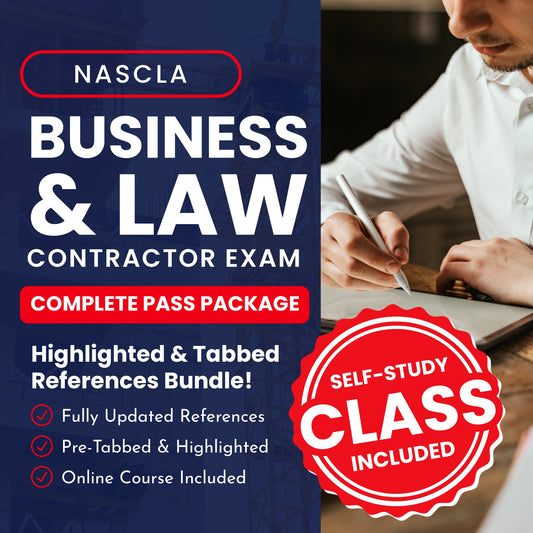
Compare the NASCLA Business Basic Edition Complete Pass Package with buying the reference on its own. Verify course access, book ownership, tabbing, shipping, and any optional services before checkout.
Use a weekly business-law study routine
Begin with an official outline, then divide the topic list into licensing, contracts, money, workers, safety, and project management. Spend the first part of each session learning one concept, the middle part applying it, and the last part reviewing incorrect answers.
At the end of the week, solve mixed questions without looking at your notes. Record the topic and reason for each mistake. If you keep confusing insurance with bonds or profit with cash flow, give that distinction its own review session.
Connect business lessons to everyday contracting
The most useful business preparation follows a project from first call to final payment. You qualify the customer, estimate the job, sign a clear agreement, schedule crews, obtain permits, supervise work, bill progress, and close the project with records.
Draw this life cycle as a simple line with eight or ten steps. Put the book's concepts beneath the appropriate step. That picture helps you remember why the content matters, whether you are studying for an exam or planning to run a business.
Avoid common exam-prep shopping mistakes
Candidates sometimes buy an edition because it is newer, cheaper, or popular. The right edition is the one the official examination calls for. They may also mistake an online prep course for registration with the testing agency, or assume a book purchase grants a contractor license.
Before paying, read the full product description and ask whether the material is for your exact state and exam. Check shipping, rental deposits, return policies, access duration, and reference editions. Keep your receipt and order details.
Plan the steps after the exam
Passing a business-and-law examination may be only one part of a contractor license application. The responsible agency can also ask for experience, a qualifying party, a financial statement, insurance, bonds, background information, fees, or another trade examination.
Save your score notice and follow the state's final instructions. Do not advertise a license you have not received. Once a business is properly licensed, track renewals, required continuing education, and changes to responsible personnel or business details.
Helpful books, courses, and official resources
Compare the listed study resources with the official agency or testing information before ordering. A product page explains what a package offers, while the licensing authority decides which books and exam rules are current.
Action checklist before test day
- Identify the exact state and contractor license classification.
- Read the agency examination bulletin and reference list.
- Select the approved Basic or state-specific guide edition.
- Make a study map covering contracts, money, safety, labor, and law.
- Practice timed lookups and realistic contractor scenarios.
- Confirm test-day reference and identification rules.
- Complete all remaining licensing steps after receiving exam results.
Frequently Asked Questions
Conclusion
NASCLA Business and Law preparation works best when you begin with a simple question: which contractor credential are you actually trying to earn? The business side of construction is broad, and there is no magic one-size-fits-all exam. State licensing authorities set the path, testing providers administer their own appointments, and official bulletins identify the subjects and references. The NASCLA Contractors' Guide can be extremely useful, but the right edition matters. A sensible first step is to confirm the license name, examination title, state, reference list, and date before you open your wallet. That small piece of homework helps you avoid a large stack of the wrong books.
Once the details are clear, look at the work of a contractor as a connected chain of decisions. You meet a customer, decide whether the project fits your license, make an estimate, sign a contract, purchase materials, organize workers, oversee safety, send invoices, and close the job. A problem in one link can affect every link after it. For example, a vague change order can create a payment dispute. An estimate that ignores overhead can make a busy project lose money. Learning how these situations connect gives business-and-law topics a purpose beyond passing a multiple-choice test.
Contractor business preparation also asks you to think about people and responsibilities. Employees and subcontractors may have different obligations, and a business owner must understand training, records, tax questions, contracts, and insurance. Terms such as lien, indemnity, bond, retainage, and gross profit deserve a clear explanation in ordinary English. You do not have to become a lawyer or accountant to benefit from the material. You do need to notice when a decision requires a licensed professional, a state-specific rule, or a written agreement. Good judgment includes knowing what should be checked rather than pretending you already know every answer.
For the study plan itself, consistency is the advantage. Use short learning sessions, real-world contractor examples, a glossary, and timed practice. Keep a record of mistakes instead of treating a wrong answer as a personal disaster. When an insurance question goes wrong, ask whether you confused a policy with a bond. When a finance problem goes wrong, ask whether you mixed profit with cash available today. If the exam permits references, practice navigating exactly the approved edition. Reading a table once feels familiar; finding and applying that table under a clock is a different skill.
Finally, remember the boundary between preparation and authorization. Buying an online course, receiving a package, or even passing the Business and Law examination does not necessarily finish the licensing process. A state may still require an approved trade examination, verified experience, qualifying personnel, insurance, financial documents, fees, or other information. Follow the responsible agency's instructions and wait for the appropriate credential before offering regulated contracting services. Then make renewal and compliance a continuing business habit. The most useful next action is easy: verify the official requirements, choose the correct reference, and complete one focused lesson today.
Strong contractor habits begin with understanding the responsibilities behind each choice, and studying them is worth the effort.
Key Takeaways
- A NASCLA business reference is not a universal license or a single nationwide business exam.
- Match the exact state, license, bulletin, and approved book edition before purchasing.
- Practice contracts, bookkeeping, estimating, insurance, personnel, safety, and project management.
- Use realistic contractor examples and timed book navigation instead of memorizing isolated words.
- Treat exam preparation, state application, and authorization to contract as separate steps.
Plain-Language Summary
Here is the simple version of the NASCLA Business and Law study guide. Contractor business exams are about running work correctly, not just knowing how to build it. You may be asked about contracts, costs, money coming in and going out, people on a job, insurance, safety, and the records a contractor should keep. These topics matter because even a well-built project can become a business problem if payments, paperwork, or responsibilities are handled poorly. The exam helps check whether a candidate understands those basic duties.
The first thing to do is find your exact exam. NASCLA produces contractor reference materials, but state-specific Business and Law exams are administered by states and their testing providers. That means a book called the NASCLA Contractors' Guide might be useful in many places, but the same edition is not automatically right for every state. Check the name of the license, the examination bulletin, and the approved reference list. Only then decide between a Basic guide, a state-specific guide, an online course, or a package that includes several items.
Think about the subjects in the order they happen on a project. First, an owner wants work done. The contractor estimates labor, materials, equipment, and overhead. Next comes a contract describing price, schedule, and who does what. During construction, the contractor buys materials, supervises workers, watches safety, and keeps records. Bills, progress payments, changes, and final closeout follow. A practice question becomes easier when you can place it in that story. If the question mentions extra work, think about written changes. If it mentions a late payment, think about cash flow and documentation.
A study routine does not have to be fancy. Choose two or three topics each week and give every lesson a goal. Read the explanation, write a simple example in your own words, and answer questions. For an open-book test, practice locating the right reference quickly. Keep an error log that tells you why an answer was wrong. You might have missed a deadline, misunderstood an accounting term, or searched the wrong chapter. Fixing the reason is more valuable than staring at the correct option for a minute.
Last, keep the exam and the license separate in your mind. A prep purchase is not an official license or exam registration. Passing a test may still leave application steps, state approvals, and business requirements. Check official instructions and save copies of records. Once your license is issued, keep track of renewal dates and any changes that affect your business. The practical plan is simple: verify the right test, get the right book, study with real examples, and complete every licensing step in order.
One last tip is to keep a small folder called 'official requirements.' Put the exam outline, book list, application instructions, and testing rules there. Keep seller information in another folder. That way, when a code cycle changes or a course description is updated, you can quickly see which source controls your next step. You will spend less time sorting through advertisements and more time learning the business skills that matter for your exam and your work.