


Nevada C-15 Roofing and Siding Contractor

Sale Sale Sale Sale Sale Sale Sale Sale Sale Sale Sale Sale Sale Sale Sale
Nevada C-15 Roofing and Siding Contractor Contractor - Online Exam Prep Course
Regular price
$250.00
Sale price
$250.00
Regular price
$279.00
Unit price
/
per
Sale Sale Sale Sale Sale Sale Sale Sale Sale Sale Sale Sale Sale Sale Sale
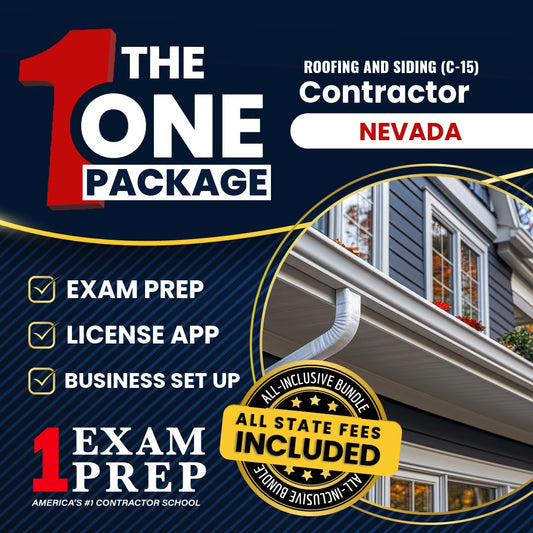
The 1 Package: All-Inclusive Nevada Roofing and Siding Contractor (C-15) Exam, Licensing & Business Setup Solution
Regular price
$3,710.00
Sale price
$3,710.00
Regular price
$4,210.00
Unit price
/
per
Nevada C-15 Roofing and Siding Contractor Exam Prep, Licensing, and Business Setup Guide
Preparing for the Nevada C-15 Roofing and Siding Contractor examination requires more than knowing how to install shingles or replace damaged siding. A contractor-level candidate may need to understand roofing systems, exterior wall coverings, waterproofing, insulation, flashing, drainage, weather protection, material installation, fall protection, estimating, project coordination, building-code requirements, and the responsibilities of operating a licensed Nevada contracting business.
The Nevada C-15 Roofing and Siding Contractor collection currently includes two preparation options for different professional goals. The Nevada C-15 Roofing and Siding Contractor Online Exam Prep Course provides flexible technical preparation for candidates who already own or can obtain the approved examination reference. The 1 Package: All-Inclusive Nevada Roofing and Siding Contractor C-15 Exam, Licensing & Business Setup Solution combines exam preparation with licensing and business organization support.
The right option depends on how much assistance the applicant needs. An experienced roofer or siding installer who has already completed the Nevada application may only need online study. A professional who plans to form a company, document experience, complete the application, prepare for the exams, and organize the business may benefit from the all-inclusive package.
Nevada C-15 Roofing and Siding Contractor Online Exam Prep Course
Flexible preparation for working roofing and siding professionals
The Nevada C-15 Roofing and Siding Contractor Online Exam Prep Course is listed at a sale price of $250.00, compared with a regular price of $279.00. It is designed for candidates preparing for the Nevada C-15 trade examination through structured online instruction and exam-style practice.
The current course information includes:
- One year of online access
- Test-taking techniques
- Guidance for highlighting and tabbing the approved reference
- Practice examinations based on the technical material
- Mobile compatibility for Android and iOS devices
- Self-paced access from a phone, tablet, or computer
The online format can help candidates prepare around installation schedules, repair calls, weather delays, active projects, family obligations, and the Nevada application process. Candidates can return to difficult lessons and repeat practice questions throughout the access period.
Who May Benefit From the Online Course?
The Nevada C-15 Roofing and Siding Contractor Online Exam Prep Course may be useful for experienced professionals who understand field installation but need a clearer examination strategy.
The course may fit candidates who:
- Already own the current approved examination reference
- Prefer self-paced preparation instead of a classroom schedule
- Need practice with building-code navigation
- Want simulated examination questions
- Need help organizing roofing and siding subjects
- Want to improve timed lookup skills
- Are preparing while continuing to work full time
The course does not replace qualifying experience, the contractor application, required financial documents, the license bond, insurance, government fees, or the separate Nevada CMS Business and Law examination.
The 1 Package: All-Inclusive Nevada Roofing and Siding Contractor C-15 Exam, Licensing & Business Setup Solution
A coordinated path from examination preparation to company organization
The All-Inclusive Nevada Roofing and Siding Contractor C-15 Exam, Licensing & Business Setup Solution is listed at a sale price of $3,710.00, compared with a regular price of $4,210.00.
This package is intended for candidates who need more than an online course. It connects examination preparation with application organization, licensing assistance, and basic business setup support.
A future Nevada C-15 contractor may need to complete several connected tasks:
- Select the correct C-15 classification or subclassification
- Form or register the contractor business
- Identify the management and trade qualifying individuals
- Document roofing and siding experience
- Prepare the required financial statement
- Complete background and disclosure forms
- Submit the Nevada contractor application
- Receive PSI examination eligibility
- Prepare for the trade and CMS examinations
- Obtain the Board-assigned contractor bond
- Provide workers’ compensation information
- Complete the final licensing requirements
The all-inclusive package is designed to make these steps easier to coordinate. The applicant remains responsible for supplying accurate information, meeting Nevada’s qualifications, completing the examinations, and paying government or third-party fees not specifically included in the product.
Who May Benefit From the All-Inclusive Package?
The all-inclusive Nevada C-15 package may be useful for:
- Roofers applying for their first contractor license
- Siding professionals moving into business ownership
- Exterior remodeling contractors expanding their services
- Out-of-state contractors entering the Nevada market
- Applicants who need help documenting experience
- Candidates unfamiliar with Nevada licensing forms
- Professionals who want examination and business support together
- Applicants who have not yet formed their company
A candidate who already owns a licensed company, has completed the application, possesses the correct books, and only needs practice questions may not need the full package. Compare the included services with the work already completed before purchasing.
Understanding the Nevada C-15 Roofing and Siding Classification
Nevada classifies C-15 as a specialty contractor license covering roofing and siding. A contractor holding the full C-15 classification may perform the work authorized under all four C-15 subclassifications:
- C-15a Roofing
- C-15b Siding
- C-15c Insulation
- C-15d Waterproofing
The full C-15 classification may be appropriate for a contractor whose business includes several connected building-envelope services. A professional who only performs one limited type of work may qualify under a narrower subclassification instead.
The exact license issued by the Nevada State Contractors Board determines the contractor’s legal scope. Candidates should confirm whether the full C-15 classification or an individual subclassification best matches their experience and planned projects.
Nevada C-15a Roofing Scope
The C-15a Roofing subclassification covers the installation, application, alteration, and repair of watertight and weatherproof roofing materials.
Materials may include:
- Asphalt
- Pitch
- Tar
- Felt
- Wood shakes
- Composition shingles
- Aluminum roofing
- Roof tile
- Slate
- Urethane systems
- Photovoltaic roof tiles serving as roofing materials
The roofing subclassification does not authorize ordinary siding installation. It also does not authorize the electrical installation of conduits, inverters, batteries, or electrical connections associated with photovoltaic roof tiles.
Roofing contractors should distinguish between installing a roofing product and performing regulated electrical or photovoltaic-system work. Additional Nevada licensing may be required for electrical connections and related equipment.
Nevada C-15b Siding Scope
The C-15b Siding subclassification covers the installation, alteration, and repair of siding used to make exterior walls watertight and weatherproof.
Siding materials may include:
- Wood
- Aluminum
- Enameled steel
- Plastic products
- Glass products
- Other accepted exterior wall-covering materials
Siding work involves more than fastening panels to a wall. Contractors may need to evaluate the substrate, weather-resistant barrier, flashing, drainage plane, fasteners, clearances, movement, penetrations, joints, trim, corners, windows, doors, and manufacturer instructions.
Nevada C-15c Insulation Scope
The C-15c Insulation subclassification covers the installation of materials used to insulate buildings.
These materials may include:
- Glass-fiber insulation
- Metal insulation systems
- Plastic insulation
- Urethane products
- Other accepted building-insulation materials
Insulation work can affect energy performance, condensation control, fire safety, indoor comfort, and building durability. Contractors should understand placement, compression, gaps, vapor control, air leakage, fire-blocking concerns, and compatibility with roofing or siding assemblies.
Nevada C-15d Waterproofing Scope
The C-15d Waterproofing subclassification covers applying materials to surfaces to prevent water from penetrating those surfaces.
Waterproofing materials may include:
- Rubber-based solutions
- Latex products
- Asphalt
- Pitch
- Tar
- Other accepted waterproofing materials
Waterproofing can involve foundations, walls, decks, roofs, transitions, joints, penetrations, below-grade surfaces, and other areas exposed to moisture. Installation must account for surface preparation, drainage, material compatibility, thickness, reinforcement, terminations, protection, and curing.
Choosing the Full C-15 License or a Subclassification
Apply for the classification that matches the work the business intends to perform and the experience the qualifier can document.
The full C-15 classification may be appropriate when the company plans to perform roofing, siding, insulation, and waterproofing work. A narrower subclassification may be more appropriate when the contractor specializes only in one area.
Before selecting the classification, consider:
- The work performed during the qualifier’s experience period
- The services the company plans to advertise
- The projects the company intends to bid
- The trade examination connected with the classification
- The financial statement and monetary limit
- Whether other Nevada specialty licenses are required
Applying for a classification that is broader than the documented experience may lead to questions or delays during application review.
Nevada C-15 Experience Requirements
The trade qualifying individual generally must document at least four full years of experience within the 15 years immediately before the contractor application is filed.
Qualifying experience may be earned as a:
- Journeyman
- Foreman
- Supervising employee
- Contractor
The experience should relate directly to the C-15 scope requested. A full C-15 applicant should be prepared to demonstrate broad roofing and siding knowledge, while a C-15a applicant may focus primarily on roofing experience.
Approved technical education, apprenticeship, or college training may satisfy up to three years of the experience requirement. Practical field experience is still required.
Documenting Roofing and Siding Experience
Experience documentation should describe the applicant’s actual duties instead of using general statements such as “roofing work” or “construction.”
Useful experience descriptions may identify work involving:
- Roof inspection and measurement
- Tear-off and substrate evaluation
- Deck repairs
- Underlayment installation
- Asphalt shingles
- Tile roofing
- Metal roofing
- Low-slope membranes
- Flashing
- Roof drainage
- Roof penetrations
- Siding installation
- Weather-resistant barriers
- Insulation
- Waterproofing
- Estimating and material takeoffs
- Employee supervision
- Safety planning
- Inspection coordination
The Nevada State Contractors Board may contact employers, customers, or references to verify the experience. Self-employed applicants may need customer information and supporting records.
Selecting the Nevada Qualifying Individual
The contractor license is issued to the business entity, but an individual must qualify the company in the requested trade.
The qualifying individual may be:
- The owner of a sole proprietorship
- A partner
- A corporate officer
- A limited liability company member or manager
- A bona fide employee
The qualifying individual should be actively involved in the company and capable of supervising the roofing, siding, insulation, or waterproofing work covered by the license.
One person may serve as both the management and trade qualifier. Nevada may also allow separate individuals to qualify the business-management and trade portions of the application.
Nevada C-15 Examination Requirements
The Nevada C-15 licensing process generally requires:
- The Nevada C-15 Roofing and Siding trade examination
- The Nevada Construction Management Survey, or CMS, Business and Law examination
The trade exam focuses on roofing, siding, waterproofing, insulation, code compliance, safety, materials, installation, estimating, and related contractor knowledge.
The CMS examination covers Nevada contractor law, business management, finance, contracts, employment, insurance, bonding, liens, safety, and project administration.
An approved endorsement or examination waiver may remove a trade-exam requirement in certain situations. Candidates should not assume a waiver applies until the Board confirms it.
Apply Before Scheduling With PSI
Nevada contractor candidates cannot schedule the licensing examinations before submitting the contractor application. The Nevada State Contractors Board reviews the application and experience before issuing examination eligibility.
A practical C-15 licensing sequence is:
- Select the full C-15 classification or an appropriate subclassification.
- Form or register the contractor business.
- Select the management and trade qualifiers.
- Gather experience documentation.
- Prepare the required financial statement.
- Complete the application and disclosure forms.
- Submit the application and processing fee.
- Wait for the Board’s review.
- Receive the Examination Eligibility form.
- Schedule the authorized examinations with PSI.
- Pass the required examinations.
- Submit the assigned bond, license fee, and insurance documents.
Applicants can study while the application is under review. Starting the application early may reduce delays once the candidate feels ready to test.
Nevada Application and License Fees
The current Nevada contractor-license application fee is $300. The fee is submitted with the application and is separate from examination costs, books, courses, accounting, bonding, insurance, and business registration.
After approval, the current biennial Nevada contractor-license fee is $600. The license remains active for two years when all renewal requirements are met.
Contractors engaged in residential work may also need to participate in the Nevada Residential Recovery Fund. The assessment is based on the monetary limit assigned to the license.
Applicants should verify all current amounts before submitting payments because state fees and procedures may change.
Nevada Financial Statement Requirements
Nevada requires contractor applicants to provide financial information in the format required by the Nevada State Contractors Board.
The required financial-statement level depends on the monetary limit requested. Depending on the application, the Board may require a self-prepared statement, compiled statement, reviewed statement, or audited financial statement.
The Board may evaluate:
- Working capital
- Net worth
- Cash
- Accounts receivable
- Current liabilities
- Long-term debt
- Business assets
- Bank verification
- The requested project limit
Review the current financial instructions before paying an accountant. An incorrectly prepared statement can delay the application.
Understanding the Nevada Monetary Limit
A Nevada contractor license includes a monetary limit. The limit controls the maximum amount of work the contractor may undertake for one client at a single construction site or subdivision site.
The Board considers the applicant’s financial position, experience, requested classification, and supporting records when assigning the limit.
A contractor must comply with both the license scope and monetary limit. A roofing project may fall within the C-15 scope but still exceed the amount the company is authorized to contract.
Nevada Contractor License Bond
Before the C-15 license is issued, the applicant must provide the contractor-license bond assigned by the Nevada State Contractors Board.
The bond amount depends on factors such as:
- License classification
- Monetary limit
- Financial responsibility
- Experience
- Applicant history
Do not purchase a bond before the Board issues the approval instructions. The business name and bond amount must match the Board’s requirements.
Current Exam-Room Reference
Current Nevada C-15 preparation information identifies the 2018 International Building Code as the primary reference allowed in the examination room.
The IBC includes important requirements related to:
- Roof assemblies
- Roof coverings
- Roof drainage
- Flashing
- Exterior walls
- Weather protection
- Fire classification
- Structural requirements
- Materials and installation
- Inspection and code compliance
Candidates should confirm the exact approved edition, tab rules, highlighting rules, and testing procedures in the PSI bulletin issued for their examination eligibility.
How to Navigate the International Building Code
Begin by reviewing the table of contents, index, definitions, chapter organization, tables, figures, and referenced standards.
Important study areas may include:
- Chapter 14 for exterior walls
- Chapter 15 for roof assemblies and rooftop structures
- Chapter 16 for structural design
- Chapter 17 for special inspections and tests
- Chapter 23 for wood
- Chapter 26 for plastic materials
A question may require more than one section. For example, a siding question may involve exterior-wall requirements, combustible materials, fire separation, weather protection, fasteners, and manufacturer instructions.
Do not stop after finding one familiar sentence. Review definitions, exceptions, footnotes, tables, and cross-references before selecting an answer.
Roofing Systems to Study
Nevada C-15 exam preparation should include several roofing types and installation methods.
Important systems may include:
- Asphalt shingles
- Wood shakes and shingles
- Clay and concrete tile
- Slate
- Metal panels
- Standing-seam roofing
- Built-up roofing
- Modified bitumen
- Single-ply membranes
- Sprayed polyurethane foam
- Roof coatings
- Photovoltaic roof tiles
For each system, review substrate requirements, roof slope, underlayment, fastening, flashing, edge conditions, drainage, penetrations, ventilation, fire classification, wind resistance, and manufacturer instructions.
Roof Deck and Substrate Preparation
A roofing system depends on the condition of the deck or substrate beneath it. Candidates should understand how to inspect and prepare wood decking, concrete, lightweight insulating concrete, gypsum decks, metal decks, and other roof surfaces.
Review:
- Damaged or deteriorated decking
- Loose fasteners
- Moisture
- Surface contamination
- Gaps and openings
- Uneven areas
- Drainage slope
- Compatibility with adhesives and membranes
Installing a new roof over an unsuitable substrate can lead to leaks, loss of adhesion, premature failure, and code violations.
Underlayment and Weather Protection
Underlayment provides an additional layer of protection below the roof covering. Study material types, installation direction, laps, attachment, valleys, penetrations, roof edges, and special conditions.
Nevada roofing conditions can include intense sun, heat, wind, sudden storms, snow in higher elevations, and large temperature changes. Material selection and installation must account for the project location and building design.
Do not assume one underlayment procedure applies to every roof covering. Asphalt shingles, tile, metal roofing, wood shakes, and low-slope membranes may require different materials and methods.
Flashing and Roof Penetrations
Flashing directs water away from vulnerable transitions and penetrations.
Review flashing at:
- Valleys
- Chimneys
- Walls
- Parapets
- Roof edges
- Plumbing vents
- Mechanical equipment
- Skylights
- Curbs
- Drains
- Scuppers
- Changes in roof slope
Many roof leaks originate at details rather than within the main field of the roof. Contractors should understand proper sequencing, laps, counterflashing, termination, sealants, and compatibility.
Roof Drainage
Roofing preparation should include gutters, downspouts, internal drains, overflow drains, scuppers, crickets, saddles, tapered insulation, and positive drainage.
Ponding water can increase structural loads, accelerate membrane deterioration, collect debris, encourage biological growth, and increase leak risk.
Contractors should recognize the difference between repairing the roofing surface and correcting an underlying drainage problem. A new membrane may fail when water remains trapped because of poor slope or blocked drainage.
Siding and Exterior Wall Assemblies
Siding installation requires a complete understanding of the exterior wall assembly.
Study:
- Wall sheathing
- Weather-resistant barriers
- Flashing
- Drainage planes
- Furring
- Fasteners
- Clearances
- Joints
- Movement
- Openings
- Corners
- Penetrations
- Manufacturer installation requirements
Siding should shed water while allowing the wall assembly to manage incidental moisture. Improper laps, missing flashing, blocked drainage, and incorrect fasteners can cause hidden deterioration.
Common Siding Materials
Review the properties and installation considerations of:
- Wood siding
- Vinyl siding
- Aluminum siding
- Steel siding
- Fiber-cement siding
- Composite siding
- Glass exterior products
- Panel siding
- Shingle siding
Each material responds differently to moisture, heat, movement, impact, ultraviolet exposure, corrosion, and fastener placement. Candidates should study the installation method rather than assuming all siding products are interchangeable.
Insulation and Energy Performance
C-15 preparation should include basic insulation concepts when the full classification or C-15c scope is requested.
Review:
- R-value
- Continuous insulation
- Thermal bridging
- Air leakage
- Vapor control
- Condensation
- Compression
- Gaps and voids
- Fire-safety considerations
- Compatibility with exterior systems
Insulation must be installed continuously and correctly. Compressed, missing, wet, or poorly fitted insulation may not provide the expected thermal performance.
Waterproofing Preparation
Waterproofing systems must be selected for the surface, exposure, movement, water pressure, drainage, and intended use.
Study:
- Surface preparation
- Primers
- Liquid-applied membranes
- Sheet membranes
- Asphaltic materials
- Rubberized coatings
- Latex products
- Reinforcement
- Joints and penetrations
- Terminations
- Protection boards
- Drainage systems
A waterproofing membrane may fail when it is applied to a dirty, damp, incompatible, unstable, or improperly prepared surface.
Roofing and Siding Safety
Safety is one of the most important areas of roofing and siding work. Contractors may expose employees to falls, ladders, scaffolds, sharp materials, hot asphalt, electrical hazards, heavy materials, weather, and powered equipment.
Important safety subjects include:
- Fall-protection systems
- Personal fall arrest
- Guardrails
- Safety nets
- Warning lines
- Ladder setup and use
- Scaffolding
- Roof access
- Material handling
- Hot work
- Heat stress
- Electrical clearances
- Personal protective equipment
- Weather monitoring
A contractor-level examination may ask for the safest first action rather than the fastest production method.
Roofing Estimating and Material Takeoffs
Roofing contractors should be able to estimate:
- Roof area
- Roof slope
- Squares of roofing
- Waste
- Underlayment
- Starter material
- Ridge and hip material
- Flashing
- Fasteners
- Drip edge
- Insulation
- Membranes
- Labor
- Equipment
- Disposal
Complex roofs with valleys, dormers, penetrations, hips, steep slopes, and limited access may require higher waste and labor allowances.
Estimating should also include permits, overhead, insurance, supervision, safety equipment, transportation, warranty obligations, and profit.
Siding Estimating and Material Takeoffs
Siding estimates may require calculation of:
- Gross wall area
- Window and door deductions
- Waste
- Starter strips
- Corner trim
- J-channel
- Furring
- Weather-resistant barrier
- Flashing
- Fasteners
- Soffit
- Fascia
- Labor
- Access equipment
Material exposure, panel dimensions, laps, pattern layout, cuts, elevation, and architectural details affect the final quantity.
Preparing for the Nevada CMS Business and Law Examination
The Nevada CMS examination is separate from the C-15 trade examination. Candidates should include both exams in the study plan.
Important CMS subjects may include:
- Nevada contractor licensing laws
- Business organization
- Estimating and bidding
- Contracts
- Change orders
- Project documentation
- Financial management
- Taxation
- Employment responsibilities
- Insurance
- Bonding
- Mechanics’ liens
- Safety
- Risk management
A candidate who passes the roofing and siding trade examination but fails to complete the CMS requirement has not finished the ordinary Nevada examination process.
How to Use the Online Course Effectively
Create fixed study appointments instead of relying on spare time. A weekly plan may include lessons, reference searches, practice questions, calculations, and review.
A productive study session can follow this sequence:
- Complete one course lesson.
- Identify the main roofing or siding subject.
- Locate the related section in the approved reference.
- Complete practice questions.
- Review every incorrect answer.
- Repeat slow reference searches.
- Record the subjects that need more work.
Do not watch several lessons without applying the information. Active code searches and practice questions create stronger exam preparation than passive viewing.
Suggested Nevada C-15 Study Plan
Stage one: Confirm the classification and application requirements
Review whether the full C-15 license or a subclassification matches the planned work and documented experience.
Stage two: Learn the approved reference
Review the International Building Code table of contents, index, definitions, roof chapter, exterior-wall chapter, tables, and figures.
Stage three: Study roofing systems
Review steep-slope and low-slope roofs, underlayment, fastening, flashing, drainage, penetrations, ventilation, and fire classification.
Stage four: Study siding and exterior walls
Review materials, weather barriers, flashing, drainage, fasteners, clearances, joints, movement, and openings.
Stage five: Study insulation and waterproofing
Review thermal control, vapor movement, condensation, membrane application, surface preparation, drainage, and protection.
Stage six: Study safety
Review fall protection, ladders, scaffolds, hot work, electrical hazards, heat stress, weather, tools, and material handling.
Stage seven: Practice estimating
Complete roofing-area, slope, material, waste, siding-area, flashing, trim, labor, and equipment calculations.
Stage eight: Complete mixed practice
Use questions that require identifying the subject before opening the reference.
Stage nine: Add realistic timing
Begin timed practice only after reference navigation and calculation methods become accurate.
Stage ten: Complete final review
Review repeated mistakes, slow searches, important code tables, examination rules, identification, and approved book preparation.
Open-Book Exam Strategies
Read the complete question before opening the book. Identify whether the question concerns roofs, exterior walls, materials, flashing, drainage, fire classification, structural requirements, safety, or estimating.
Look for controlling words such as:
- Minimum
- Maximum
- Required
- Permitted
- Prohibited
- Except
- First
- Most likely
When you find a possible answer, read the surrounding language. Check the section heading, exceptions, footnotes, tables, definitions, and referenced standards.
Do not spend too long on one search. Mark difficult questions and return later when the testing system permits review.
Common Nevada C-15 Preparation Mistakes
One common mistake is focusing only on shingles. The full C-15 examination may include roofing, siding, insulation, waterproofing, code, safety, estimating, and contractor responsibilities.
Another mistake is assuming field experience replaces code study. Experienced contractors may still struggle with exact code wording and timed navigation.
Candidates may purchase the online course but fail to obtain the approved reference. Open-book preparation requires regular practice with the book that may be used during the examination.
Another mistake is ignoring the CMS Business and Law examination. Both exams should be included in the licensing plan.
Applicants may also delay submitting the contractor application. Nevada does not authorize examination scheduling until the application and experience have been reviewed.
Another mistake is applying for the full C-15 classification when the applicant can only document one limited area of experience. The requested classification should match the work history.
Finally, contractors may underestimate safety. Roofing and siding work presents significant fall, heat, ladder, electrical, and material-handling hazards.
Frequently Asked Questions
Q. What does a Nevada C-15 Roofing and Siding Contractor license allow?
A. A full C-15 license includes the work authorized under the roofing, siding, insulation, and waterproofing subclassifications.
Q. What is covered by the C-15a Roofing subclassification?
A. C-15a covers the installation, alteration, application, and repair of watertight and weatherproof roofing materials, including shingles, shakes, tile, slate, metal, urethane, and qualifying photovoltaic roof tiles.
Q. Can a C-15a roofer install photovoltaic electrical equipment?
A. The roofing scope does not authorize installation of conduits, inverters, batteries, or electrical connections. Separate electrical or photovoltaic licensing may be required.
Q. What is covered by the C-15b Siding subclassification?
A. C-15b covers the installation, alteration, and repair of siding materials used to make exterior walls watertight and weatherproof.
Q. Does the full C-15 license include insulation and waterproofing?
A. Yes. The full C-15 classification includes work authorized under C-15c Insulation and C-15d Waterproofing.
Q. How much experience is required for a Nevada C-15 license?
A. The trade qualifying individual generally needs four full years of relevant experience within the 15 years before the application is filed.
Q. Can education count toward the experience requirement?
A. Nevada may accept approved education, apprenticeship, or technical training for up to three years of the experience requirement. Practical experience is still required.
Q. Which examinations are required?
A. Candidates generally need the Nevada C-15 trade examination and the Nevada CMS Business and Law examination unless an approved waiver applies.
Q. Can I schedule the PSI exam before applying?
A. No. The contractor application must be submitted and the qualifier’s experience reviewed before the Board issues examination eligibility.
Q. What is included in the Nevada C-15 online course?
A. The course currently includes one year of online access, test-taking techniques, reference-highlighting and tabbing guidance, practice examinations, and mobile-compatible study access.
Q. How much does the Nevada C-15 online course cost?
A. The online course is listed at a sale price of $250.00, compared with a regular price of $279.00.
Q. Which book is currently identified for the C-15 exam?
A. Current preparation information identifies the 2018 International Building Code as the primary reference allowed in the testing room. Candidates must confirm the latest PSI reference list.
Q. Is the Nevada C-15 exam open book?
A. The examination permits specified references. Candidates should confirm the exact approved book, edition, highlighting, tab, note, and calculator rules in the current PSI bulletin.
Q. What does the all-inclusive package add?
A. The all-inclusive package connects examination preparation with contractor-license application assistance and basic business setup support.
Q. How much does the all-inclusive Nevada C-15 package cost?
A. The package is listed at a sale price of $3,710.00, compared with a regular price of $4,210.00.
Q. Does the all-inclusive package guarantee license approval?
A. No. The Nevada State Contractors Board determines eligibility and approval. The applicant must meet all experience, examination, financial, bond, insurance, and licensing requirements.
Q. How much is the Nevada contractor application fee?
A. The current Nevada contractor-license application fee is $300.
Q. How much is the Nevada license fee after approval?
A. The current biennial contractor-license fee is $600.
Q. Is a contractor bond required?
A. Yes. The Nevada State Contractors Board assigns the required bond amount after reviewing the application.
Q. Where can I compare the Nevada C-15 preparation products?
A. The Nevada C-15 Roofing and Siding Contractor collection from 1 Exam Prep lists the online exam prep course and the all-inclusive exam, licensing, and business setup package.
Conclusion
The Nevada C-15 Roofing and Siding Contractor license can support professionals who install and repair important building-envelope systems. The full classification includes roofing, siding, insulation, and waterproofing, while narrower subclassifications are available for contractors specializing in one area.
The Nevada C-15 Roofing and Siding Contractor Online Exam Prep Course provides a flexible preparation option for candidates who already have or can obtain the approved examination reference. It is listed at a sale price of $250.00, compared with a regular price of $279.00.
The 1 Package: All-Inclusive Nevada Roofing and Siding Contractor C-15 Exam, Licensing & Business Setup Solution provides broader support. It combines examination preparation with licensing organization and business setup assistance. The package is listed at a sale price of $3,710.00, compared with a regular price of $4,210.00.
Before choosing a package, confirm which C-15 classification matches the work the company plans to perform. Review the current Nevada application, experience, financial-statement, examination, bond, insurance, monetary-limit, and licensing requirements.
Use the preparation resources actively. Complete lessons with the approved code book available, practice locating roofing and exterior-wall requirements, work through estimates, review safety subjects, and study every missed question.
No course or licensing package can guarantee examination approval, a passing score, a particular monetary limit, license issuance, or business success. Results depend on qualifying experience, accurate documentation, financial responsibility, technical understanding, study consistency, and examination performance.
With a complete application, a steady study schedule, and regular code-navigation practice, candidates can approach the Nevada C-15 licensing process with stronger roofing and siding knowledge and a clearer path toward becoming a licensed contractor.
Key Takeaways
- The full Nevada C-15 classification includes roofing, siding, insulation, and waterproofing work.
- The C-15a roofing scope does not authorize electrical installation of photovoltaic conduits, inverters, batteries, or electrical connections.
- The trade qualifier generally needs four years of relevant experience within the previous 15 years.
- Candidates generally need the C-15 trade exam and Nevada CMS Business and Law exam unless a waiver applies.
- The contractor application must be submitted before PSI examination scheduling is authorized.
- The online course is listed at $250.00 and includes one year of access, practice exams, and reference-navigation guidance.
- The all-inclusive package is listed at $3,710.00 and combines exam preparation with licensing and business setup support.
- Current preparation information identifies the 2018 International Building Code as the primary exam-room reference.
- Choosing a selection results in a full page refresh.
- Opens in a new window.