


Tennessee Journeyman Plumber Exam Prep: Codebooks, Local Rules, and Licensing Paths
Getting ready for a Tennessee journeyman plumber examination can feel straightforward until you encounter three different terms: journeyman, Limited Licensed Plumber, and plumbing contractor. They describe different licensing or work arrangements, and not every Tennessee city uses the same local requirements. The smartest first step is identifying who will issue the credential you need. This guide explains practical plumbing exam subjects, how to compare the Tennessee Journeyman Plumber collection, what comes in the 2021 IPC study package, and how the state's LLP and contractor paths differ. You will also find a manageable study plan and common exam-prep questions.
Important Details to Check First
Identify your exam authority: Tennessee's Board for Licensing Contractors administers the state Limited Licensed Plumber (LLP) and plumbing contractor paths, while local jurisdictions may have their own journeyman credentials or permits. The state changed its exam provider to Prov beginning July 1, 2026. Do not assume a product titled 'Journeyman Plumber' corresponds to a single statewide journeyman exam or that every locality uses the same 2021 International Plumbing Code edition.
Exam policies, state rules, fees, reference lists, and product inclusions may change. Verify current official instructions before ordering study materials or submitting an application.
Find out which plumbing credential you actually need
Start with the city or county where you intend to work. Ask its permitting or licensing office whether it requires a local journeyman license, recognizes another credential, or follows the state's Limited Licensed Plumber system for the work you plan to perform. The answer can affect the application, experience requirements, exam outline, approved code edition, and permitted references. A course title cannot settle a jurisdiction-specific licensing question.
Write down four details: issuing authority, exact exam name, adopted plumbing code, and work scope. Save the official response in your records. The Tennessee LLP guidance specifically advises applicants to check with the local government, because municipalities may have their own licensing rules for permits and inspections. This small investigation is the foundation of an accurate study plan.
Understand the Tennessee Limited Licensed Plumber path
Tennessee's LLP credential is a state-level program for specific plumbing work, not a universal substitute for every local journeyman or contractor license. The board says LLP requirements apply in municipalities that use the state Division of Fire Prevention for permits or inspections, generally to projects under $25,000. Certain minor maintenance work under $500 is exempt. The authority and contract conditions matter, so avoid applying the dollar figures to unrelated license categories.
The state's LLP page describes a trade examination through Prov and a separate initial application. Check the current fee and identification requirements directly with the board. Before scheduling, confirm that the scope of the job you want is within LLP authority and that the local jurisdiction actually accepts the credential. Otherwise, passing the right state test might still leave you without the local permission needed to work.
Separate journeyman work from plumbing contracting
A working journeyman, an individual LLP holder, and a company holding a plumbing contractor classification can have different legal responsibilities. The Tennessee Board for Licensing Contractors lists the CMC-A Plumbing contractor classification and the broader CMC mechanical classification for certain contractor licensing situations. These routes are not simply a more difficult version of a local journeyman test. They involve their own state business and trade requirements.
If you plan to bid jobs, hire workers, sign contracts, or qualify a company, examine the Tennessee contractor license guidance as well as any local plumbing rules. Do not use a journeyman study guide as proof that your company can accept regulated work. The right combination of credentials depends on the job value, location, and the kind of services offered.
Follow the current Tennessee testing-provider rules
The state changed its contractor-related exam provider from PSI to Prov beginning July 1, 2026. New scheduling through the Board's program should follow the current Prov instructions. Previously scheduled PSI appointments had transitional rules, but those should not be treated as the standard procedure for a new candidate. A local journeyman examination, if required by your city, may use a different provider altogether.
Begin with the Tennessee exam information page and then the exact instructions from your local licensing office. The state notes that plumbing CMC-A and full mechanical CMC candidates need board preapproval for those trade examinations. These rules do not establish a single statewide 'Tennessee Journeyman Plumber' exam. Your appointment confirmation is the final place to double-check identification, timing, permitted books, and testing conditions.
Compare the 2021 IPC book package with your exam
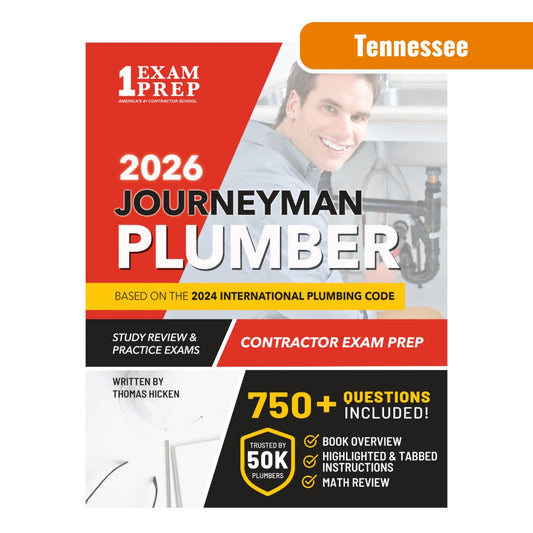
1 Exam Prep sells a Tennessee Journeyman Plumber Exam Prep Package based on the 2021 International Plumbing Code. The product lists a softbound 2021 IPC, quick-reference tabs, and a softbound study guide with practice questions and explanations. That is a concrete set of resources, not a promise that every jurisdiction will test the same edition or accept the same books at its testing center.
Read the product description and compare it with your issuing authority's candidate bulletin. Check if the exam is open book, whether tabs are accepted, and whether local code amendments are tested. Confirm shipping, editions, included items, and return conditions before ordering. The package can help with plumbing reasoning even when the official exam requires another reference, but exam-room permission should never be guessed from a retailer's description.
Get comfortable with the plumbing code structure
If your exam references the International Plumbing Code, learn its organization before trying to memorize obscure details. The sections cover general requirements, fixtures, faucets, water heaters, water supply, sanitary drainage, vents, traps, storm drainage, and additional topics. An effective candidate can identify which code chapter is likely to answer a question, even when the question does not use the exact wording of a section title.
Build a topic map and practice finding answers through the table of contents, index, and definitions. Mark your weak areas during home study, but follow the testing authority's restrictions on notes and tabs. Code books are reference tools, not magic answer dispensers. Being able to find a section quickly helps only when you understand which part of the rule applies to the problem.
Focus on drain, waste, and vent systems
Drainage and venting are central plumbing subjects because an apparently small layout change can affect system performance. Review fixture-unit concepts, allowable pipe materials, slopes, branch drainage, stack connections, cleanouts, trap arms, vent sizing, and permitted configurations. Many practice questions describe a layout rather than simply naming the rule. You may have to picture the piping and see why the arrangement does or does not work.
Sketch common examples, including a bathroom group, kitchen sink, laundry connection, and building drain. Label the direction of flow and the relevant venting points. Then check each scenario in the adopted code. Avoid using a rule you remember from a different model code or edition without verifying it. Tennessee localities may adopt specific amendments, and those details can change a seemingly easy answer.
Study water distribution and backflow safety
Safe water-supply design involves adequate demand, proper pressure, approved materials, accessible shutoffs, connections, and protection against contamination. Understand why backflow prevention is a health issue, not just an equipment preference. Different conditions can require different methods of protection. A question might describe the fixture or use of a connection and expect you to identify the hazard before choosing a compliant solution.
Build practice sets around common settings: a home, an outdoor hose connection, a commercial fixture, or a water heater installation. For each, ask what the water is supplying, what could go wrong, and where the code addresses the requirement. Practice using tables and section exceptions instead of guessing from worksite habits. A familiar shortcut on a job is not guaranteed to be the correct exam answer.
Review fixtures, traps, and water heaters
Plumbing fixtures create a long list of details worth organizing: fixture counts when applicable, clearances, connections, trap protection, access, testing, and installation requirements. Water heaters add pressure and temperature relief, venting or combustion considerations where relevant, piping, and equipment safety. Do not memorize a single number without knowing the situation that makes the number apply. The same fixture can raise different code questions in different locations.
Try a room-by-room study exercise. Review a residential bathroom, kitchen, utility room, and equipment space. List the main fixtures and components in each, then find the code provisions that control their installation. When a question includes distances, occupancy information, or an appliance type, underline those details before answering. This habit makes it harder to overlook the key condition hidden in the middle of a long question.
Practice plumbing math with realistic problems
Journeyman-level plumbing work can involve measurement, slope, layout, capacity, dimensional conversions, and table-based sizing. The exam's exact calculations depend on the issuing authority, but accurate units and a repeatable method always help. A fraction of an inch can become a serious installation problem if you lose track of pipe length or confuse feet with inches halfway through a calculation.
For every problem, write what is known, what is being asked, and which unit the answer needs. Draw a quick sketch when geometry matters. Check whether the outcome is physically reasonable and whether the code requires a table or an exception. Mix easy drills with more complicated scenarios. Short daily calculation practice is much more useful than one exhausting night spent battling conversions at the kitchen table.
Add fuel gas and safety to the review plan
Some plumbing programs and job scopes include fuel gas and combustion-related topics. The 1 Exam Prep Tennessee study guide lists an International Fuel Gas Code review and OSHA review among its subject areas. These may help broaden your understanding, but only your particular exam's official outline determines which subjects count toward the test. Do not automatically treat every topic in a package as a required tested domain.
Study gas concepts carefully, especially material selection, connections, testing, and safety precautions where they are relevant. For jobsite safety, think about excavation, ladders, tools, personal protection, and exposure to other construction hazards. Ask which standard controls each situation. The best preparation connects the rule to the underlying risk instead of memorizing a set of isolated warnings.
Use the study guide and practice questions wisely
The Tennessee exam prep package advertises a study guide with 750 practice questions, answer keys, test-taking guidance, and reviews of code topics and calculations. Treat those questions as training exercises, not a prediction of exactly what will appear on your exam. Practice materials are most helpful when you take the time to explain why the correct answer works.
After each set, sort mistakes into code navigation, misunderstanding the question, calculation errors, or unfamiliar terms. Then return to the matching reference. Repeat missed questions several days later rather than reviewing them only when the correct answer is still fresh in memory. If your local exam uses another code edition, verify model questions against the version required for your credential.
Create a flexible month-long study schedule
A four-week plan can keep the work manageable. Week one should confirm the exam requirements, organize reference books, and identify weak topics. Week two can focus on drainage, vents, fixtures, and piping materials. Week three can address water supply, backflow, water heaters, safety, and calculations. Use week four for mixed timed sets, diagram questions, reference navigation, and final scheduling checks. Extend the plan if you need more foundational practice.
Aim for steady sessions that fit your job and family schedule. A useful hour might include fifteen minutes reviewing past mistakes, thirty minutes working new questions, and fifteen minutes locating the rules behind those answers. On a weekend, solve a longer mixed set. Track scores by subject rather than obsessing over one total percentage. If venting is your weakest domain, five more hours on easy fixture definitions will not solve the problem.
Prepare for exam day without surprises
Before test day, confirm the address or online testing arrangements, approved identification, start time, calculator rules, and reference-book restrictions. A state Prov appointment and a locally administered journeyman examination may have different rules. Even the definition of an approved tab can vary. Review your actual confirmation and current candidate instructions instead of copying a checklist from another candidate's social media post.
Make one folder for approval letters, registration confirmations, receipts, and contact information. Prepare materials ahead of time and leave room for travel problems or technical checks. During the test, read the whole question, identify its subject, and avoid wasting too long on one difficult item. A calm, organized process is more reliable than hoping every answer is something you happened to see at work last week.
Plan your next step after the exam
A passing exam result is valuable, but the issuing authority still controls whether a credential is issued and what work it allows. Local journeyman licensing may involve experience documentation and local registration; the Tennessee LLP path requires its own application; and state plumbing contractor licenses follow a separate board process. Keep these steps distinct. Do not take regulated work outside your authorized scope just because the testing portion went well.
Use the LLP licensing page or the appropriate local government instructions for your final paperwork. Ask how renewals, continuing education, and supervision apply to your credential. Then keep a professional records calendar. The goal is more than passing a test: it is maintaining a clear, lawful path for the plumbing work you want to do.
Relevant Products and Official Resources
Compare available study materials against the official agency requirements for your precise exam and licensing path.
A Practical Action Checklist
- Write down the exact licensing authority, credential, and examination name.
- Check eligibility, current exam format, official outline, and reference editions.
- Compare the selected products with approved materials and your study needs.
- Create a weekly plan that includes diagrams, calculations, and practice questions.
- Keep a log of mistakes and verify the correct rules in official references.
- Confirm testing logistics and complete the licensing steps after your exam.
Frequently Asked Questions
Conclusion
The best way to prepare for a Tennessee journeyman plumber examination is to begin with the licensing authority rather than the first study book you find. Tennessee has local journeyman requirements in some jurisdictions and state-level paths for Limited Licensed Plumbers and plumbing contractors. The names can look similar to someone researching from home, but they are not interchangeable. Identify the city or county where you intend to work, the exact credential required, and which office will accept your application and exam results.
Once that is settled, verify the code edition. The Tennessee Journeyman Plumber Exam Prep Package offered by 1 Exam Prep includes the 2021 International Plumbing Code, permanent quick-reference tabs, and a study guide. Those can be useful materials, particularly where a related codebook is approved. But a store listing cannot establish what every Tennessee locality has adopted or what an examination center will permit. Compare the package to the official exam bulletin and any local amendments before deciding it is the right fit.
Your technical preparation should concentrate on understanding how plumbing systems work as a whole. Fixtures lead to traps, traps connect to drains, and vents help keep drainage functioning properly. Water supply systems must deliver adequate service without creating contamination hazards. Water heaters, materials, cleanouts, pipe sizing, and installation details each bring their own code requirements. A correct exam answer often depends on several conditions together, so do not study every topic as if it lives on its own island.
Use sketches and examples to build reasoning skills. Draw common bathroom or kitchen layouts and trace the direction of flow. Work problems involving fixture units, drainage slopes, vent arrangements, and water supply. When studying backflow prevention, ask what hazard a rule is meant to stop. Practice calculations with written units. If a problem stumps you, locate the section that controls it and write a short explanation. That explanation is more helpful than memorizing only the answer letter.
Make your study plan fit your actual exam. A local journeyman test could have different subjects, reference permissions, and scheduling than the state's LLP exam. Tennessee's Board changed its examination provider to Prov in July 2026 for board-administered exams. That update matters for someone using an old study checklist. CMC-A plumbing contractor candidates have their own preapproval requirements. Check the current instructions for your path and do not borrow another person's registration process.
A predictable schedule can make the preparation much less stressful. Spend the first week verifying requirements and organizing books. Use the next two weeks on core plumbing systems, code navigation, and math. Reserve the final stretch for mixed practice questions, diagrams, weak areas, and exam-day planning. Work a few problems daily when possible. An error notebook lets you see improvement and keeps you from making the same mistake over and over. You do not need perfect study sessions. You need repeatable ones.
After passing, finish the application steps required by your issuing authority. A score report does not necessarily authorize work, and the scope of a local credential may differ from an LLP or contractor license. Keep renewal requirements and permitted activities clear. Start today by contacting the right office and writing down your exact exam name, adopted code, required books, and application steps. That one page of verified information can make every study hour more productive and every purchase more sensible.
Key Takeaways
- Check your city or county first because Tennessee journeyman plumbing requirements can be local.
- Tennessee LLP and plumbing contractor classifications are different from local journeyman credentials.
- The Tennessee product includes a 2021 IPC book, tabs, and study guide, but verify your local code edition.
- For Tennessee board-administered exams, Prov replaced PSI as the new scheduling provider in July 2026.
- Study drainage, venting, fixtures, water supply, safety, math, and the actual exam bulletin, then finish the licensing paperwork.
Plain-Language Summary
A Tennessee journeyman plumber exam plan starts with one question: who issues the credential you need? Some Tennessee cities and counties have their own plumbing licensing requirements. The state also has a Limited Licensed Plumber program and separate contractor license classifications. These do not all work the same way. Contact your local licensing office and find out which credential is required for the type of plumbing work you want to do.
If the state LLP path applies, review the Tennessee Board for Licensing Contractors' official information. The board explains where the LLP license is used, the kinds of jobs it covers, and the application steps. For board-administered examinations, the provider changed to Prov in July 2026. If your goal is a full plumbing contractor classification, you must follow different rules and may need trade-exam preapproval. Do not assume that a locally required journeyman exam is scheduled in exactly the same way.
Once you know which exam you are taking, check the code edition. 1 Exam Prep offers a Tennessee Journeyman Plumber Exam Prep Package that includes a 2021 International Plumbing Code book, quick-reference tabs, and a practice study guide. It can be a useful collection of materials, but only the examining authority can tell you which books and editions are permitted. Ask about local amendments and whether the test is open book. Do not rely only on a package title.
Core plumbing subjects usually include drains, vents, traps, fixtures, water supply, backflow protection, and water heaters. Read a question and try to understand the whole system. If you are looking at a piping diagram, trace what connects to what. If a fixture might contaminate drinking water, think about how the hazard is controlled. If the question involves pipe size or slope, use the correct code rule or table instead of guessing.
Math deserves practice too. Work on measurements, conversions, slopes, and basic sizing examples. Write your work clearly and check the units. Use the codebook's table of contents and index regularly so you know where topics are located. When you answer a question incorrectly, write down why. This will show whether you need help with plumbing concepts, a code lookup, or the calculation itself.
A four-week plan is a useful starting point. Spend the first week checking your exam requirements and reviewing the codebook. Practice drainage and venting during week two. Cover water systems, fixtures, safety, and math in week three. In the final week, take mixed practice sets and review your mistakes. Add more time if the subject feels unfamiliar or if you need to strengthen basic skills.
On exam day, follow your actual testing center's directions for identification, books, tabs, calculators, and arrival. After the exam, submit any remaining licensing paperwork and confirm when your credential becomes active. Keep the limits of your license in mind when taking jobs. The whole process becomes easier when you know your jurisdiction, prepare with the right references, and follow the official steps one by one. That simple habit will help you choose materials confidently and avoid studying an outdated or unrelated examination.