


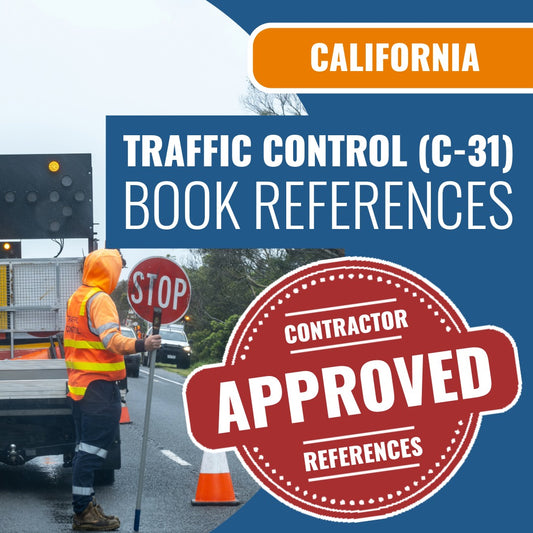
California C-31 Construction Zone Traffic Control Contractor Licensing Exam Prep: Books, Courses, and Study Tips
Thinking about earning your California C-31 Construction Zone Traffic Control contractor license? This specialty covers the important work of setting up and removing temporary lane closures, flagging operations, and traffic diversions. When crews repair a road or build near moving vehicles, a good traffic control plan helps everyone get through the work area safely. That includes drivers, pedestrians, bicyclists, and the people working inches away from a very busy roadway.
But the contractor exam does not simply ask whether you know which end of a traffic cone goes up. It tests planning, permits, safe installation, flagging, transportation, and smart decisions when conditions change. You will also need to prepare for California's separate Law and Business examination when required for your licensing application. The California C-31 Construction Zone Traffic Control collection at 1 Exam Prep is a starting point for trade study resources matched to this classification.
In this guide, you will learn what the C-31 license covers, how the official exam is divided, and how to prepare without wasting time on the wrong material. We will also explain study books, business-exam options, practical practice methods, and a manageable study schedule. The goal is simple: go into the test ready to think clearly, not just hope the answers line up as neatly as your barricades.
What Work Does a California C-31 Contractor Perform?
The Contractors State License Board (CSLB) describes the C-31 classification as work involving preparation or removal of lane closures, flagging, and traffic diversions using portable traffic control devices. Examples include cones, delineators, barricades, sign stands, flashing beacons, arrow trailers, and changeable message signs. These devices guide road users through or around construction activity on streets, highways, and other public routes. You can read the official C-31 classification description to understand the scope.
A C-31 contractor needs more than a truck full of cones. The job starts by understanding the road, the work to be done, visibility, expected users, access needs, and how traffic may react to a temporary change. Crews must set up devices correctly, inspect the zone, respond to problems, and remove traffic control when the authorized work is finished.
This is a specific trade classification, not a general license to perform unrelated paving, roadbuilding, or electrical work. If a project involves work outside traffic control, confirm which other classifications or properly licensed contractors are needed. Knowing your professional boundaries is part of good business planning and good public safety.
California C-31 Examination Overview and Topic Weights
The CSLB's official C-31 examination study guide, applicable to examinations scheduled on or after February 1, 2024, divides the trade exam into five sections. These percentages are approximate, but they show where most questions are likely to be concentrated. Use them to decide how much study time each subject deserves.
- Traffic Control Installation: 51% — installation plans, lane closures, flagging, inspections, maintenance, device removal, and contingencies.
- Planning and Estimating: 18% — plans, California MUTCD compliance, scope, materials, equipment, and labor.
- Safety: 12% — personal protective equipment, equipment condition, safe environments, and emergencies.
- Notifications and Coordination: 11% — permits, public notices, and working with agencies and other contractors.
- Transportation and Training: 8% — loading and transporting equipment and training flaggers and employees.
The C-31 trade examination is closed-book. It uses multiple-choice questions, and the guide says a calculator is provided for computation questions. Books and manuals can be valuable while studying, but you cannot take them into the examination. Study until you understand the ideas well enough to apply them without turning pages.
Traffic Control Installation: The Biggest Part of the C-31 Exam
At approximately 51% of the trade exam, Traffic Control Installation deserves your largest block of preparation time. This category includes developing an installation plan, selecting and placing the appropriate devices, implementing lane closures, flagging, inspecting the traffic zone, and removing control devices after the work. It also includes planning for problems that may interrupt the original setup.
Study the order of operations. Before workers enter the roadway, the authorized traffic control setup needs to be understood and coordinated. During installation, safe access, device placement, visibility, and communication matter. Once the area is active, the crew must watch for displaced cones, confusing signs, changing traffic, and unexpected hazards. When work ends, removal needs to follow a safe, planned sequence, too.
Try practice scenarios instead of only memorizing definitions. Ask what could go wrong if a lane closure begins without proper advance warning, or why a flagger must be positioned for visibility and escape options. These situations test practical judgment. A successful C-31 candidate learns why a device is used, where it belongs under the approved plan, and when conditions call for escalation rather than improvisation.
Planning, Estimating, and the California MUTCD
Planning and Estimating makes up about 18% of the C-31 exam. It covers reading plans, deciding the scope of work, evaluating the correct standards, and estimating labor, equipment, and materials. A useful preparation exercise is to look at a proposed work zone and write down what is needed before a single cone gets unloaded. Think about equipment quantities, workers, setup time, traffic demands, and the different stages of the project.
The California Manual on Uniform Traffic Control Devices (CA MUTCD) is a major study reference. Caltrans has issued the California MUTCD 2026, effective January 18, 2026. Because standards may be updated, use the current Caltrans materials when studying and confirm whether your testing instructions specify particular references. The exam guide explains the categories, while the current manual helps you understand California traffic control standards.
Estimating also calls for straightforward math. Practice multiplying equipment quantities by rental days, calculating labor hours, and comparing material needs with the planned length and duration of work. You do not need to turn into a human calculator. You do need to recognize the information that matters and check whether the answer is reasonable.
Notifications, Permits, and Coordination With Agencies
A work zone affects more than the contractor who sets it up. City and county agencies, state transportation officials, emergency responders, other contractors, local businesses, and travelers may all depend on timely communication. That is why Notifications and Coordination represents approximately 11% of the exam.
Review how to verify project permits and authorization, recognize when public notification is required, and coordinate with the agency responsible for a street or highway. Different projects and road owners can have different processes. The best exam preparation is to understand why these steps occur and who may need information, rather than assuming one permit or notice procedure works in every location.
Imagine a crew is ready for a lane closure, but another contractor is using the same access route. The problem may not be solved by moving a few cones. It may call for coordination and a revised authorized plan. Think through questions that involve scheduling, permitted work hours, detours, emergency access, or communication after conditions change. On real projects, paperwork and phone calls are often safety tools wearing less exciting outfits.
Flagging, Lane Closures, and Temporary Traffic Control Devices
Flagging is an important part of C-31 installation work. Candidates should understand the role of trained flaggers, effective communication, safe positioning, and the need to follow the approved traffic control plan. Signs, channelizing devices, arrow trailers, and changeable message signs have different jobs. Using the right device in the right situation helps road users recognize a change early enough to react safely.
For exam study, practice identifying how the components of a temporary traffic control zone work together. Think about advance warning, transition areas, work spaces, and the path provided for vehicles and other road users. Learn why damaged or poorly positioned devices can create confusion. Focus on safe decision-making, not shortcuts that might appear convenient on a rushed morning.
When reading scenario questions, look for clues about road type, speed, visibility, pedestrians, cyclists, lane restrictions, and the available work area. These details can change which answer is best. The point is not to invent a lane-closure design from a short question. It is to demonstrate knowledge of approved methods, worker safety, and the situations that require additional direction from the responsible agency.
Inspection, Maintenance, and Safe Removal of Traffic Control
Temporary traffic control is not a one-time setup. Weather, passing traffic, construction equipment, and ordinary wear can change a work zone after installation. The C-31 exam specifically includes inspecting and maintaining traffic control zones. Study how workers recognize missing, damaged, misplaced, or ineffective devices, and why problems need prompt, authorized correction.
A useful exercise is to imagine a supervisor walking through a work zone at different points in the day. Are signs visible and correctly positioned? Are access paths clear? Are devices standing where they should? Have changes in work activity created a new risk? These questions can help you understand the reason behind inspection and maintenance requirements.
Removal matters just as much as installation. A closure that is dismantled carelessly may put workers and road users at risk. Learn the purpose of a planned removal sequence, communication among crew members, and confirming that the roadway is ready for normal use. This subject is a good reminder that finishing the construction task and safely ending the traffic control operation are not always the same moment.
Transportation, Loading, and Employee Training
Transportation and Training accounts for approximately 8% of the official C-31 outline. Although it is the smallest section, it should not be ignored. Traffic control devices need to arrive in usable condition, and crews must understand how to handle them safely. Study practical concerns in loading, securing, transporting, and unloading signs, stands, cones, and larger equipment.
Crew training is also part of the exam. Consider how a contractor makes sure flaggers and employees understand their assignments, the approved plan, work-zone communication, and emergency actions. Equipment is only as helpful as the people who know when and how to use it. A neatly stacked truck is not proof that the crew is ready for a complicated lane closure.
Review the difference between training someone to perform a specific task and merely giving them a quick verbal instruction. For study purposes, make short flashcards connecting tasks to responsibilities and common hazards. Also be clear that an exam prep course is not automatically a substitute for any separate flagger training, jobsite qualification, or agency approval required for actual work.
Safety, PPE, and Emergency Procedures
Safety makes up about 12% of the C-31 trade exam, but it influences nearly every other section. Workers may be exposed to moving vehicles, construction equipment, low visibility, weather, and changes in traffic behavior. The official guide covers personal protective equipment, inspection of traffic control equipment, safe working environments, and emergency response.
Study the purpose of high-visibility apparel, safe equipment handling, communication, and maintaining awareness near live traffic. Think about what a supervisor should do when equipment is damaged, a worker cannot perform a task safely, or a vehicle enters a protected work area. Exam questions may ask you to recognize the best decision, not merely identify an item from a picture.
Approach emergency questions with a simple principle: protect life, follow established procedures, communicate with the appropriate people, and do not improvise beyond your authority or training. Real safety choices depend on the conditions and the approved traffic control plan. A strong study routine helps you notice warning signs before a small issue becomes a much larger one.
California C-31 Exam Prep Book Reference Package
Reference books make sense even for a closed-book examination because they help you understand the rules while preparing. The California C-31 Contractor Licensing Exam Prep Book Reference Package is a C-31-specific study option offered by 1 Exam Prep. The product page describes coverage of traffic control plans, estimating, permits, coordination, lane closures, devices, flagging, inspections, transportation, training, and jobsite safety.
Use reference books actively rather than reading the same page five times and hoping it sticks. Start with a topic from the CSLB outline, read the relevant explanation, then close the book and describe the key points aloud. Next, answer a few practice questions or create a realistic scenario. If you cannot explain why a choice is right, return to the reference and identify the missing piece.
Before buying a package, check the specific titles, editions, product availability, delivery terms, and whether the material matches your study goals. Do not assume a reference bundle includes online lessons or that reference books are allowed in the test room. In this case, they are tools for learning before exam day, not a stack to carry past the proctor.
California Law and Business Exam Preparation
California contractor applicants generally need to prepare for both their classification trade examination and the separate Law and Business examination, unless CSLB grants an applicable waiver. The Law and Business test focuses on contractor responsibilities such as business organization, contracts, employment, finance, insurance, liens, and construction law. It requires a different kind of review from traffic control installation.
The California Contractor Licensing Law and Business Online Exam Prep Course provides an online study option. Candidates who prefer printed references can review the California Law and Business Exam Prep Book Reference Package. For question-based review, 1 Exam Prep also lists California Law and Business Online Practice Questions. Each is a separate product; check the description to see what it includes.
A practical strategy is to study trade material and business material on different days, then mix short review sessions later. Learn the purpose of contract rules and business procedures instead of treating them as strange facts to memorize. Traffic control protects people on the road, while sound contractor business practices help manage the work behind the scenes. Both skills matter once you become licensed.
Who Can Apply for a California C-31 Contractor License?
The licensing application has requirements beyond passing an exam. For an original contractor license, CSLB generally requires a qualifying individual with four years of verifiable journey-level or higher experience in the classification within the previous ten years, subject to the board's rules and recognized alternatives. Eligibility, application documentation, and possible examination waivers should be checked directly with CSLB. Start with the official application instructions.
Experience and exam study are not the same thing. A book package can help you review temporary traffic control concepts, but it does not create qualifying experience or replace an approval required by a road agency. Similarly, taking a practice quiz does not automatically qualify someone to serve as a flagger or perform a particular work-zone task.
Before committing to an exam date, collect the information you will need about your work history and application status. Review the board's instructions for the qualifying individual and verify the exams you have been assigned. If you have an unusual employment history or a question about which experience counts, the licensing authority is the appropriate place for an official answer.
A Six-Week California C-31 Study Plan
A good study plan does not need complicated software or an inspirational poster. It needs to fit your actual schedule. The six-week outline below gives more time to Traffic Control Installation because that topic carries approximately half of the trade examination. Adjust the pace based on your experience and the current exam guide.
- Week 1: Read the CSLB outline, confirm your test status, organize references, and review the scope of C-31 work.
- Week 2: Study lane closures, devices, and installation planning. Sketch example traffic control zones and explain their purpose.
- Week 3: Continue installation with flagging, inspections, maintenance, removal, and changing conditions.
- Week 4: Work on planning, estimating, CA MUTCD concepts, permits, and agency coordination.
- Week 5: Review transportation, training, safety, and the Law and Business topics required for your application.
- Week 6: Take timed multiple-choice practice sessions, review incorrect answers, and confirm exam-day rules.
Keep a simple error log. Write down what you missed, why you missed it, and the concept that fixes the mistake. A few minutes of careful review is usually more valuable than racing through another hundred questions without learning anything from the first set.
Practice Questions, Exam-Day Rules, and Common Mistakes
The official CSLB study guide says the C-31 exam uses multiple-choice questions with four answer options and one best answer. Some questions include calculations, and the testing provider supplies a calculator. There is no penalty for guessing. Read every answer fully before choosing. Words such as best, first, and safest can make a major difference in the correct response.
Do not spend all your preparation time on the easiest subjects. Because Traffic Control Installation is worth about 51%, a study plan that gives cones and closures one afternoon and business vocabulary three weeks is probably out of balance. At the same time, do not overlook coordination or transportation simply because their percentages are smaller.
The evening before testing, confirm your appointment information, identification requirements, testing location, and the current rules for personal items. The trade exam is closed-book, so do not arrive planning to use highlighted manuals at your desk. Get enough rest and allow travel time. You want your hardest decision that morning to be which breakfast to eat, not whether the testing center is on the other side of town.
Choosing the Right C-31 Study Resources
The right resources are the ones that match the actual C-31 examination and help you learn consistently. A focused trade reference package may suit candidates who want to build deeper technical understanding. Online Law and Business instruction may be useful for people balancing full-time work with the separate business examination. Practice questions can help reveal which topics need attention.
Compare each product carefully. Ask whether it is dedicated to C-31 or covers a different classification, whether it includes physical references or digital access, which editions are used, and how long access lasts. More material is not always better. A smaller set that you understand and review regularly can be more useful than a giant shelf of books that never gets opened.
You can explore the California Construction Zone Traffic Control (C-31) collection for related options and review the CSLB's C-31 study guide alongside it. Remember that 1 Exam Prep provides independent preparation materials; licensing decisions and exam requirements come from CSLB and the official testing process. A clear plan, the correct sources, and steady practice can help you approach your licensing goals with stronger confidence.
Frequently Asked Questions
Choose a question to see a clear answer about California C-31 licensing, exam prep, and traffic control rules.
Conclusion: Prepare for Your California C-31 Contractor Exam With Confidence
Preparing for the California C-31 Construction Zone Traffic Control contractor examination is really about learning to make sound decisions around moving traffic. This trade affects drivers, cyclists, pedestrians, and crews who may be working close to active travel lanes. The equipment is familiar to almost everyone, but managing it safely takes planning, training, clear communication, and a strong understanding of temporary traffic control. Earning a contractor license is a major professional step because it connects technical skills with responsibility for the whole job.
Start with the official CSLB study guide. Its five subject areas give you a clear road map: Traffic Control Installation represents about 51%, Planning and Estimating about 18%, Safety about 12%, Notifications and Coordination about 11%, and Transportation and Training about 8%. These weights are approximate, but they show how to divide your time. Installation should be your biggest study focus. Learn how devices, lane closures, flagging, inspections, maintenance, and removal work together. Do not ignore the smaller subjects, because a real project depends on every one of them.
Next, understand how standards and testing information fit together. The CSLB guide tells you which subjects the exam covers, while the current California MUTCD helps explain traffic control standards and device practices. Caltrans issued its 2026 edition effective January 18, 2026. Always check the most recent official information, especially when planning real work. The trade examination remains closed-book. That means reference manuals are useful for studying, but you must be able to recall and apply the information without bringing them into the test room.
Choose study tools that support this goal. A C-31 reference-book package can provide structured technical reading. Separate California Law and Business resources can help with contracts, employment, finance, insurance, and the responsibilities that come with operating a construction business. Before buying, confirm what is included and whether the format fits your schedule. No product can replace qualifying experience, official application approval, or required jobsite training. Study materials are tools, not a substitute for the licensing process.
Finally, make the plan practical. Break your review into short sessions, practice calculations, answer scenario questions, and keep track of mistakes. When you miss an answer, ask why the better choice would protect workers or road users. Use a six-week routine if it suits your calendar, or extend it if you need more time. Confirm the exam location, identification rules, and testing instructions well before your appointment. You do not need to know everything about every highway project. You need to understand your classification, follow the approved rules, and show that you can make responsible choices. With the right preparation, you can approach the C-31 examination more calmly and build on skills that matter beyond test day.
As you prepare, remember that temporary traffic control is a team effort. Road owners, inspectors, prime contractors, flaggers, and equipment operators may all need to share information. Knowing when to ask questions, report a hazard, or adjust an authorized plan is just as important as recognizing a sign. The purpose of the exam is to measure sound professional judgment. The purpose of that judgment in the field is to help everyone get home safely after the work is done.
Key Takeaways
- Study the five C-31 trade exam categories and spend the most time on Traffic Control Installation, which represents about 51% of the test.
- Review the current California MUTCD, understand approved traffic control plans, and practice safe responses to changing work-zone conditions.
- Use C-31 reference books for preparation only: the official trade examination is closed-book.
- Prepare separately for California Law and Business when required, and confirm eligibility and experience rules directly with CSLB.
- Use consistent practice, simple calculations, scenario questions, and a manageable study calendar to improve exam readiness.
California C-31 Contractor Licensing: Plain-Language Summary
The California C-31 Construction Zone Traffic Control contractor license is for a specific kind of road work. It involves setting up and removing temporary lane closures, flagging operations, and traffic diversions. Contractors use portable devices such as cones, barricades, warning signs, arrow trailers, and changeable message signs. Their job is to help people move safely around areas where construction is happening. It is not a general license to perform every type of highway construction.
To prepare for the C-31 trade examination, start with the Contractors State License Board study guide. The exam has five main subjects. Traffic Control Installation is the biggest section at about 51%. It includes lane closures, placing devices, flagging, inspections, maintenance, and removing the temporary setup. Planning and Estimating is about 18%. Safety is about 12%. Notifications and Coordination is about 11%, and Transportation and Training is about 8%. Because installation carries the largest share, you should spend the most time learning that subject.
You will also need to understand traffic control plans, work-zone permits, communication with agencies, equipment handling, and safe choices when a situation changes. The California Manual on Uniform Traffic Control Devices is an important source for understanding the standards. Caltrans issued an updated California MUTCD in 2026. Use the current official information when studying and working. The CSLB guide explains what the exam tests, but you should always check new agency instructions, because rules and standards can change.
The C-31 trade examination is closed-book. You cannot bring your reference books to the testing desk. That does not make books useless. In fact, studying from good references can help you understand the ideas before the examination. Read a subject, close the book, and explain what you learned. Then use practice questions to check your understanding. Some questions may include math, such as figuring out equipment rental costs. CSLB says a calculator will be provided for questions that need one.
California contractors generally must also prepare for a separate Law and Business examination unless an approved waiver applies. That exam deals with subjects such as contracts, insurance, finances, employment, and business responsibilities. You can study these topics with online lessons, practice questions, or reference books. The important thing is to keep business study separate from technical traffic control study so both receive enough attention.
A simple six-week plan can help you get organized. Begin with the exam outline and job scope, spend extra weeks on lane closures and flagging, then review planning, safety, transportation, and business topics. Finish with timed practice questions and a review of your mistakes. Before exam day, confirm your appointment and identification requirements. You can explore the C-31 study materials at 1 Exam Prep, but remember to check official CSLB instructions for eligibility and examination rules. Good preparation means understanding the work, not only memorizing test answers.
You should also check the application requirements. CSLB generally asks for four years of qualifying trade experience within the previous ten years, with certain rules and exceptions. Buying a course does not replace real experience, and passing the exam is not the only step in licensing. Keep your records organized, follow the board's application process, and ask CSLB for help with unusual eligibility questions. The best approach combines honest experience, current technical knowledge, and steady study habits.