


Important West Virginia scope fact: a Residential Contractor is considered licensed for the crafts required to construct, repair, or improve a residential structure, except crafts for which another state law or local ordinance requires separate licensure. That means the Residential classification is broad, but it does not erase separate electrical, plumbing, HVAC, or other licensing requirements where those laws apply.
What Is the West Virginia Residential Contractor License?
West Virginia defines a Residential Contractor as a person whose principal business is connected with the construction, repair, or improvement of real property used, or intended to be used, for residential occupancy, including work incidental to that construction or repair.
The classification covers a broad range of residential building work. That can include site preparation, foundations, concrete, masonry, framing, roof and wall systems, interior and exterior finishes, repairs, doors, windows, stairs, and other crafts required for the residential structure, subject to separate licensing laws.
The exam reflects that broad scope. Carpentry is the largest published category, but plan reading, concrete, masonry, sitework, safety, and finish work all matter.
Licensing authority: West Virginia Contractor Licensing Board.
Testing provider: Prov.
Residential trade exam: 60 questions.
Trade exam time: 3 hours.
Passing score: 70%.
Format: computer based and open book.
Contractor Licensing Act exam: 90 questions, 3 hours.
Current residential code reference: International Residential Code, 2018.
Largest exam category: Carpentry, 15 questions.
Exam fee: $59.95 per exam under the current Prov bulletin, verify before scheduling.
For residential-specific preparation, review the West Virginia Residential Contractor Online Exam Prep Course .
West Virginia Residential Contractor Licensing Path
The licensing process combines the Residential trade examination, the Contractor Licensing Act examination, a qualifying individual, and the contractor business application.
| Step | Requirement | What to Verify |
|---|---|---|
| Confirm Residential Scope | Classification | Make sure the planned work involves construction, repair, or improvement of residential real property |
| Identify the Qualifying Individual | Board Relationship | The person taking the required exam must be part of responsible management or a full-time employee of the entity seeking licensure |
| Prepare the Residential Trade Exam | Prov | 60 questions, 3 hours, open book, 70% passing score |
| Prepare Contractor Licensing Act | State Contractor Exam | 90 questions, 3 hours, open book, business and licensing law |
| Use Current Approved References | Prov Bulletin | IRC 2018, Masonry and Sitework, and Residential Carpentry and Repair guide |
| Pass Required Exams | 70% Cut Score | Prov grades current contractor exams against a 70% passing standard |
| Prepare Business Documentation | Contractor Application | Business registration, qualifier information, insurance, tax, workforce, and other current Board requirements |
| Address Separate Trade Licenses | Specialty Laws | Electrical, plumbing, HVAC, and other separately licensed work may require additional credentials |
| Submit the Contractor Application | WV Contractor Licensing Board | Use the newest application forms and classification instructions |
West Virginia Residential Contractor 2026 Exam Snapshot
Use the current West Virginia Contractor Licensing Board Candidate Information Bulletin and Prov testing rules as the final authority for questions, time, passing score, references, fees, and exam-room procedures.
| Verified Point | Authority | Current Result |
|---|---|---|
| Licensing authority | WV Contractor Licensing Board | State contractor licensing authority |
| Testing provider | WVCLB Bulletin | Prov |
| Residential questions | WVCLB CIB 2026.05.07 | 60 |
| Residential exam time | WVCLB CIB 2026.05.07 | 3 hours |
| Passing score | WVCLB CIB 2026.05.07 | 70% |
| Format | Prov | Open book |
| Exam fee | WVCLB CIB 2026.05.07 | $59.95 per examination, verify before scheduling |
| Contractor Licensing Act | WVCLB CIB 2026.05.07 | Required in addition to applicable trade exams |
| Contractor Licensing Act questions | WVCLB CIB 2026.05.07 | 90 |
| Contractor Licensing Act time | WVCLB CIB 2026.05.07 | 3 hours |
| Residential code reference | WVCLB CIB 2026.05.07 | International Residential Code, 2018 |
| Sitework / masonry reference | WVCLB CIB 2026.05.07 | Masonry and Sitework for the Residential Contractor, 2nd Edition |
| Carpentry reference | WVCLB CIB 2026.05.07 | Study Guide for Residential Carpentry and Repair, 2nd Edition, 2014 |
| Qualifier relationship | WVCLB CIB 2026.05.07 | Responsible management or full-time employee of the entity seeking licensure |
| Remote testing | WVCLB CIB 2026.05.07 | Examroom remote-proctor option is currently described by Prov |
Reference rule: Prov allows older or newer versions of the same authorized reference, but the exam is scored from the version listed in the bulletin. For code questions, the listed residential code is IRC 2018.
West Virginia Residential Contractor Exam Breakdown
The current Residential Contractor trade examination contains 60 questions across 8 published subject areas.
Carpentry is the largest category with 15 questions. This can involve framing, floor systems, wall systems, roof framing, stairs, materials, tools, fastening, repairs, layout, and practical residential construction methods.
Plan Reading, Concrete, and Masonry contain 9 questions each. Those three categories account for another 27 questions.
Sitework and Safety-OSHA contain 6 questions each. Interior Finish and Exterior Finish contain 3 questions each.
Carpentry, Plan Reading, Concrete, and Masonry combine for 42 of the 60 questions. That is 70% of the trade exam, so those four areas deserve the largest share of your study time.
Primary SEO TargetWest Virginia Residential Contractor Exam Prep
ClassificationResidential Contractor
Licensing AuthorityWest Virginia Contractor Licensing Board
Testing ProviderProv
Trade Questions60
Trade Time3 hours • 180 minutes
Passing Score70%
FormatComputer based • Open book
Contractor Licensing Act90 questions • 3 hours • separate contractor exam
Primary CodeInternational Residential Code, 2018
Largest CategoryCarpentry • 15 questions
Plan Reading9 questions
Concrete9 questions
Masonry9 questions
Exam Fee$59.95 per exam • verify before scheduling
How to Study for the West Virginia Residential Contractor Exam
Study by construction system and by reference. The exam is open book, but the winning skill is knowing which reference should answer the question before the timer watches you search all three.
Carpentry: review layout, floor framing, wall framing, roof framing, stairs, materials, fasteners, tools, repair methods, structural components, and residential construction sequences.
Plan Reading: practice scales, dimensions, symbols, elevations, sections, details, notes, schedules, and the relationship between plans and specifications.
Concrete: study footings, slabs, forms, reinforcement, placement, finishing, curing, foundation work, and practical residential concrete construction.
Masonry: review units, mortar, walls, foundations, openings, flashing, reinforcement, bonding, site conditions, and masonry terminology.
Sitework: review excavation, grading, drainage, soil, foundation preparation, site layout, and project sequencing.
Safety: practice OSHA-related jobsite questions involving falls, ladders, scaffolds, PPE, tools, excavation, material handling, and general construction hazards.
For structured residential study, review the West Virginia Residential Contractor Online Exam Prep Course .
Residential Code, Carpentry, Masonry, and Plan Reading Strategy
A Residential Contractor exam question can move from a footing detail to a roof-framing problem, then to a plan symbol, then to OSHA. The fastest candidate is usually the one who recognizes the subject first.
West Virginia Residential Contractor preparation for code navigation, carpentry, sitework, masonry, concrete, plans, finishes, and safety.
- Identify the reference first: IRC for formal residential code, Masonry and Sitework for exterior and foundation topics, and the Carpentry and Repair guide for practical trade subjects
- Read the plan before calculating: find the scale, dimensions, notes, symbols, and detail references before doing math
- Know the construction sequence: sitework, footings, foundations, framing, enclosure, interior, exterior, and finish work connect to each other
- Use the IRC index: residential code questions often turn on definitions, tables, exceptions, and cross-references
- Practice carpentry heavily: 15 questions make it the largest single category
- Do not neglect safety: six OSHA questions can move a borderline score
- Train at exam pace: 180 minutes for 60 questions averages about three minutes per question
Your West Virginia Residential Contractor Licensing Roadmap
Move from classification selection through qualifier requirements, trade testing, contractor-law testing, business documentation, and final licensing.
1
Confirm the Residential classification
Make sure the business plans to construct, repair, or improve real property used or intended for residential occupancy.
2
Identify the qualifying individual
The exam qualifier must be part of responsible management or a full-time employee of the entity seeking licensure.
3
Get the current Residential references
Prepare the 2018 IRC, Masonry and Sitework for the Residential Contractor, and Study Guide for Residential Carpentry and Repair.
4
Prepare the Residential trade exam
Study all eight content areas, with extra time on carpentry, plan reading, concrete, and masonry.
5
Prepare Contractor Licensing Act
Study state licensing law, Board rules, written contracts, and residential defect-notice procedures.
6
Pass the required Prov examinations
Meet the 70 percent cut score on the applicable exams.
7
Prepare the contractor business application
Complete required business, insurance, tax, workforce, qualifier, and supporting documentation.
8
Keep separate trade licensing in mind
Residential contractor authority does not replace other state or local licenses required for separately regulated crafts.
West Virginia Residential Contractor Trade Exam Topic Weighting
The current Residential outline contains 60 questions. The bars compare each subject with the 15-question Carpentry category.
Carpentry 15 questions
Plan Reading 9 questions
Concrete 9 questions
Masonry 9 questions
Sitework 6 questions
Safety - OSHA 6 questions
Interior Finish 3 questions
Exterior Finish 3 questions
High-value study block: Carpentry, Plan Reading, Concrete, and Masonry combine for 42 of the 60 questions. That is 70% of the trade examination.
West Virginia Residential Contractor Exam References
The current May 7, 2026 Contractor Licensing Board bulletin lists three references for the Residential trade examination.
| Reference | Bulletin Share | Primary Study Use |
|---|---|---|
| International Residential Code, 2018 | 40% | Residential building requirements, planning, structural provisions, framing, roofs, foundations, walls, openings, stairs, safety, tables, and code navigation |
| Masonry and Sitework for the Residential Contractor, 2nd Edition | 25% | Masonry, concrete, foundations, excavation, grading, drainage, soil, and site preparation |
| Study Guide for Residential Carpentry and Repair, 2nd Edition, 2014 | 38% | Carpentry, framing, repairs, tools, materials, structural components, construction methods, and residential trade knowledge |
Prov edition rule: older or newer versions of the same authorized reference may be permitted, but the examination is scored from the edition shown in the bulletin. For final exam-specific preparation, match the listed editions whenever possible.
Why the reference percentages can look odd: Prov publishes source percentages as guidance for where questions are drawn. Treat the current bulletin as the official reference source rather than trying to force those percentages into a perfect 100% accounting exercise.
How to Prepare for the Open-Book West Virginia Residential Exam
Build these exam-prep habits
- Practice with the exact references you plan to bring
- Learn the 2018 IRC table of contents and index
- Use the masonry/sitework book for foundations and exterior site subjects
- Use the carpentry guide for framing, repairs, materials, and trade methods
- Apply permanent tabs before exam day when allowed
- Highlight important sections before entering the test center
- Complete timed 60-question practice exams
- Prepare separately for the Contractor Licensing Act examination
Avoid these exam-prep mistakes
- Bringing unauthorized study guides into the testing room
- Using removable tabs or Post-it notes
- Writing handwritten notes in references
- Bringing photocopied reference books
- Studying carpentry while ignoring plan reading and masonry
- Assuming field experience replaces code navigation
- Ignoring OSHA safety
- Waiting until test day to learn which book covers which subject
Current Prov rules: highlighting and permanent tabs are allowed, but handwritten notes, moveable tabs, Post-it notes, photocopied reference books, and test-preparation study guides are not permitted in the testing room.
What Can a West Virginia Residential Contractor Do?
The Residential Contractor classification covers the construction, repair, and improvement of real property used, or intended to be used, for residential occupancy, including work incidental to that construction or repair.
West Virginia states that a Residential Contractor is considered licensed for the crafts required in the construction, repair, or improvement of a residential structure, except crafts that require separate licensure under another law or local ordinance.
That broad authority can include sitework, foundations, concrete, masonry, framing, roof systems, wall systems, interior finishes, exterior finishes, doors, windows, stairs, repairs, and related residential construction.
Separate-license warning: electrical, plumbing, HVAC, and other regulated crafts may require additional licenses or individual certifications. The Residential classification is broad, but it is not a universal permission slip.
West Virginia Residential Construction Classification Comparison
Several West Virginia contractor classifications can touch residential work, but their scopes are different.
| Classification | Main Scope | Current Trade Exam | Key Difference |
|---|---|---|---|
| Residential Contractor | Construction, repair, and improvement of residential real property | 60 questions • 3 hours | Broad residential construction classification |
| Remodeling & Repair | General remodeling, additions, and repairs to existing structures within the classification limit | 50 questions • 3 hours | Narrower existing-structure repair/remodel scope |
| General Building Contractor | Broader building-construction work across commercial and other building projects | Separate Prov trade examination | Broader building classification beyond residential-only scope |
| Specialty Trade Contractor | Specific regulated trade such as electrical, plumbing, HVAC, roofing, or another specialty | Depends on classification | Trade-specific license or certification requirements may still apply on residential projects |
West Virginia Residential Contractor Exam and Business Requirements
Residential Trade Exam
60 Questions • 3 Hours
- Plan Reading
- Sitework
- Concrete
- Masonry
- Carpentry
- Interior Finish
- Exterior Finish
- Safety-OSHA
Contractor Licensing Act
90 Questions • 3 Hours
- West Virginia Contractor Licensing Act
- Board rules
- Written contract requirements
- Residential construction-defect procedures
- Licensing and classification rules
- Open-book law navigation
- Separate from the Residential trade exam
Contractor Business License
Application + Compliance
- Qualifying individual relationship
- Business registration
- Insurance and applicable coverage
- Tax and workforce compliance
- Correct contractor classification
- Current state fees
- Separate trade licenses where required
- Renewal and ongoing compliance
Qualifying individual rule: the current Prov bulletin states that qualifying individuals taking an exam must be part of responsible management or a full-time employee of the entity seeking the contractor license.
Six-Week West Virginia Residential Contractor Exam Prep Plan
Build plan-reading accuracy, carpentry knowledge, foundation and masonry confidence, code-navigation speed, and contractor-law readiness.
Week 1
Exam Map + Plan Reading
- Verify current Prov references
- Organize all three residential books
- Study scales, symbols, dimensions, and notes
- Practice sections, elevations, and details
- Take a baseline practice test
Week 2
Sitework + Concrete
- Excavation
- Grading and drainage
- Footings and foundations
- Slabs and reinforcement
- Concrete placement and curing
Week 3
Masonry
- Brick and block
- Mortar
- Walls and foundations
- Openings and flashing
- Reinforcement and site relationships
Week 4
Carpentry
- Floor framing
- Wall framing
- Roof framing
- Stairs
- Materials, fasteners, tools, and repairs
Week 5
Finishes + Safety + Contractor Law
- Interior finish
- Exterior finish
- OSHA safety
- Contractor Licensing Act
- Written contracts and defect procedures
Week 6
Full Residential Simulation
- 60-question trade simulation
- 180-minute timer
- Mixed-reference navigation
- Separate contractor-law practice
- Repair weak topics and retest
How Hard Is the West Virginia Residential Contractor Exam?
The Residential Contractor exam is broad because residential construction is broad. A candidate can move from a plan-reading question to a concrete footing, then masonry, then roof framing, then OSHA, all before the coffee has finished doing its job.
Candidates receive 180 minutes for 60 questions. That averages three minutes per question.
The four biggest categories make up 70% of the examination. Carpentry carries 15 questions, while Plan Reading, Concrete, and Masonry carry 9 each. That gives you a clear study priority.
Open-book preparation helps, but only when the references are familiar. The IRC can answer formal code questions, the masonry/sitework book covers different practical subjects, and the carpentry guide supports another large chunk of the exam.
The separate Contractor Licensing Act exam means technical construction knowledge is not enough. A contractor also needs to understand the legal and business responsibilities that come with the license.
West Virginia Residential Contractor Exam Day Checklist
Do this
- Confirm the exact Prov examinations you are scheduled to take
- Bring valid government-issued identification
- Bring only authorized references
- Use the current listed IRC edition for final exam-specific preparation
- Prepare permanent tabs before test day when allowed
- Complete permitted highlighting before testing
- Use only an allowed simple calculator
- Keep a pace near three minutes per question
- Flag difficult plan or calculation questions and return when useful
- Review the newest Prov bulletin before the appointment
Do not do this
- Bring handwritten notes inside reference books
- Use removable tabs or Post-it notes
- Bring photocopied reference books
- Bring test-preparation study guides into the testing room
- Ignore the separate Contractor Licensing Act exam
- Study only carpentry and skip concrete or masonry
- Assume field experience replaces plan-reading practice
- Ignore separate licensing requirements for regulated specialty trades
- Assume passing the exams automatically issues the contractor license
Exam-day priority: the current Prov bulletin gets the final word on references, markings, tabs, calculator rules, identification, testing procedures, and exam fees.
West Virginia Residential Contractor Exam Prep Options
Online Residential Contractor Course
Guided Residential Trade Preparation
- West Virginia Residential Contractor focus
- Residential code review
- Carpentry and repair preparation
- Masonry and sitework review
- Reference-navigation practice
- Open-book testing techniques
- Practice questions
- One year of online access
Highlighted and Tabbed Books
Faster Open-Book Navigation
- International Residential Code, 2018
- Masonry and Sitework for the Residential Contractor
- Residential Carpentry and Repair study guide
- Professional highlighting
- Permanent tabs
- Residential-code navigation
- Trade-reference organization
- Verify final editions against Prov
Books & Courses Rental Package
Trade + Business Exam Support
- Highlighted and tabbed residential books
- Contractor Licensing Act study materials
- Residential trade course
- Business exam preparation
- Rental reference option
- Open-book study support
- Residential construction review
- Licensing preparation resources
Need permanent tabs? Review the West Virginia Residential Contractor Pre-Printed Tabs .
Want the larger rental package? Review the West Virginia Residential Contractor Ultimate Exam Prep Book Rental Package .
Need contractor-law study? Review the West Virginia Contractor Licensing Act Online Course .
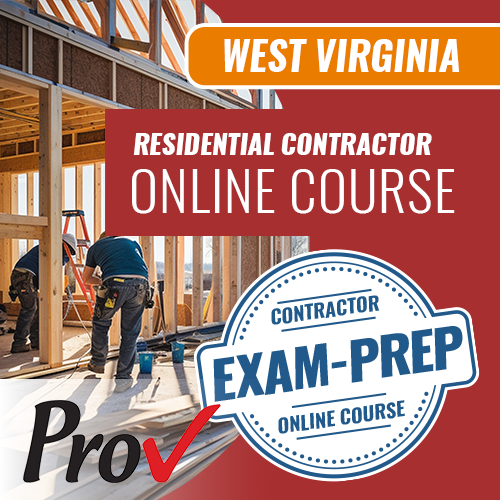
West Virginia Residential Contractor Exam Prep
This West Virginia-specific 1 Exam Prep image directly matches the Residential Contractor exam-preparation topic.
• West Virginia Residential Contractor classification
• Prov-administered testing
• 60-question trade examination
• 3-hour testing period
• 70% passing score
• Open-book preparation
• Plan Reading
• Sitework, Concrete, and Masonry
• Carpentry
• Interior and Exterior Finish
• OSHA Safety
Residential exam prep rewards organized builders. Know the construction sequence, know the reference, and know how to move from a plan detail to a code table without turning three books into a paper avalanche.
Frequently Asked Questions
West Virginia Residential Licensing
The West Virginia Contractor Licensing Board oversees contractor licensing, with administrative and enforcement assistance from the Division of Labor.
The current West Virginia contractor examinations are administered through Prov.
The classification covers construction, repair, or improvement of real property used or intended for residential occupancy, including work incidental to that construction or repair.
No. West Virginia specifically excludes crafts that require separate licensure under another state law or local ordinance.
Residential Trade Exam
The May 7, 2026 Contractor Licensing Board bulletin lists 60 questions.
Candidates currently receive three hours.
Current Prov contractor exams are graded against a 70 percent cut score.
Yes. The current Prov bulletin describes the contractor examinations as open book using authorized references.
Exam Topics
Carpentry is the largest published category with 15 questions.
The current outline lists 9 Plan Reading questions.
The current outline lists 9 Concrete questions.
The current outline lists 9 Masonry questions.
Yes. Safety-OSHA contains 6 questions.
References and Open-Book Rules
The May 7, 2026 bulletin lists the 2018 International Residential Code.
The current bulletin lists Masonry and Sitework for the Residential Contractor, 2nd Edition.
The current bulletin lists Study Guide for Residential Carpentry and Repair, 2nd Edition, 2014.
Yes. Prov permits permanent tabs in authorized references.
No. Prov does not permit moveable tabs or Post-it notes.
No. Handwritten notes are not allowed in exam references.
No. Prov states that test-preparation study guides and practice exams are not approved references inside the testing room.
Contractor Licensing Act
Yes. West Virginia requires contractor applicants to pass the Contractor Licensing Act exam in addition to applicable trade examinations.
The current bulletin lists 90 questions.
Candidates currently receive three hours.
It covers West Virginia contractor licensing law, Board rules, written contract requirements, and residential construction-defect notice and opportunity-to-cure procedures.
Residential Scope
Yes. The classification covers construction of residential real property as well as repair and improvement work.
Yes. Repair and improvement of residential property are part of the classification scope.
No. Work requiring a separate electrical license or other separate credential remains subject to that licensing law.
1 Exam Prep
Yes. 1 Exam Prep offers a West Virginia Residential Contractor Online Exam Prep Course for the Prov examination.
Yes. 1 Exam Prep offers a highlighted and tabbed Residential Contractor book package using the three listed references.
Yes. 1 Exam Prep offers West Virginia Residential Contractor pre-printed tabs.
Yes. 1 Exam Prep offers Residential Contractor rental packages that combine prepared books with trade and business exam preparation options.
Watch: How to Pass the West Virginia Residential Contractor License Exam
This topic-specific 1 Exam Prep video is embedded from the West Virginia Residential Contractor product page. Use it to reinforce open-book study strategy, reference navigation, residential construction review, and exam organization.
Residential study tip: use the video for strategy, then build timed practice around Carpentry, Plan Reading, Concrete, Masonry, Sitework, Finishes, and Safety. The largest four categories make up 70% of the current trade exam.
West Virginia Residential Contractor Exam Prep Resources
Combine current West Virginia Contractor Licensing Board and Prov information with 1 Exam Prep courses, books, highlighted references, tabs, rental packages, and Contractor Licensing Act preparation.
West Virginia Residential Contractor Online Course West Virginia Residential Contractor Collection West Virginia Residential Contractor Book Package Highlighted and Tabbed Residential Books West Virginia Residential Pre-Printed Tabs West Virginia Residential Rental Package West Virginia Residential Ultimate Rental Package Contractor Licensing Act Online Course How to Pass the West Virginia Residential Contractor Exam West Virginia Contractor Licensing Board Prov Testing Current WV Contractor Candidate Bulletin Contact 1 Exam Prep
Final verification rule: use the newest West Virginia Contractor Licensing Board / Prov bulletin for question counts, time, passing score, exam fees, reference editions, book preparation rules, and testing procedures. Use the Board's current application materials for final contractor licensing requirements.
Ready for West Virginia Residential Contractor Exam Prep?
Build stronger plan-reading skills, faster residential-code navigation, better carpentry knowledge, confidence with concrete, masonry, sitework, interior and exterior finishes, and OSHA safety, plus a clear study plan for the separate West Virginia Contractor Licensing Act examination.
Questions? Call 877-775-9400
or email sales@1examprep.com
West Virginia Residential Contractor Exam Prep
- Al elegir una selección, se actualiza la página completa.
- Se abre en una nueva ventana.