


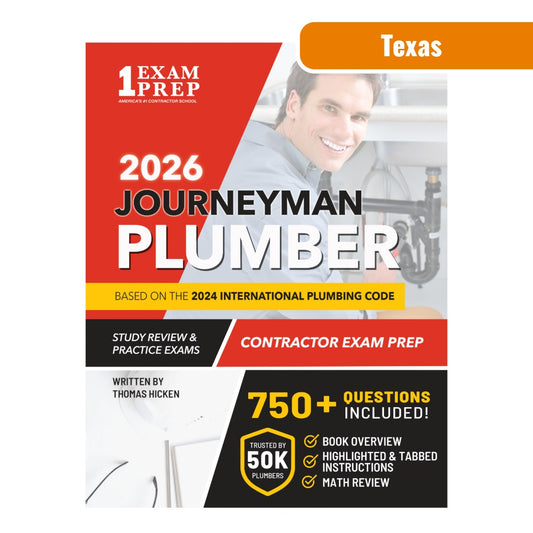


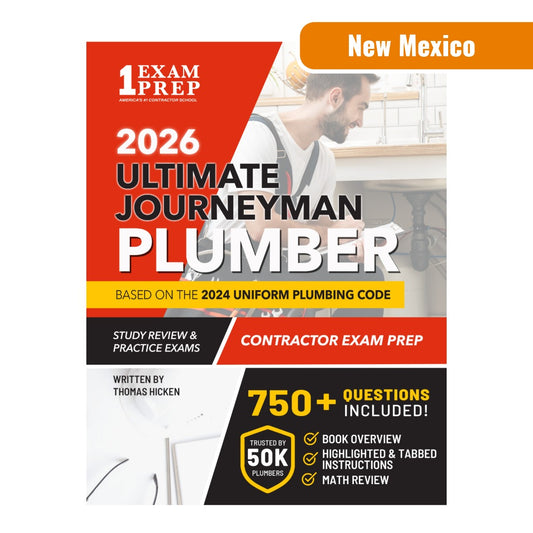




2026 Journeyman Plumber Exam Prep: Study Guides, Online Courses, and Codebook Packages
Working toward a journeyman plumber credential in 2026? You already know plumbing takes more than tightening fittings and hoping for the best. Licensing exams can ask about code requirements, drainage and venting, water supply, fixture connections, isometric drawings, and trade math. Even a skilled worker can lose time on an exam if the questions use unfamiliar wording or require looking up a rule quickly.
The 2026 Journeyman Plumber collection at 1 Exam Prep brings together state-focused study guides, online courses, and larger book-and-course packages. The useful part is having choices. Some candidates want a compact workbook; others need videos, timed exam practice, printed codes, tabs, and flash cards. The right option depends on your exam, not on how many books fit in the box.
In this guide, we will compare those options, explain the difference between the IPC and UPC, review common plumbing subjects, and build a realistic study schedule. One important detail comes first: a product labeled “2026” may be based on the 2024 plumbing code. That can be appropriate for some exams, but you must confirm your own jurisdiction’s required code and edition before you study or buy.
What a Journeyman Plumber License Means in 2026
Journeyman status generally marks a stage of professional experience and competency beyond beginner training, but it does not mean the same thing in every state. Some places license individual plumbers through a statewide board. Others rely on local authorities, different titles, registration systems, or additional practical testing. Experience, training hours, supervision, and application paperwork may all affect eligibility.
Your first job is to identify the actual credential you need. Write down the issuing authority, official examination title, reference list, exam provider, and application requirements. Then compare those details with the product you are considering. A guide intended for one state may be helpful for general learning, but it cannot automatically substitute for another state’s official materials.
Keep a folder for your experience records, important dates, and candidate bulletin. This may seem less exciting than reviewing pipe sizes, but licensing involves administrative steps too. A well-organized application is part of a well-organized study plan, and neither should be left for the night before a deadline.
Understand the 2024 IPC and 2024 UPC Before Choosing a 2026 Guide
Two familiar plumbing code families are the International Plumbing Code, or IPC, and the Uniform Plumbing Code, or UPC. Both address important topics such as water distribution, drainage, vents, fixtures, and safe plumbing practices. However, they are different documents. Their layout, terminology, sizing approaches, and detailed requirements can vary, especially once local amendments are involved.
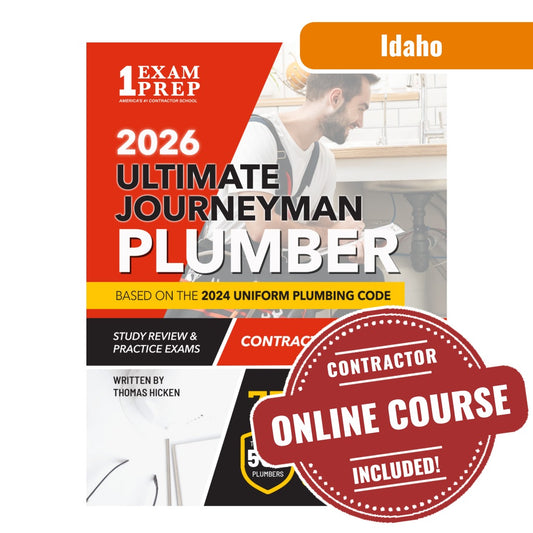
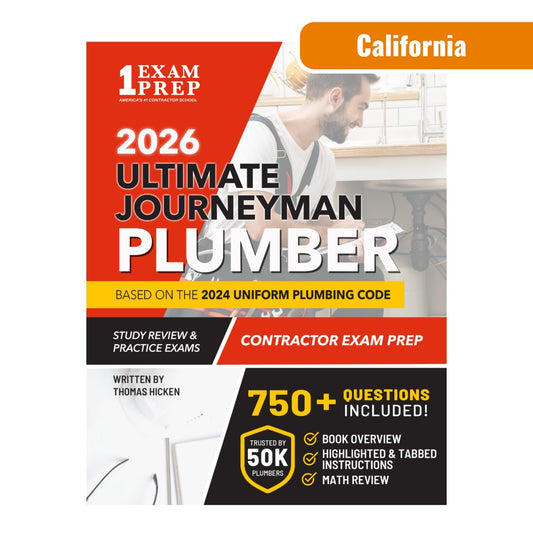
The 2026 collection includes resources based on the 2024 IPC as well as resources based on the 2024 UPC. For example, the 2026 Indiana Journeyman Plumber Study Guide & Online Course is identified as IPC-based, while the 2026 California Journeyman Plumber Study Guide & Online Course is listed as UPC-based.
Those product labels describe the study materials, not a guarantee that every local testing program uses those exact editions. Always compare the publication and exam outline with your testing provider’s current instructions. Treat the code edition like the correct fitting size: close is not automatically good enough.
2026 Journeyman Plumber Study Guides for Independent Learners
A focused study guide can be the right starting point when you already understand much of the field work and want a structured way to review. A useful guide divides the material into manageable topics, offers practice questions, and explains why an answer is correct. That last feature matters. Remembering the letter “C” will not help when the exam asks the same idea in a different way.
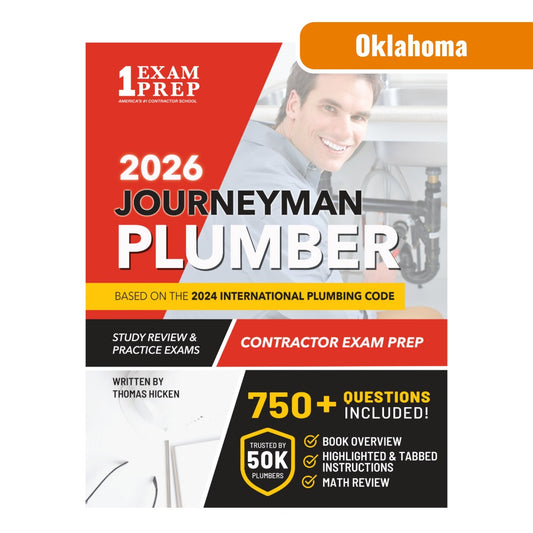
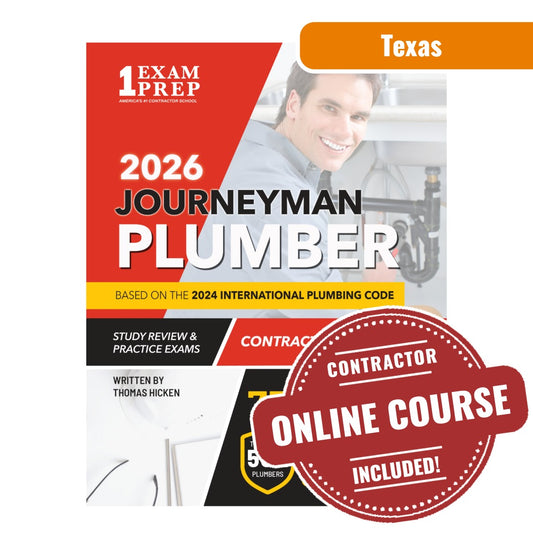
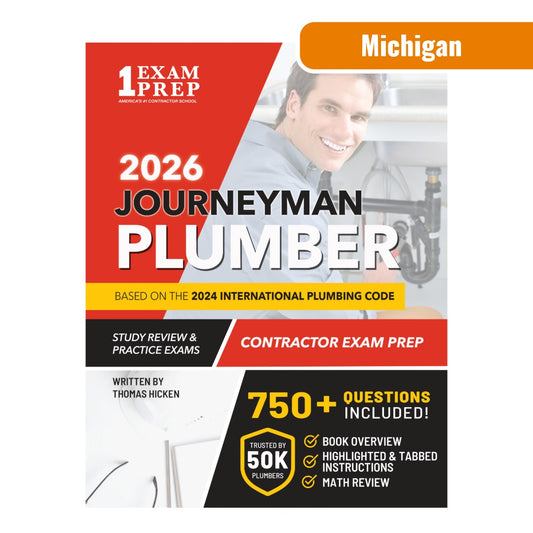
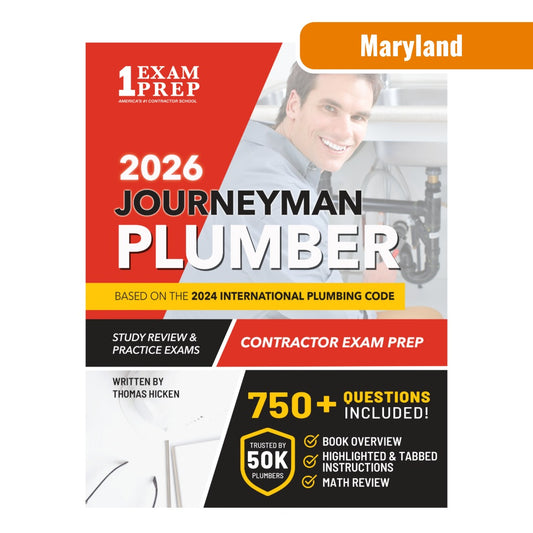
The 2026 Oklahoma Journeyman Plumber Study Guide is one example of an IPC-based workbook option. The 2026 Maryland Journeyman Plumber Study Guide offers another state-labeled study path. Review each listing for its included topics and confirm the state, code edition, and testing details before purchase.
Use your workbook actively. Complete a few questions without checking the answer key, then locate the governing code language or explanation. Mark weak subjects for another session. A guide works best when it becomes a series of small decisions you practice, not a stack of pages you intend to read someday.
Study Guide and Online Course Combos
If you learn well from explanations and examples, pairing a printed or downloadable guide with a course may give you more ways to understand a difficult topic. A video can demonstrate an isometric drawing or a calculation, while the guide lets you slow down and work the same kind of problem yourself. That combination is especially handy after a long day at the jobsite, when dense code text may feel like bedtime reading.
The 2026 Nevada Journeyman Plumber Study Guide & Online Course advertises guided video lessons, practice questions, and simulated computer-based review. The Indiana combo lists eight or more hours of training, plumbing-code walkthroughs, and isometric drawing lessons. Product features and access terms can change, so review the individual listings.
During each lesson, pause before the instructor explains a problem. Attempt the answer, write down your reasoning, and then compare your result. Watching someone else solve an equation can feel easy. Solving it alone is what proves you understand it.
Complete Books, Tabs, Flash Cards, and Course Packages
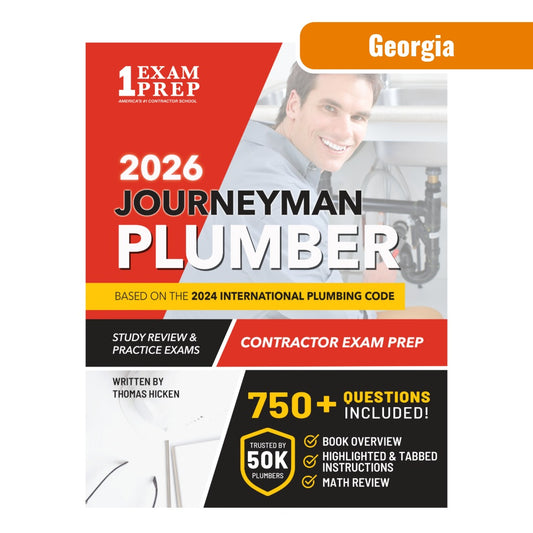
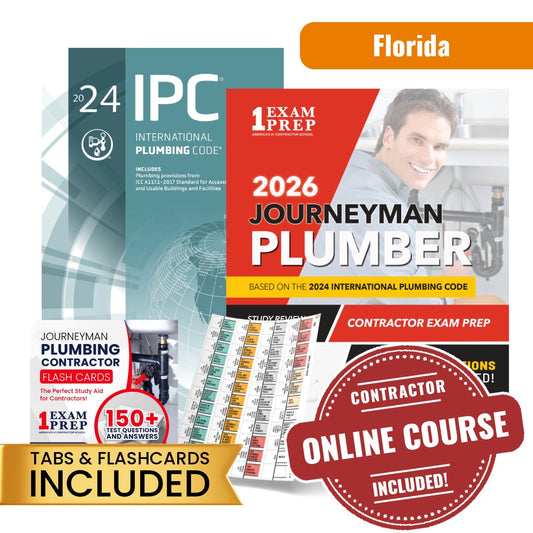
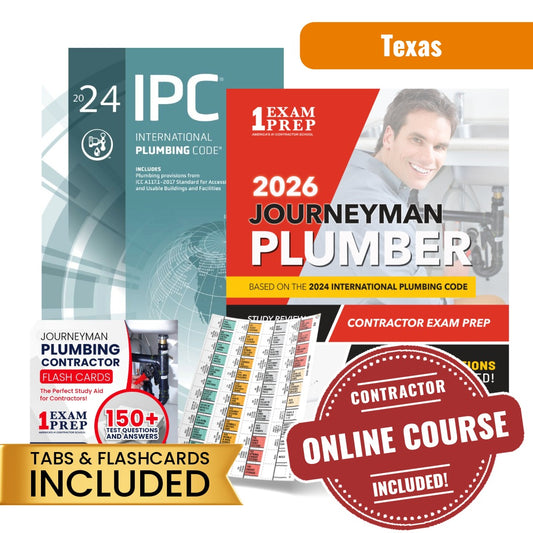
Some candidates want a bigger set of resources in one purchase. The 2026 Georgia Journeyman Plumber Complete Books, Tabs & Course Package includes an IPC reference, quick-reference tabs, a study guide, flash cards, and course-related support according to its listing. The 2026 North Carolina Journeyman Plumber Complete Books, Tabs & Course Package is another comprehensive option based on the 2024 IPC.
The advantage of a complete package is that each resource can serve a separate purpose. Codebooks help you find the actual requirements. Study guides provide structured explanations. Tabs support navigation during practice. Flash cards help with definitions, formulas, and frequently confused terms. Online questions help with speed, accuracy, and time pressure.
A larger bundle is not automatically a better value for everyone. Check whether you need the included reference, whether you already own some components, and whether your exam allows marked books. Choose the package for the work it helps you do, not simply because the title sounds impressive.
What Plumbing Code Tabs Can and Cannot Do
Tabs can make a thick codebook less intimidating. By marking major chapters and frequently used locations, they help you build a mental map of the book. That can reduce the number of pages you flip during a timed open-book practice exam. They can also help you learn where fixtures, venting, drainage, and water supply topics are organized.
Tabs do not replace the index, definitions, exceptions, and tables. You still need to read the entire applicable rule. A question might sound straightforward until the last sentence mentions an exception. Getting fast at finding the wrong paragraph is not a useful exam skill.
Exam centers may limit book tabs, handwritten notes, highlighting, loose sheets, or even which codebooks may enter the room. Some exams are closed-book. Use any prepared book as a study aid unless the current test-provider instructions specifically approve it for testing. Never assume a product described as “tabbed” is automatically allowed at your particular testing site.
Drainage, Waste, and Venting Topics
Drainage, waste, and vent systems are important because they have to work together. A successful installation must move wastewater as intended while protecting trap seals and maintaining proper ventilation. During review, practice identifying fixture connections, trap requirements, cleanouts, offsets, allowable methods, and the relationships among pipe size, slope, and vent arrangements.
Do not study these subjects as isolated vocabulary words. Draw a simple layout, label the fixtures, and follow the water from the fixture to the building drain. Then trace the vents and ask what the system is trying to prevent. A drawing can turn several pages of technical language into a picture that makes sense.
For code questions, first determine what information is given, then identify the right table or section. If you are using practice problems, check why each incorrect choice fails. This habit trains you to spot small but important details instead of relying on what seems familiar from the last installation you worked on.
Water Supply, Backflow Prevention, and Fixtures
Water distribution subjects may include material selection, pressure control, water-supply sizing, valves, fixture connections, and the protection of potable water. Backflow and cross-connection questions often test whether you understand the hazard being controlled, not just the name of a device. Water heaters and temperature-related safety may appear as well, depending on the examination.
Build a study sheet that connects each subject with an everyday example. For pressure, picture an upper-floor fixture that is not receiving enough flow. For protection of drinking water, think about how a nonpotable connection could contaminate the supply. For water heaters, review why placement, relief devices, and associated piping deserve careful attention.
Practice applying the correct code requirements rather than memorizing a number without context. Codes and local rules vary, and an answer based on the wrong edition can be wrong even when the arithmetic is perfect. Keep your chosen reference nearby during study and verify that your notes match the book named by your exam authority.
Plumbing Math and Isometric Drawings
Trade math is easier when you practice a little at a time. Common skills include working with fractions and decimals, unit conversions, pipe lengths, offsets, slope, percentages, and basic dimensional reasoning. You may also need to interpret an isometric drawing, identify fittings, or translate a flat plan into a three-dimensional piping system.
Begin with problems you can solve accurately without a timer. Write each step and include units. Next, try similar questions with a reasonable time limit. If you make an error, decide whether the problem came from the formula, the conversion, the diagram, or simply rushing. Each error has a different fix.
For isometric practice, sketch simple branches before complicated networks. Label flow direction and connection points. Repeated drawing builds a useful visual language. You do not need to become a famous artist. You only need to understand what the piping does when it turns that corner.
Workplace Safety and Practical Installation Judgment
Safety topics can include excavation awareness, ladder use, personal protective equipment, hazardous conditions, tool safety, and work around existing utilities. The exact exam outline will determine which subjects are tested. Treat safety as a decision-making skill instead of a final chapter to skim when you run out of time.
Ask what the hazard is, who is exposed, and which control fits the situation. Work through examples involving confined areas, tools, lifting, and unfamiliar conditions. A strong answer should connect the hazard with an appropriate prevention method and current requirements, not just a rule you remember hearing on a jobsite.
Plumbing professionals also need to notice when a plan and the actual field conditions do not agree. Learning to read the scope, communicate problems, and check instructions can prevent costly mistakes. Exam preparation should strengthen that judgment. Good safety thinking is useful long after the score report has been filed away.
How to Use Practice Questions and Simulated Exams
Practice questions are valuable when they reveal what you do not yet know. Start with topic-based sets covering drainage, vents, water distribution, fixtures, code navigation, and math. Review every wrong answer, then write a short note explaining the correct principle. If the product includes a larger question bank, resist the urge to speed through it just to see a high completion number.
After your topic knowledge improves, schedule timed simulations. Create exam-like conditions: put your phone away, use only permitted reference materials for the practice format, and track the time. Review questions that took too long even when you answered them correctly. A slow correct answer can still become a problem under exam pressure.
Practice tests are not the actual licensing exam, and no question bank can guarantee what appears on test day. The real benefit is building a process: read, identify the issue, apply the rule, check the answer, and move on. That is a skill you can practice repeatedly.
A Six-Week Journeyman Plumber Study Schedule
A simple calendar can turn a vague goal into steady progress. Adapt this plan to your exam date, work schedule, and official subject list. If you need more time, spread the same stages over additional weeks. Consistency matters more than completing every task on a heroic schedule.
- Week 1: Verify your exam details, obtain the correct code edition, learn the book layout, and complete a baseline quiz.
- Week 2: Review drainage, waste, venting, and trap topics with drawings and code lookups.
- Week 3: Study water distribution, fixtures, water heaters, and protection of potable water.
- Week 4: Work on plumbing math, isometrics, installation judgment, and required safety topics.
- Week 5: Combine topic reviews with timed practice exams and an error log.
- Week 6: Repeat your weakest areas, confirm test-center rules, and prepare your documents and travel plan.
Try a short study block on busy days and a longer session when your schedule allows. A plan you can follow is more useful than an ambitious one that lasts until Tuesday.
Exam-Day References, Eligibility, and Application Details
Before you arrive at the test center, read the latest candidate handbook. Check the exact exam name, application status, identification requirements, approved calculators, allowable references, and the rules for any notes or tabs. Do not assume an exam is open-book because a prep package contains a codebook. The testing authority makes that decision.
Also verify your experience, apprenticeship, and other qualification requirements with the licensing office. A passing examination score may be only one part of getting your credential. Some jurisdictions require additional forms, fees, background steps, or other approval before you can legally work under a new license title.
Keep your exam preparation and application preparation on separate checklists. This avoids the frustrating situation of knowing the plumbing answers but missing an administrative deadline. When in doubt, contact the regulator or testing provider and ask for written clarification. That small step is usually cheaper than booking the wrong examination.
Choosing the Right 2026 Journeyman Plumber Package
The best study option is the one that matches the actual examination and the way you learn. Choose a study guide if you want an affordable structure for independent review. Consider a guide-and-course combo if you benefit from videos, demonstrations, and guided practice. Explore a complete books-and-tabs package if your preparation genuinely calls for a full reference set.
Compare the 2026 Journeyman Plumber collection by state, edition, inclusions, and access terms. Read the product description carefully and check whether any listed book or course is suitable for your actual test. Do not mix a UPC-focused exam with an IPC-focused package without verifying the difference. And remember that some licensing requirements are local even when the product has a state name.
Once you pick a resource, put it to work. Study regularly, review mistakes, and practice applying the code. A well-used small workbook can do far more for your preparation than an impressive bundle that stays unopened on your desk.
Final Prep Checklist: Know Your Code, Practice Your Process
Finishing the last chapter does not mean preparation is complete. You should be able to explain key ideas in your own words, read piping diagrams, perform routine calculations without guessing, and handle timed questions with a sensible plan. You should also know which subjects deserve one more review instead of repeating only the material you enjoy.
Use a short checklist during the final days: official exam name confirmed, reference edition checked, testing rules reviewed, identification ready, application records organized, and weak topics revisited. If you have an approved reference-book exam, practice locating information calmly. If it is closed-book, emphasize recall and application under realistic timing.
Journeyman preparation does not need to be dramatic. It needs to be steady, accurate, and matched to your licensing authority. Keep your focus on the right code, solid trade reasoning, and a repeatable study process. Those habits make you a stronger exam candidate and a more careful plumbing professional.
Frequently Asked Questions
Explore common questions about the right exam, study materials, reference editions, and testing rules. Select a question to see its answer.
Conclusion: Plan Your Next Exam With Confidence
Preparing for a journeyman plumber examination in 2026 begins with an important question: which examination are you actually taking? Different licensing authorities use different code families, code editions, eligibility rules, and testing procedures. The right answer changes what you need to study and which package will be useful. A product with “2026” in its title may be based on the 2024 IPC or the 2024 UPC. That does not make the product wrong, but it does mean you should compare it with your official candidate bulletin. Taking a few minutes to confirm the reference list can prevent weeks of practicing from the wrong source.
Once the exam details are clear, build your preparation around the topics that appear on the outline. Drainage and venting, water distribution, fixtures, water heaters, backflow prevention, plumbing math, isometric drawings, and safety are familiar subjects, but every test has its own emphasis. Treat code reading as a practical skill. Instead of reading a paragraph and moving on, connect the requirement with an example. Sketch a small piping layout, work a calculation, or ask what hazard a rule helps prevent. A clear explanation in your own words is often a stronger sign of learning than recognizing the answer on a page.
The 2026 Journeyman Plumber collection offers several ways to organize this work. A focused study guide may be enough for someone who likes independent learning and already has solid experience. A guide plus online course may work better for learners who want to see demonstrations or revisit difficult subjects. A complete books, tabs, and course package can combine reference navigation, practice questions, flash cards, and lessons. Before paying for a larger bundle, review its included code edition, book ownership or access terms, course length, and suitability for your exam. No bundle can replace the licensing authority's eligibility requirements or guarantee a passing result.
Practice is where the different tools become useful. Work small sets of questions after each subject. When you make a mistake, identify whether you misunderstood the wording, chose the wrong code section, made a calculation error, or rushed through the problem. Keep an error log and revisit those points regularly. Then add timed simulations so the test format feels more familiar. If your exam is open book, practice navigating only the references permitted by your testing provider. If it is closed book, strengthen recall and application. Do not assume a tabbed book can enter the exam room just because it helped during preparation.
Finally, leave room for the ordinary details of exam day. Confirm the appointment, identification, calculator rules, application status, testing address, and permitted materials. Organize your experience records and any remaining licensing steps separately from your study checklist. The goal is not to turn exam preparation into a full-time second job. The goal is to use your limited study hours effectively, build stronger plumbing judgment, and approach each question with a reliable method. Explore the 2026 Journeyman Plumber study options, match the materials to your exam, and keep your practice steady. The result is preparation based on understanding rather than guesswork.
Key Takeaways
- Confirm your license authority, exam name, testing rules, and correct IPC or UPC edition before purchasing a 2026 study package.
- Choose a workbook, online course, or complete books-and-tabs bundle based on what your specific exam and learning style require.
- Study drainage, venting, water supply, fixtures, plumbing math, isometric drawings, and safety using the official exam outline.
- Review missed practice questions carefully and add timed simulations once your topic knowledge becomes stronger.
- Check experience requirements, exam-day identification, calculators, and reference-book restrictions separately from your study plan.
Plain-Language Summary
Journeyman plumber exam preparation can become confusing when every state and product seems to use a slightly different name. The first thing to know is that a journeyman license does not have one universal set of rules. An authority may require experience, education, an application, an examination, or other steps. Before buying a study guide, check the exact license you want and who issues it. Find the current exam outline and approved reference list. Those documents tell you what to study and help you avoid buying materials for the wrong test.
There is also a difference between a product's year and its code edition. The 2026 Journeyman Plumber collection includes study products based on the 2024 International Plumbing Code and products based on the 2024 Uniform Plumbing Code. The two books cover many similar plumbing topics, but they are not interchangeable. Rules and organization may differ. Your local testing authority can also have amendments. Make sure the study book matches the specific reference identified in your candidate handbook.
You have several ways to prepare. A basic study guide may provide practice questions, explanations, and an organized path through the topics. A study guide with an online course can add lessons, demonstrations, and exam-style practice. A larger package may include a codebook, tabs, flash cards, printed study materials, and course access. The right choice depends on how you learn, what you already own, and what the exam requires. Bigger does not always mean better. A small study guide that you actually use can be worth more than a large box that remains unopened.
Important topics often include drainage, vents, traps, water supply, fixtures, water heaters, safety, plumbing math, and isometric drawings. Do not just memorize the names. Practice following a drain layout, understanding what a vent does, choosing the correct code section, and completing a calculation step by step. When you answer a practice question incorrectly, read the explanation and find the reason. Make a short list of your weak topics so you know where to spend your next study session.
A six-week plan is one easy way to organize your time. Begin by confirming the exam and learning the codebook. Move to drainage and venting, then water supply and fixtures. Add math, drawing interpretation, and safety. Finish with timed practice tests and review. You can make the schedule longer if you need more time. Consistency matters more than a perfect calendar. Even a short session after work can help when you know exactly what you want to practice.
Before test day, check whether your exam is open book or closed book and which materials are allowed. Tabs, highlighting, and calculators may be restricted. Confirm your identification, appointment, and application requirements. Finally, compare the 2026 Journeyman Plumber collection with the current official exam notice. Choose matching resources, practice carefully, and use the mistakes you make while studying to become better prepared for the examination.
Keep your records in one place and check the rules again before booking. A test preparation plan is most useful when it matches both the technical subjects and the steps required to receive a credential.