


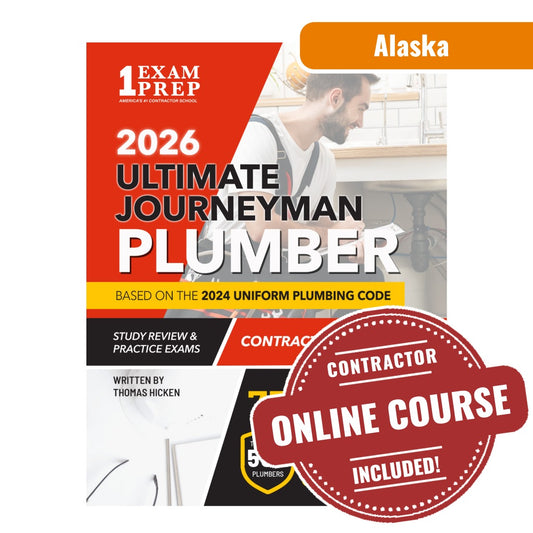

Alaska Journeyman Plumber Exam Prep: Certificate of Fitness, Codebooks, and Study Plan
Alaska journeyman plumbers work with systems people depend on every day, often in demanding environments. The licensing exam asks candidates to turn field experience into clear code-based decisions. The state uses a journeyman plumber Certificate of Fitness, not just a store-bought course certificate. This guide explains the experience and application path, major plumbing study subjects, and how to choose suitable reference books without confusing an advertised book edition with the exam's official rules. Start with the Alaska Journeyman Plumber collection to compare the current products with the requirements that apply to you.
Important Details to Check First
Alaska's Mechanical Inspection program lists 8,000 qualifying hours for Plumber Journeyman, an examination with a 70% passing score, and separate application and certificate fees. Experience exclusions and maximum substitutions matter. Verify the current state rules and approved testing references before acting.
Know what Alaska calls the credential
Alaska's Department of Labor and Workforce Development issues a Plumber Journeyman Certificate of Fitness through its Mechanical Inspection program. This is a worker credential connected with qualifying plumbing activities, not the same thing as registering a contracting company. Getting the terminology right helps you find the correct application and keeps your study materials focused on the proper exam.
Write 'Plumber Journeyman COF' on your exam plan and keep the state's official license requirements page bookmarked. If someone asks for your contractor license, clarify whether they mean your personal trade credential or a separate business authorization.
Watch out: Do not assume that passing the plumbing exam alone registers a company, supplies insurance, or grants every other professional credential.
Verify 8,000 qualifying experience hours
Alaska lists 8,000 hours of legally obtained commercial and residential plumbing installation work for the standard journeyman route. Not every hour spent near a plumbing system qualifies. The program explains limits for certain gas, utility, classroom, military, and vocational credit, and it excludes maintenance hours. The rules also address work done with a proper trainee certificate in Alaska.
Gather work dates, employers, supervisors, and descriptions of actual installation tasks. Compare them with the state's Experience Verification Form and request documentation early. This step should happen before you spend weeks preparing for an exam date you are not yet eligible to receive.
Watch out: Do not round up hours or assume work performed without the required trainee authorization will be accepted.
Understand trainee status and supervision
Workers developing toward journeyman status generally need to follow Alaska's trainee and apprenticeship procedures. A valid trainee Certificate of Fitness and qualifying supervised work are important parts of the experience record. The state publishes guidance about registration, employer sponsorship, and the types of work that may count. Paperwork that seemed minor at the start can become important when an application is reviewed years later.
Keep copies of trainee credentials, apprenticeship records, and periodic employer verifications. Make an annual habit of asking whether your current registration and supervision arrangements meet state requirements. A clear folder is easier to fix than missing records from an old job.
Watch out: Never treat a study-course receipt as authorization to perform work requiring a state trade credential.
Prepare the application before the exam
The state lists an application packet with experience verification and fees. After review, qualified candidates are scheduled for the examination under Alaska's process. On the current Mechanical Inspection page, the nonrefundable application charge and the later certificate issuance charge are different steps. Costs and procedures can be revised, so check them directly when applying.
Build a checklist for the application, experience forms, identity information, supporting documents, and state communications. Write down the contact office and save each confirmation. If a form is unclear, ask Mechanical Inspection rather than guessing what a missing signature means.
Watch out: Receiving an exam-prep course does not automatically submit your state application or guarantee approval.
Choose the correct plumbing code edition
Plumbing exams rely on code provisions, tables, and exceptions. Some current retail Alaska study products advertise material based on the 2024 Uniform Plumbing Code. That is useful information about the product, not proof of the official examination reference list. State-adopted codes and exam references can change at a different pace from new books on the market.
Before ordering a Uniform Plumbing Code book, compare the edition stated by the seller with the instructions issued by Alaska's Mechanical Inspection exam program. Record whether books, tabs, notes, calculators, or other tools are permitted. Use the exact documents for your scheduled sitting.
Watch out: An attractive 'latest edition' label should never be treated as a substitute for an official exam bulletin.
Understand drainage and waste system design
Sanitary drainage questions can involve pipe sizing, slope, fixture discharge, fitting use, cleanouts, and the way drains connect to building systems. Knowing a rule is not enough if you cannot find its table or identify which facts in the question matter. A drawing may look simple until a branch, fixture, or change in direction alters the requirements.
Sketch a small residential drainage layout. Label fixture connections, pipe sizes for discussion, cleanouts, and the direction of flow. Then find the corresponding requirements in your approved codebook. Repeat with a commercial-style example to broaden your practice.
Watch out: Do not use a study sketch as an engineered design or installation instruction for a real building.
Practice venting and trap protection
Vent systems protect drainage performance and help safeguard trap seals. Exam problems may ask you to recognize which configurations and distances the code permits. Terms such as wet vent, individual vent, branch vent, and trap arm should become familiar in a practical context. Many mistakes happen when a reader remembers one rule but ignores the exact fixture arrangement shown.
Draw three simplified vent layouts and explain the purpose of each component. Look up the applicable sizing and distance rules rather than memorizing a number without conditions. Use practice questions to train yourself to identify the fixture type and arrangement first.
Watch out: Code exceptions may be important; do not carry a measurement from one plumbing layout into an unrelated one.
Review potable water distribution
Water supply work includes sizing, pressure considerations, materials, protection against contamination, and service of plumbing fixtures. A licensing exam may present a short situation and ask which condition matters most. For example, a plumbing system can have a large supply pipe and still suffer poor performance if pressure or demand has been misunderstood.
Build a sample fixture schedule and identify the facts needed for a sizing exercise. Practice locating the right table and units in your approved reference. For each answer, describe how the code requirement protects the building occupants.
Watch out: Do not guess pipe sizing from familiar residential habits when the problem specifies a different building or demand.
Know backflow and cross-connection basics
Protecting potable water from contamination is a core responsibility. Backflow, cross-connections, air gaps, and protective devices may appear in code interpretation questions. The challenge is to recognize what can connect a safe supply to a source of contamination, then identify the appropriate prevention approach in the applicable rules.
List real examples from everyday work, such as hose connections and equipment supply lines. For each, describe how unwanted reverse flow might happen and where you would find the approved protection method. Turn these into short scenario questions.
Watch out: Do not confuse knowing the terminology with holding a separate backflow-testing credential where one is required.
Study fixtures, accessibility, and installation details
Fixture requirements can involve placement, clearances, counts, water consumption, and connections. Commercial and residential questions may use different building conditions. An exam candidate should not rush to a table before identifying the fixture, occupancy, or special condition described. Clearances and installation details matter because a code-compliant pipe hidden behind a wall is only part of a safe system.
Choose a bathroom plan and mark the information you need to check: fixtures, access, supply, drainage, and venting. Use the approved code to verify each part. Practice explaining why one detail matters instead of collecting isolated numbers.
Watch out: Accessibility and building-code rules may involve documents beyond the plumbing reference alone.
Review water heaters and protective devices
Water-heating systems bring together plumbing, pressure, temperature, venting or energy source rules, and safe installation practices. A question might focus on a device, location, drain, or clearance. The useful habit is to identify the hazard first and then look for the provision that addresses it. That approach is less error-prone than relying on memory of one brand of equipment.
Make a labelled drawing of a typical water-heating arrangement for studying. Identify where you would verify the relief, discharge, and connection requirements. Compare gas and electric examples at a conceptual level.
Watch out: Equipment-specific instructions and gas or electrical work may have additional requirements beyond the journeyman plumbing exam.
Know where gas and utility work fit
Alaska lists separate restricted Plumber Gas and Plumber Utility certificates, while also allowing certain hours from those work categories toward journeyman experience within stated limits. That distinction matters. A resume saying 'plumber' does not tell an examiner exactly which work hours qualify or what credential applies. Read the description of each certificate instead of treating the names as synonyms.
Sort your experience log into commercial/residential installation, gas, utility, classroom, and any other allowable categories. Compare the totals with the state limits. If you have unusual experience, ask Mechanical Inspection how it should be documented.
Watch out: Do not assume that holding a restricted certificate grants the full journeyman scope or that all gas and utility hours count without limit.
Make calculations and tables a daily skill
Plumbing exam questions can combine measurement, unit conversion, fixture loading, sizing, and table lookup. A candidate may know what to do in the field but lose points by reading the wrong table heading or skipping a unit. Calm, repeatable calculations matter more than speed alone. They also help you catch an answer that does not make physical sense.
Study with a notepad and your approved code. Write the quantities given, the unknown, the relevant table, and the result. Work similar problems with different numbers until the method feels familiar. Then practice under a reasonable time limit.
Watch out: Only use calculators and reference materials that are allowed for the actual examination.
Build a code-navigation study system
A complete Alaska exam-prep package may combine a guide, course, books, and tabs, but the precise contents are product-specific. Start by identifying weak subjects in drainage, venting, water supply, fixtures, and code navigation. With an open-reference exam, every search still costs time; with a closed-reference format, knowing the code structure still improves understanding.
Spend several sessions doing timed lookups. Begin by identifying the likely chapter, then find the table or section and read its conditions. Record the location in a personal study log and return to it later without a hint.
Watch out: Do not assume the exam is open book or permits personalized tabs until the official instructions confirm that rule.
Know the passing score and renewal path
Alaska's published Plumber Journeyman requirements list a 70 percent exam passing score and a wait period after an unsuccessful attempt. The certificate has a two-year duration, with renewal and continuing education requirements described on the current state page. A good preparation plan includes both the first test and the professional duties that follow after it.
Confirm the current score, scheduling, fee, and renewal rules directly before submitting paperwork. After you pass, preserve the certificate information and start a renewal calendar. Keep continuing-education records in the same folder as your other licensing documents.
Watch out: Passing an exam does not remove the need to follow applicable codes, supervision rules, and continuing education obligations.
Relevant Products and Official Resources
Use these regular hyperlinks to review current product details and official guidance. Check the latest instructions and each listing before relying on an older edition, course description, or application form.
A Practical Action Checklist
- Identify the exact exam, training requirement, license classification, and responsible authority.
- Check current eligibility, candidate bulletins, reference editions, and permitted materials.
- Match courses, books, tabs, and service inclusions to the actual requirements.
- Schedule short study blocks and practice weak topics before a full mock exam.
- Keep an error log and review why wrong answers are wrong.
- Confirm identification, appointment rules, and the actions needed after completion.
A Seven-Day Study and Verification Plan
This plan is a starting point, not an official study schedule. Adjust it for your exam date, job duties, and the topics you find difficult. In particular, do the verification tasks before buying references or reserving a test.
- Day 1: Read Alaska's Mechanical Inspection requirements and list your qualifying installation hours, trainee status, and missing experience documents.
- Day 2: Check the state application packet, approved code edition, test instructions, fee steps, and correspondence from Mechanical Inspection.
- Day 3: Draw residential and commercial drainage examples. Find drainage sizing, fittings, slope, and cleanout rules in the correct reference.
- Day 4: Focus on vents, traps, and cross-connection protection. Solve questions that change fixture arrangements rather than only numbers.
- Day 5: Review water distribution, fixture requirements, water heating, and applicable calculations, always recording the governing table or section.
- Day 6: Complete a mixed timed practice set. Investigate every wrong answer and distinguish a code-navigation problem from a technical misunderstanding.
- Day 7: Organize identification, scheduling details, reference permissions, and post-exam steps. Make a renewal and continuing-education folder for later.
Repeat the weak days as needed. A steady routine and accurate reference list are far more useful than rushing through a package and discovering the wrong materials on exam day.
Frequently Asked Questions
Conclusion
Preparing for the Alaska journeyman plumber exam starts well before opening a study guide. The state wants qualified installation experience that is correctly documented, an approved application, and a passing examination. Those pieces belong together. A person might be excellent at diagnosing leaks but still need to verify whether particular past work counts toward the 8,000-hour requirement. Someone else may have complete experience records but need time to practice finding code tables quickly. The best plan respects both sides of the process: eligibility and exam knowledge.
Alaska's Department of Labor and Workforce Development issues a Plumber Journeyman Certificate of Fitness through its Mechanical Inspection program. Write 'Plumber Journeyman COF' on your exam plan and keep the state's official license requirements page bookmarked. Alaska lists 8,000 hours of legally obtained commercial and residential plumbing installation work for the standard journeyman route. Gather work dates, employers, supervisors, and descriptions of actual installation tasks. Looking at these subjects together helps you see how an early decision affects the work that follows.
Workers developing toward journeyman status generally need to follow Alaska's trainee and apprenticeship procedures. Keep copies of trainee credentials, apprenticeship records, and periodic employer verifications. The state lists an application packet with experience verification and fees. Build a checklist for the application, experience forms, identity information, supporting documents, and state communications. Looking at these subjects together helps you see how an early decision affects the work that follows.
Plumbing exams rely on code provisions, tables, and exceptions. Before ordering a Uniform Plumbing Code book, compare the edition stated by the seller with the instructions issued by Alaska's Mechanical Inspection exam program. Sanitary drainage questions can involve pipe sizing, slope, fixture discharge, fitting use, cleanouts, and the way drains connect to building systems. Sketch a small residential drainage layout. Looking at these subjects together helps you see how an early decision affects the work that follows.
The goal is not to memorize every line of a book connected with Alaska Journeyman Plumber. It is to understand which authority sets the rules, why a particular condition matters, and how to find reliable instructions when you need them. That approach makes preparation calmer and helps you recognize questions that change one important fact. Use your personal error log to revisit the subjects that have caused the most trouble, and compare each answer with the approved material. A few minutes spent correcting a repeated misunderstanding can be more useful than completing another large quiz without reviewing the results. Remember also to keep purchases, course enrollment, testing, and official authorization in separate columns on your checklist. A product may help you learn, while a licensing office or training authority makes the decision about the credential.
Vent systems protect drainage performance and help safeguard trap seals. Draw three simplified vent layouts and explain the purpose of each component.
Water supply work includes sizing, pressure considerations, materials, protection against contamination, and service of plumbing fixtures. Build a sample fixture schedule and identify the facts needed for a sizing exercise.
Key Takeaways
- Alaska issues a Plumber Journeyman Certificate of Fitness, not just a training certificate.
- Document 8,000 qualifying hours and review exclusions before applying.
- Use the correct official code edition and exam rules, even if a retailer advertises a newer book.
- Practice drainage, venting, water supply, fixtures, and timed code lookups.
- Plan for renewal and continuing education after passing.
Plain-Language Summary
If you want to become an Alaska journeyman plumber, begin with the state rules. Alaska issues a Certificate of Fitness for this trade. The standard route calls for 8,000 qualifying hours of plumbing installation work. Some training or related experience can count within limits, but maintenance time does not count under the stated rules. Keep your work records and ask the state for help when anything is unclear. Next, find the instructions for the exam and the right plumbing code reference. A book listed as new or updated is not always the edition allowed on your test.
Think about know what alaska calls the credential. Alaska's Department of Labor and Workforce Development issues a Plumber Journeyman Certificate of Fitness through its Mechanical Inspection program. Write 'Plumber Journeyman COF' on your exam plan and keep the state's official license requirements page bookmarked. Then consider verify 8,000 qualifying experience hours. Alaska lists 8,000 hours of legally obtained commercial and residential plumbing installation work for the standard journeyman route. Gather work dates, employers, supervisors, and descriptions of actual installation tasks.
Think about understand trainee status and supervision. Workers developing toward journeyman status generally need to follow Alaska's trainee and apprenticeship procedures. Keep copies of trainee credentials, apprenticeship records, and periodic employer verifications. Then consider prepare the application before the exam. The state lists an application packet with experience verification and fees. Build a checklist for the application, experience forms, identity information, supporting documents, and state communications.
Think about choose the correct plumbing code edition. Plumbing exams rely on code provisions, tables, and exceptions. Before ordering a Uniform Plumbing Code book, compare the edition stated by the seller with the instructions issued by Alaska's Mechanical Inspection exam program. Then consider understand drainage and waste system design. Sanitary drainage questions can involve pipe sizing, slope, fixture discharge, fitting use, cleanouts, and the way drains connect to building systems. Sketch a small residential drainage layout.
Think about practice venting and trap protection. Vent systems protect drainage performance and help safeguard trap seals. Draw three simplified vent layouts and explain the purpose of each component. Then consider review potable water distribution. Water supply work includes sizing, pressure considerations, materials, protection against contamination, and service of plumbing fixtures. Build a sample fixture schedule and identify the facts needed for a sizing exercise.
You do not need to learn everything in one evening. Keep your notes in one place, use the current official instructions, and practice a little at a time. Before buying a course or book, confirm the title, exam code, reference edition, and what is included. Before the appointment, check identification and testing rules. After completion, follow any remaining application or workplace requirements. Good preparation is a chain of small, accurate decisions rather than a race to finish a long reading list.
Protecting potable water from contamination is a core responsibility. List real examples from everyday work, such as hose connections and equipment supply lines.
Fixture requirements can involve placement, clearances, counts, water consumption, and connections. Choose a bathroom plan and mark the information you need to check: fixtures, access, supply, drainage, and venting.