



Iowa Journeyman Plumber Exam Prep: 2024 UPC, Licensing Steps, and Study Guide
Preparing for the Iowa journeyperson plumber examination takes more than memorizing the names of fittings. You need to connect real plumbing work with code rules, understand the licensing sequence, and know which references apply on your exam date. One incorrect book edition can turn a good study plan into a very expensive paperweight. This guide explains Iowa's application process, the 2024 Uniform Plumbing Code, practical study topics, and how to compare Iowa Journeyman Plumber preparation materials. It is written for apprentices, working plumbers, and anyone organizing their next step. Official board instructions and your individual exam approval letter always take priority over a store listing or an old online forum.
Important Details to Check First
Current rules matter: Iowa's Plumbing and Mechanical Systems Board, within the Department of Inspections, Appeals, and Licensing (DIAL), handles the journeyperson plumbing licensing path. Iowa has adopted the 2024 Uniform Plumbing Code with state amendments. The board uses Kirkwood Community College for approved examinations. Confirm the allowed reference list, current fees, and appointment instructions before testing.
Exam policies, state rules, fees, reference lists, and product inclusions may change. Verify current official instructions before ordering study materials or submitting an application.
Start with the Iowa licensing roadmap
Iowa separates permission to take the exam from receiving the journeyperson license. First, identify the plumbing discipline and verify that your training or experience qualifies you. Then apply for exam approval, follow the approval letter, schedule with the approved provider, and complete the post-examination licensing application after passing. That last step catches people by surprise. A passing score is good news, but it is not a license magically appearing in your mailbox.
Keep one folder for apprenticeship records, identification, correspondence, payment confirmations, scheduling information, and exam results. Read the Iowa examination instructions from start to finish. Make a checklist with separate boxes for approval, testing, and licensure. If you apply through a special experience pathway, collect its evidence early rather than discovering a missing affidavit on the night before a deadline.
Understand apprenticeship eligibility
The board's standard journeyperson path centers on a registered apprenticeship and qualifying practical experience. Its examination page discusses eligibility to sit after at least 36 months in a U.S. Department of Labor registered program, while the journeyperson license rules generally require four years of practical apprentice experience. Candidates may be eligible to test before completing the full apprenticeship credit. These are different milestones, not a contradiction you should solve by choosing whichever number sounds easier.
Ask your apprenticeship coordinator to verify documented hours and completion dates. If you are relying on qualifying experience from before January 1, 2010, review the board's separate historic-experience rules and affidavit requirements. Do not assume that an informal job history or a general contractor letter satisfies the registered-apprenticeship standard. For an unusual background, request guidance from DIAL before purchasing materials or booking an exam.
Know what a journeyperson is allowed to do
A journeyperson plumber is skilled and responsible, but Iowa still distinguishes that credential from a master license and a contractor business license. The state describes journeypersons as working under the supervision of a properly licensed master in their discipline. A journeyperson may supervise apprentices within defined conditions, yet cannot simply act as an independent licensed plumbing contractor because the exam is complete.
Make the distinction practical. If someone asks whether a person may bid and contract for a project, supervise an apprentice, or install a regulated system without a licensed business, identify which license and relationship the law requires. These questions also help you understand why code competence and business authority are not the same thing. The Iowa journey-level licensing page explains the supervised role in more detail.
Study the 2024 Uniform Plumbing Code
The 2024 Uniform Plumbing Code, as adopted and amended in Iowa, is the main code foundation to understand. Learn the table of contents, definitions, general regulations, materials, fixtures, water supply and distribution, sanitary drainage, venting, and inspection provisions. Rather than reading every page as if it were a mystery novel, use a topic map. Write down the chapters you reach most often when solving common plumbing problems.
Read the statewide amendments alongside the model code. An answer that is correct in the unmodified UPC can be incomplete in Iowa. Check the DIAL plumbing and mechanical licensing hub for current code information. If your practice materials were created for a prior UPC edition, compare the subjects, but verify every test-sensitive value, exception, and required installation method against the applicable edition.
Compare the Iowa-specific book package carefully
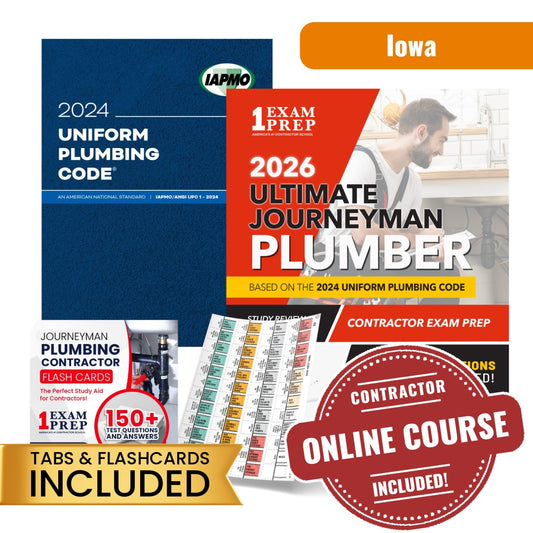
The store offers an Iowa Journeyman Plumber with Gas Book Package that lists the 2024 Uniform Plumbing Code and 2024 Iowa State Plumbing Code. That can make a useful starting point for a candidate whose approved exam covers those materials. The words 'with gas' deserve attention, however. Your exact discipline, testing content, and permitted references must match the examination you are actually approved to sit.
Before ordering, compare edition years, physical or online format, included tabs, practice-question access, shipping, and the seller's terms. Ask whether the package includes the amendments in a convenient form and whether any gas-specific content fits your exam. A product can be excellent for one candidate and still be the wrong package for another. Spending five minutes on the product description is much cheaper than returning books after you have already highlighted them.
Practice drain, waste, and vent reasoning
Drainage questions often combine several rules. You may need to understand fixture units, permissible pipe materials, size selection, slopes, cleanout access, and how branches join stacks or building drains. Vent questions add another layer: a system must keep traps properly protected while allowing the drainage piping to function. A drawing that looks tidy is not always a code-compliant design.
Turn each practice problem into a short plan. Identify the fixture or group, trace the piping, find the relevant sizing information, check distances and exceptions, and only then pick an answer. Sketch the system on scrap paper when studying. Label trap arms, vents, cleanouts, and changes of direction. A few carefully drawn examples will teach you more than rereading a definition and hoping it follows you into the exam room.
Master water supply and pressure concepts
Water distribution involves more than choosing a pipe that looks large enough. Study supply sizing, demand, pressure, allowable materials, shutoffs, fixture connections, backflow prevention, and protection of potable water. Remember that a system must be safe and dependable under realistic use, not merely capable of delivering one impressive burst from a faucet. Code tables and definitions work together in this subject area.
Practice questions should make you identify the problem before looking for a table. Is the issue insufficient capacity, an improper connection, contamination risk, or an installation requirement? Keep notes on where to locate each answer in the approved reference. Review how a pressure problem can affect fixtures and equipment. When memorizing a number, always connect it to the condition that makes the number relevant.
Treat backflow protection as a safety topic
Cross-connections can create serious public-health risks. For studying, understand the difference between keeping contaminants out of drinking-water systems and merely stopping water from moving backward. Familiarize yourself with common protection principles, device selection, air gaps, and why a hazard classification changes the answer. The exact approved method depends on the situation, the code, and the authority with jurisdiction.
Use examples from real jobs: an exterior hose connection, commercial equipment, a heating system, or a fixture with a special supply arrangement. Ask what could enter the water, what condition could drive a reversal, and what protection the code requires. Do not let the word 'check valve' become a one-size-fits-all answer. The proper solution depends on the use and the risk being controlled.
Review fixtures, traps, and water heaters
Fixtures and equipment questions test both basic installation knowledge and careful reading. Study trap seals, prohibited arrangements, fixture clearances, accessibility where applicable, water-heater safety components, temperature controls, drain pans, relief discharge, and required access. Many mistakes begin when a candidate remembers one detail correctly but ignores the rest of the scenario. The code rarely rewards that kind of selective listening.
Create a small comparison sheet for bathroom fixtures, kitchen fixtures, floor drains, and water heaters. For each, list typical concerns and the chapter or section family used to research them. When a practice question contains dimensions, installation locations, or occupancy details, mark those facts before opening the book. It is often the smallest condition in the question that decides which requirement applies.
Prepare for fuel gas and related subjects
Fuel gas may be relevant to your approved examination or job duties. The Iowa plumbing code addresses gas piping and related requirements, with state provisions that may direct certain situations to other rules. Study only the scope that your individual examination requires, while recognizing where plumbing and gas work overlap in equipment connections, material selection, testing, and safe installation.
Gas-system questions deserve a deliberate process, not a guess based on what you saw on one project. Identify the fuel, equipment, pipe run, pressure conditions, and governing standard before searching tables. If your study package includes gas references, verify that those references are allowed or required for your particular test. Avoid promising yourself that every included volume can be carried into the exam room.
Learn the practical math behind the questions
Plumbing math is rarely about fancy algebra. It is about staying organized while calculating slopes, measurements, areas, capacities, quantities, and pipe runs. Unit conversions are where many otherwise confident people trip over their own tape measures. Practice writing units on every line. If the problem begins in feet and ends in inches, make the conversion visible rather than relying on mental gymnastics.
Use a repeatable four-step method: write the given numbers, write the required answer unit, select the formula or table, and check whether the result makes physical sense. Solve some problems without answer choices so you cannot reverse-engineer the solution. Then do them again with a timer. Your goal is accuracy under ordinary pressure, not a dramatic last-second calculator performance.
Get comfortable with reference navigation
If your testing instructions allow code references, knowing where information lives can save valuable minutes. Begin with the table of contents, chapter headings, index, and official definitions. Practice deciding whether a question belongs in drainage, venting, water supply, materials, fixtures, or general requirements. That first decision is often faster than scanning an index for every word in a question.
Follow Kirkwood's current permitted-materials rules exactly. Do not assume that personal notes, sticky tabs, a calculator, or a particular book edition are allowed because another testing program permits them. Create a home practice routine with the books you expect to use and a stopwatch. If an answer takes several minutes to locate, record the topic and practice that search again the next day.
Build a practical four-week study schedule
A simple calendar prevents exam preparation from turning into random page-flipping. In week one, organize the current code and complete a topic diagnostic. In week two, concentrate on drainage, venting, sizing, and water supply. In week three, review fixtures, safety, code navigation, and the areas where your practice answers are weakest. Use week four for mixed practice, calculations, and exam-day logistics.
Schedule shorter sessions you can actually complete. For example, a weekday hour might include twenty minutes of concept review, thirty minutes of problems, and ten minutes of error notes. Reserve a longer weekend block for mixed questions and diagrams. Keep your missed questions in one notebook with the reason for each mistake. The best improvement often comes from fixing the same recurring misunderstanding rather than collecting another pile of practice questions.
Submit the correct paperwork after passing
Passing the journeyperson plumbing exam is a major step, but DIAL says candidates must apply for post-examination licensure. Do not begin work that requires an issued credential simply because you have a passing report. Confirm when the license becomes effective and whether your employer, supervisor, or contractor registration needs updated information. Administrative details may be boring, but they matter the moment a job is inspected.
Keep a copy of the test result and follow the journey-level licensure guidance for the next application. If you are renewing an existing credential or moving from another jurisdiction, use the board's instructions for that situation instead of reusing someone else's checklist. License renewal, continuing education, and discipline-specific requirements should become part of your long-term professional calendar.
Choose books for your actual exam date
Reference changes are especially important in plumbing because adopted codes receive regular revisions and Iowa can modify model-code language. A book titled 'Journeyman Plumber Study Guide' may contain useful general explanations but still use the wrong code cycle. The correct edition should be checked against the current state rules and the provider's authorized-materials list, not a product title alone.
Start your comparison at the Iowa Journeyman Plumber collection, then open each product description individually. Verify which books are included, whether tabs come attached, and how additional practice materials are delivered. Write your exam name and date at the top of a shopping checklist. Matching those two facts to the reference list is the easiest way to avoid buying the right subject in the wrong year.
Relevant Products and Official Resources
Compare available study materials against the official agency requirements for your precise exam and licensing path.
A Practical Action Checklist
- Write down the exact licensing authority, credential, and examination name.
- Check eligibility, current exam format, official outline, and reference editions.
- Compare the selected products with approved materials and your study needs.
- Create a weekly plan that includes diagrams, calculations, and practice questions.
- Keep a log of mistakes and verify the correct rules in official references.
- Confirm testing logistics and complete the licensing steps after your exam.
Frequently Asked Questions
Conclusion
Passing the Iowa journeyperson plumber examination is a meaningful career step, but it works best as part of a larger plan. Begin by identifying the plumbing discipline you are applying for and finding out which experience and training records the Plumbing and Mechanical Systems Board needs. Exam approval, the testing appointment, and the actual license are separate stages. Keep each stage on a written checklist so you do not finish the hard part, celebrate, and then forget the application that turns a passing result into an issued credential.
Next, make sure the reference books match the present rules. Iowa's current adopted plumbing code uses the 2024 Uniform Plumbing Code with state amendments. That does not mean every piece of older study material is worthless. Older explanations can still teach fundamentals, but they should not control a question about a changed code rule. Compare your books with the board's information and your testing provider's authorized-materials instructions. Check the specific edition, the amendment source, and what you may carry into the exam room.
Effective study comes from using the code like a working tool. A plumber must do more than recite a pipe size. The correct decision may require recognizing the fixture, tracing the flow, checking the material, applying a sizing table, and spotting an exception. Work through these steps with drainage and venting layouts, supply systems, backflow concerns, water heaters, and common fixture installations. Sketch examples when needed. If you can explain your reasoning to someone else without hiding behind code language, you probably understand the issue more clearly.
Practice math a little at a time. Measurement, unit changes, slope, and sizing questions can feel surprisingly difficult when you try to solve them too quickly. Writing down units and checking whether an answer makes sense can prevent simple errors. The same is true of reference navigation. Learn the chapters and index before timing your lookups. A well-organized approach turns a giant book into a set of known places rather than a collection of pages waiting to surprise you.
Think carefully about study packages as well. The Iowa Journeyman Plumber with Gas product lists current plumbing references that may be helpful, but its contents should match your approved exam. Check any gas-specific material and the state code amendments instead of assuming that every included item is automatically required. Useful tools include books, practice questions, diagrams, and a mistake notebook. What matters most is not the number of products on your shelf. It is whether they help you answer the questions your examination is designed to test.
Finally, take care of the professional details after you pass. Submit the required post-examination licensure application, verify the supervision rules that apply to your position, and keep your continuing education and renewal dates organized. Iowa distinguishes journeyperson, master, and contractor roles. Understanding those differences protects your career as much as knowing a technical rule. Use the official DIAL examination guidance and current testing instructions whenever you are uncertain.
A practical next step is to spend twenty minutes today creating your study and application checklist. Record your exam name, current code edition, required paperwork, target test window, and three weakest technical topics. Then schedule your first practice session. Preparation gets easier once you replace a vague goal like 'study plumbing' with small actions you can measure. Strong knowledge, reliable records, and a careful licensing process can work together to move you toward the journeyperson credential you have earned.
Key Takeaways
- Confirm Iowa board eligibility and obtain exam approval before scheduling through the approved provider.
- Study the 2024 UPC and Iowa amendments, and verify the exact reference rules for your testing date.
- Use diagrams, calculations, timed lookups, and an error notebook for practical preparation.
- Compare the Iowa Journeyman Plumber with Gas package with the discipline and materials you actually need.
- After passing, apply for the journeyperson license and follow supervision and renewal requirements.
Plain-Language Summary
The Iowa journeyperson plumber process has three big parts: qualify for the exam, pass the exam, and apply for the license. You do not receive the license automatically after passing. The Iowa Plumbing and Mechanical Systems Board reviews the application and uses an approved examination provider. If you are planning to test, start with the board's official instructions. Find out whether your registered apprenticeship and experience records meet the rules. Keep your approvals, receipts, and exam details together so you do not have to look for them at the last minute.
Iowa currently uses the 2024 Uniform Plumbing Code with state amendments. That means a 2021 book can be useful for learning basic ideas, but it may not show the rules that apply to today's exam. Make sure your main codebook and state information are current. Also check the testing provider's list of allowed materials. You should never assume that a book, personal note, or tab can enter an exam room just because it is helpful at home.
Most of your technical study should focus on the systems plumbers use every day. Learn how sanitary drainage works, how vents protect traps, and how pipe size and slope affect performance. Practice finding code rules for cleanouts, fittings, fixtures, and water heaters. Review potable water supply, pressure, backflow protection, and materials. Ask what each rule prevents. A rule is much easier to remember when you understand the problem that would happen without it.
Spend time on math and diagrams, too. Draw a small piping layout and label the traps, vents, branches, and drains. Solve questions involving length, slope, units, and sizing. Write the steps instead of trying to do everything in your head. If you answer incorrectly, find out why. Maybe you read the diagram wrong, used the wrong table, or mixed up inches and feet. Correcting that mistake will help more than simply checking the right letter and moving on.
The Iowa Journeyman Plumber with Gas Book Package lists 2024 plumbing reference materials. Check that its scope matches your approved exam, especially if gas content is included. Compare what is in the package with what the provider allows. No package can replace exam eligibility or guarantee a passing score. It should make study easier by giving you suitable materials for the right topics.
A four-week plan can keep preparation organized. Use the first week to check official rules and learn the codebook. Review drainage, venting, and water supply in the next two weeks. Then practice mixed questions, math, and quick reference lookups. Keep a list of errors and return to them. If you need more time, extend the schedule. Regular practice is better than cramming.
After the exam, follow the board's post-examination application steps. Remember that a journeyperson license does not automatically give you the authority of a master plumber or plumbing contractor. Keep renewal and training requirements on your calendar. The basic approach is simple: confirm your rules, choose the right codebooks, study one problem at a time, and finish every licensing step.