Utah Business and Law Exam: Contractor License and Exam Prep Guide

Knowing how to build something and knowing how to run the company that builds it are two very different skills. Utah contractors have to deal with licensing, estimates, bids, contracts, employees, taxes, insurance, liens, project management, safety, and financial records. Apparently the toolbox needed one more compartment.

The Utah Contractor Business and Law examination focuses on the business and legal responsibilities connected with operating a contracting company. It is separate from the hands-on trade knowledge a contractor may use in the field.

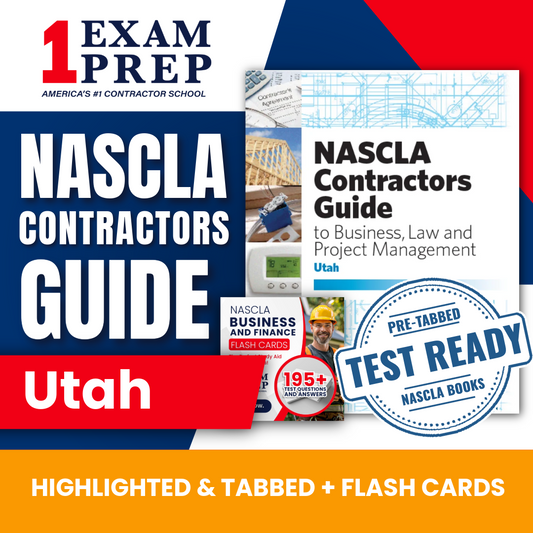
Start with the Utah Business and Law collection from 1ExamPrep. The collection includes an online preparation course, the Utah NASCLA Contractors Guide, highlighted and tabbed references, tab packages, and Business and Law book combinations.

Who Regulates Utah Contractors?

Utah contractor licensing is administered through the Utah Division of Professional Licensing, commonly called DOPL.

Utah licenses contractors by classification. The classification tells you what work the contractor is authorized to perform and what qualifications the designated qualifier needs to meet.

Current general classifications include:

  • E100 General Engineering Contractor
  • B100 General Building Contractor
  • R100 Residential and Small Commercial Contractor
  • H100 HVAC Contractor
  • E200 General Electrical Contractor
  • E201 Residential Electrical Contractor
  • P200 General Plumbing Contractor
  • P201 Residential Plumbing Contractor

Utah also has many specialty classifications covering work such as roofing, concrete, excavation, landscaping, fire suppression, sign installation, elevators, solar photovoltaic systems, and other specialized construction activities.

What Is a Contractor Qualifier?

The qualifier is the person whose qualifications support the contractor license.

Utah's current application requires the qualifier to hold an appropriate position in the company. The current form allows a qualifier who owns at least 20 percent of the business or who is a W-2 employee serving in a management position.

The qualifier is responsible for making sure the contracting company complies with applicable contractor laws and rules and must exercise meaningful authority in the business.

The qualifier is not just a name placed on an application. Utah expects that person to have a real connection to the licensed business.

Who Needs the Utah Business and Law Exam?

The current DOPL contractor application identifies the Utah Contractor Business and Law examination as an examination requirement for general classification qualifiers unless one of the listed alternative qualifications applies.

Current alternatives include certain applicants who previously served as Utah contractor qualifiers, applicants who qualify by endorsement, and other situations recognized by DOPL.

Do not assume every Utah specialty contractor takes the same exam. The current application separates general-classification exam requirements from specialty classifications.

Always match your preparation to the classification you are actually requesting.

Utah Business and Law Exam Format

60 Questions

Multiple Choice

The published Utah Business and Law examination outline contains 60 questions.

2 Hours

Testing Time

Candidates receive two hours to complete the examination.

70%

Passing Score

A 70 percent score means you need at least 42 correct answers.

Open Book

Approved References

Approved reference materials may be used under the testing provider's rules.

Current Utah Business and Law Exam Blueprint

Exam Subject Questions
Business Organization 4
Licensing 10
Estimating and Bidding 6
Contract Management 6
Project Management 5
Labor Laws 6
Lien Laws 3
Financial Management 6
Risk Management 5
Tax Laws 5
Safety 4
Total 60

Licensing is the largest individual category with 10 questions. Estimating and Bidding, Contract Management, Labor Laws, and Financial Management each contribute six questions.

Licensing Is the Largest Exam Category

Ten questions focus on licensing, so candidates should understand how Utah regulates contractors and qualifiers.

Review topics such as:

  • Contractor classifications
  • Qualifier responsibilities
  • Licensing requirements
  • Business organization requirements
  • Insurance
  • Employees and subcontractors
  • License maintenance
  • Unlicensed contracting
  • Renewal responsibilities

Learn the reason behind the rules. It is much easier to remember a licensing requirement when you understand which problem it is designed to prevent.

Estimating and Bidding Are Worth Six Questions

A contractor can build beautiful work and still lose money if the estimate was written with optimism instead of arithmetic.

Study:

  • Labor costs
  • Material costs
  • Equipment costs
  • Subcontractor pricing
  • Direct costs
  • Indirect costs
  • Overhead
  • Profit
  • Bid preparation
  • Plans and specifications

Practice identifying costs that belong directly to a job and costs that belong to running the company.

Contract Management Is Another Six Questions

Construction contracts define the work, price, responsibilities, payment, schedule, changes, and other important project terms.

Review:

  • Contract formation
  • Scope of work
  • Payment terms
  • Change orders
  • Delay provisions
  • Contract documents
  • Breach
  • Dispute resolution
  • Subcontracts
  • Project closeout

A handshake can be friendly. A clear written contract is usually friendlier when somebody later remembers the project differently.

Project Management Is Worth Five Questions

Contractors need to coordinate people, materials, money, schedules, subcontractors, inspections, and project changes.

Study project management concepts involving:

  • Scheduling
  • Project organization
  • Subcontractor coordination
  • Material delivery
  • Progress tracking
  • Quality control
  • Documentation
  • Change management

Good project management usually looks boring from a distance. That is often a compliment.

Labor Laws Are Worth Six Questions

Contractors who hire workers take on employment responsibilities in addition to construction responsibilities.

Review subjects involving:

  • Employees versus independent contractors
  • Payroll
  • Workers' compensation
  • Unemployment insurance
  • Tax withholding
  • Wage requirements
  • Federal and state employment rules

Utah DOPL specifically warns contractors that paying an unlicensed worker on a 1099 does not automatically make that person an independent contractor.

Do Not Ignore Utah Lien Law

Lien law only contributes three questions, but it deals with one of the subjects contractors tend to care about very quickly when payment stops.

Study the general mechanics of Utah construction liens, notices, deadlines, project records, and the State Construction Registry concepts covered by your approved references.

Three questions may sound small until one of them is the point between a passing and failing score.

Financial Management Is Worth Six Questions

Contractors manage more than job revenue. They need to understand whether the business is actually making money.

Review:

  • Financial statements
  • Cash flow
  • Job costing
  • Accounts receivable
  • Accounts payable
  • Payroll
  • Overhead
  • Profit and loss
  • Record keeping
  • Financial controls

Revenue is not the same thing as profit. That sentence has ruined many otherwise exciting sales totals.

Risk Management and Insurance Matter

Risk Management contributes five exam questions and connects directly with operating a licensed contracting business.

Current Utah DOPL guidance requires contractors to maintain general liability insurance. The current DOPL contracting page lists minimum coverage of $1 million per occurrence and $2 million aggregate.

Study:

  • General liability insurance
  • Workers' compensation
  • Property risks
  • Contractual risk
  • Insurance certificates
  • Claims
  • Loss prevention
  • Safety programs

Tax Laws Contribute Five Questions

Contractors deal with federal and state tax responsibilities connected to payroll, business operations, and employees.

Review concepts involving:

  • Employer Identification Numbers
  • Payroll taxes
  • State withholding
  • Federal withholding
  • Business records
  • Employee reporting
  • Tax responsibilities

The exam does not need to turn you into a tax accountant. It does expect a contractor to recognize the basic responsibilities of running a legal business.

Safety Is Part of Business and Law Too

The current blueprint includes four Safety questions.

Safety affects workers, schedules, costs, insurance, compliance, and the public. It belongs in the business exam because safety failures do not stay politely inside the safety department.

Review:

  • Employer safety responsibilities
  • OSHA concepts
  • Hazard communication
  • Accident prevention
  • Training
  • Record keeping
  • Jobsite safety administration

The Exam Is Open Book, But Time Still Matters

Sixty questions in two hours gives you an average of about two minutes per question.

That is enough time when you know your references. It can feel extremely short when every question begins with a five-minute tour of the index.

  1. Learn the chapter structure of each approved reference.
  2. Practice using the index.
  3. Organize permitted tabs before exam day.
  4. Highlight only useful material.
  5. Practice locating answers under a time limit.
  6. Mark difficult questions and return to them later.
  7. Leave time to review calculations and wording.

Which Books Should You Study?

The current 1ExamPrep Utah Business and Law package focuses on two major preparation references:

  • NASCLA Contractors Guide to Business, Law and Project Management, Utah, 4th Edition
  • Utah Contractor Education Book

Review the Utah Business and Law Book Package to obtain both references together.

Candidates who want a guided preparation program can also review the Utah Business and Law Online Exam Prep Course. The course includes structured review, reference-navigation guidance, and practice questions.

Highlighted and Tabbed References Can Save Study Time

An open-book exam rewards organized reference materials.

Contractors who already understand the material can still lose time if they cannot find it quickly. Properly placed permanent tabs can help you move from licensing to contracts, finance, taxes, liens, labor, and safety without flipping through half the book.

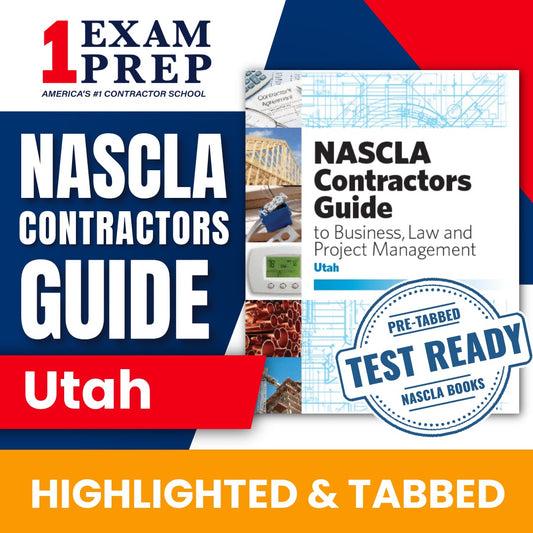
Review the Utah NASCLA Contractors Guide Highlighted and Tabbed Edition for a prepared reference option.

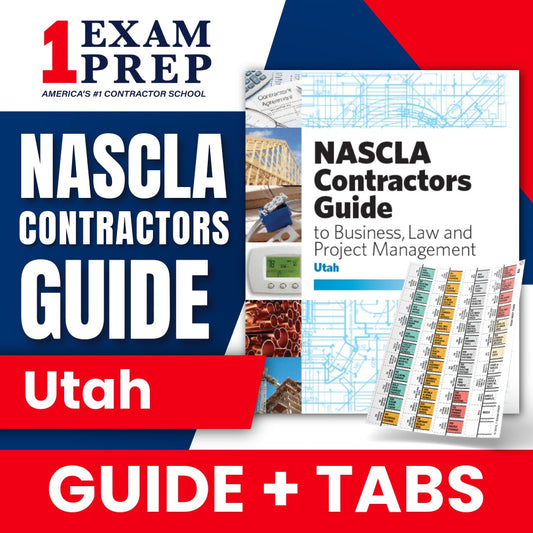
If you already own the book, the Utah NASCLA 4th Edition Pre-Printed Tabs provide a separate navigation option.

Always follow the current Prov rules for what tabs, highlighting, notes, or other reference modifications are permitted at your specific examination.

Prelicensure Education Is Separate From Exam Prep

Utah currently requires contractor qualifiers to satisfy prelicensure education requirements or qualify through an approved alternative.

The current contractor application identifies a minimum 25-hour prelicensure course, plus a 5-hour Business and Law course when applying for a general or primary classification.

That creates a typical 30-hour prelicensure education path for the covered general classifications.

A required prelicensure course and an exam-prep course are not automatically the same product. One satisfies a licensing education requirement. The other is designed to help you prepare for the examination.

General Contractor Experience Is Another Requirement

Current DOPL materials require a general-classification qualifier to meet an experience pathway unless another accepted qualification applies.

One current route allows the qualifier to self-certify at least 4,000 hours of paid experience in the construction industry together with knowledge of contractor business principles.

Other current qualification paths can include:

  • Prior qualifying experience on a Utah contractor license
  • An accredited two- or four-year degree in Construction Management
  • An active unrestricted Utah Professional Engineer license
  • Passing the NASCLA Commercial General Building Contractor examination
  • Qualifying for Utah licensure by endorsement

These alternatives relate to qualification for the classification and should not be confused with automatically waiving every other application requirement.

Electrical, Plumbing, and HVAC Have Extra Requirements

Business and Law is only part of the licensing picture for certain classifications.

Utah's current contractor application requires E200 and E201 electrical contractor qualifiers to hold the applicable Utah Master Electrician license. P200 and P201 plumbing contractor qualifiers likewise need the applicable Utah Master Plumber license.

Beginning with the 2026 H100 changes, HVAC qualifiers also have additional requirements that include the H100 written trade examination, qualifying gas certification, and documented HVAC-specific experience or an accepted alternative.

Current Utah Contractor Application and Renewal Fees

$175

Contractor Application

Utah DOPL currently lists a $175 application fee for a primary contractor classification.

$128

Contractor Renewal

The current DOPL contractor renewal fee is $128.

Exam-provider fees, education, books, insurance, business registration, bonds when required, and other costs are separate from the DOPL application fee.

Contractor Licenses Renew in Odd Years

Utah contractor licenses currently expire on November 30 of odd-numbered years.

Contractors need six hours of approved continuing education during each licensing period. Current DOPL guidance states that three hours must be core education and three may be core or professional education.

Contractors must also keep their business entity and required liability insurance current for renewal.

How Prov Testing Works

DOPL currently uses Prov for the Utah contractor examinations covered by its exam program.

Current DOPL guidance says no preapproval is required before sitting for the contractor examinations handled through Prov.

Candidates can currently test in person at a Prov testing center or use the approved online testing option identified by DOPL.

Current DOPL guidance also allows three attempts with 30 days between attempts. Additional retakes after that require a longer waiting period, so repeated guessing can become a surprisingly long study plan.

A Practical Utah Business and Law Study Plan

  1. Start with Licensing. It is the largest category with 10 questions.
  2. Study Contracts and Estimating. Each category contributes six questions.
  3. Learn Labor and Financial Management. These are another 12 questions combined.
  4. Review Project and Risk Management. Understand how business decisions affect active construction projects.
  5. Study Tax and Lien Law. Both subjects affect getting paid and staying compliant.
  6. Review Safety. Do not donate four questions because the subject sounds familiar.
  7. Practice with the real references. The examination is open book.
  8. Use a timer. Practice finding answers within about two minutes per question.

Prepare to Run the Business, Not Just Pass the Test

The strongest Business and Law candidates connect the exam topics to the way a real contracting company operates.

Estimating connects to cash flow. Contracts connect to scope and payment. Labor law connects to payroll and workers' compensation. Safety connects to insurance and project costs. Lien law connects to collections. Licensing connects to which work the company is legally allowed to perform.

Learn those relationships instead of studying eleven unrelated chapters. It makes the material easier to remember and more useful after exam day.

Because the test is open book, practice locating information instead of simply reading the references from front to back. Know which chapter handles licensing. Know where contracts live. Know where to find liens, labor, tax, finance, and risk management.

At the same time, prepare the licensing side. Identify the correct Utah contractor classification, qualifier, prelicensure education path, experience requirement, business entity, insurance, workers' compensation status, EIN, and employee registrations that apply to your company.

Start with the Utah Business and Law collection at 1ExamPrep to compare exam-prep courses, books, tabs, and organized reference packages.

For a guided preparation program, review the Utah Business and Law Online Exam Prep Course.

For the primary study references, review the Utah Business and Law Book Package.

If you need help organizing the Utah contractor license application, review the Utah Contractor License Application Service.

For books, exam preparation, application expenses, and other licensing costs, you can also review 1ExamPrep financing options.