












West Virginia Electrician License Exam Prep: Journeyman, Master and Specialty Guide
West Virginia electricians do more than connect wires and hope the breaker stays quiet. They read drawings, size conductors, choose protection, test installations, and understand when electrical work needs a qualified person. State exams check how well that knowledge translates into clear code-based decisions. This guide explains how to choose the right West Virginia electrician license, prepare for questions based on the National Electrical Code, organize experience documents, and build a sensible study plan.
Begin with the West Virginia Electrician collection. You can compare preparation guides and packages there, but the West Virginia State Fire Marshal controls applications, testing notices, licenses, and renewals. One especially useful habit is to verify the NEC edition in your current exam authorization before ordering books. An attractive study package does not change the state's approved reference list.
Choose the correct electrician credential
The West Virginia State Fire Marshal administers electrician licensing, including journeyman, master, and specialty levels. These categories are not interchangeable. A journeyman candidate may focus on practical installation and code application, while a master candidate must understand broader work and supervision responsibilities. Specialty licenses address narrower areas, and some applicants may qualify by a different education or experience path. Start by writing the full license name on your study notebook.
Do not confuse an individual electrician license with the separate business permissions sometimes required for contracting work. Before paying for an examination, compare your intended work, experience records, and present job duties with the state's rules. You do not want to study for a higher-sounding credential when a different category is the one your work actually requires.
Confirm experience and application eligibility
The state's examination application describes routes to a journeyman exam based on qualifying practical electrical experience, approved apprenticeship training, or an approved vocational program. Master applicants need a stronger history of qualifying electrical work. Details about which hours count, what certificates to include, and how supervisors should document work depend on the current license application. A job title by itself is not proof that every hour qualifies.
Create an experience worksheet listing employers, work dates, approximate hours, supervisors, and the types of installations you performed. Separate structural wiring from unrelated maintenance or administrative duties. Have former supervisors confirm records early when possible. A neat experience log reduces back-and-forth later and helps you identify gaps while there is still time to resolve them.
Understand the 2026 NEC exam edition
A 2026 examination update described by current preparation materials indicates the West Virginia electrical exams use the 2023 National Electrical Code. Some older state application PDFs still describe the 2020 NEC, and some newer commercial packages are labeled for the 2026 NEC. That is precisely why checking the official notice for your examination date matters. The edition printed on a book cover and the edition actually approved for testing must match.
There is also a difference between an exam reference and a statewide construction code adopted for building enforcement. Avoid assuming those dates are identical. Use the latest instructions from the State Fire Marshal, and ask the office directly if the published application and newer exam announcement conflict. When you know your edition, put its year on every study worksheet so it stays obvious.
Prepare for the current question format
Current 2026 exam-preparation descriptions report that master, journeyman, and single-family-dwelling electrician tests have 50 multiple-choice questions, with calculations folded into that format. Older instructions may describe different formats or scores. Rather than memorizing one outdated testing rumor, read your authorization and current exam-day notice for the exact number of questions, passing standard, permitted time, and materials.
Practice answering mixed questions without a pause between topics. You may move from conductor sizing to grounding and then to a motor question in less than a minute. Mixed practice teaches you to reset your thinking quickly, identify what the question actually asks, and use the codebook instead of selecting an answer merely because its wording looks familiar.
Make NEC navigation a practical skill
The NEC contains articles, tables, definitions, exceptions, and informational material. Memorizing all of it is a terrible weekend plan. A better approach is to learn the structure and recognize the likely article based on the system in the question. For example, a conductor problem sends you toward ampacity rules, while a grounding problem requires a different trail of definitions and requirements.
Create a two-column chart with question keywords on the left and possible article locations on the right. During practice, start with the index or table of contents, then confirm the actual code language. Do not trust an unofficial summary when the test asks for a specific rule. In open-book preparation, speed matters, but reading the correct sentence matters more.
Study branch circuits and feeders
Branch circuits and feeders show up in everyday installation decisions. The candidate should understand overcurrent protection, conductor selection, load requirements, equipment ratings, and the relationship between circuits and the equipment they serve. A question may give a simple-looking load but hide an exception, continuous-load condition, or different conductor termination rating. Reading the full scenario keeps you out of trouble.
Work several examples for residential and small commercial circuits, writing down the starting assumption and each table or rule used. Then change one condition, such as ambient temperature or the number of conductors, and solve the question again. That exercise teaches why a correct answer on one job can be wrong on the next.
Get comfortable with grounding and bonding
Grounding and bonding can sound like the same thing in casual conversation, but the NEC treats their purposes and installation requirements carefully. Candidates should know how to identify equipment grounding conductors, bonding paths, grounding electrode systems, and fault-current considerations. A question about a service, feeder, or separately derived system can change which connections are appropriate.
Draw a simplified service and panel arrangement. Label the neutral path, equipment grounding path, disconnect, electrodes, and conductors before consulting the code. Explain what each connection is meant to accomplish. If you can draw and describe the arrangement clearly, a wordy exam question becomes easier to untangle.
Review services, disconnects and protection
Electrical service questions can combine utility supply, service conductors, disconnect locations, equipment ratings, and overcurrent protection. You should understand the basic order of components and how code provisions affect installation choices. Do not assume the layout used by your most recent employer represents every permitted arrangement in the code. Exam questions often remove familiar field details and ask only about specified conditions.
Use a simple service diagram and trace power from the supply point to the branch circuits. For each major component, note what must be checked: rating, location, accessibility, wiring method, grounding, and protection. When answering a question, select the controlling rule before reaching for a number.
Practice conductor ampacity calculations
Ampacity questions are common places for rushed assumptions. A conductor's allowable ampacity can depend on material, insulation rating, number of current-carrying conductors, ambient temperature, termination limits, and installation conditions. The first answer in a table is not always the usable answer. These problems reward a tidy written method more than mental arithmetic performed at top speed.
Build a calculation sheet with spaces for given data, table values, adjustments, corrections, and final verification. Check each unit before choosing a multiple-choice option. Then explain in one sentence why you used that particular table column. Repeating this routine reduces mistakes caused by overlooking a condition buried halfway through the question.
Learn raceways, boxes and wiring methods
Conduit, cable, supports, fittings, and boxes are familiar materials, yet code tests examine details beyond recognition. Expect to read questions about fill, support, burial, location, box volume, or the suitability of a wiring method for particular conditions. A trade habit may be useful, but the NEC's actual conditions still control the correct exam answer.
Sort practice questions by installation setting, such as dry indoor, wet outdoor, underground, or exposed to physical damage. Identify what changes about the wiring method. For box-fill problems, write down every device, conductor, clamp, and fitting that matters before calculating. Careful inventory prevents small counting errors.
Understand motors and controls
Motor questions can involve branch-circuit protection, overload protection, conductor selection, controllers, disconnects, and equipment nameplate data. These related concepts serve different purposes. A candidate who treats every protective device as interchangeable may struggle even with years of installation experience. Read the question carefully to distinguish the equipment and the protection it asks about.
Make a motor worksheet with nameplate information on one side and the applicable code steps on the other. Practice determining which table value applies, then check whether a specific provision uses nameplate current instead. Use short examples first, then try mixed problems with several devices in the same circuit.
Prepare for transformers and special equipment
Transformer and special-equipment questions are good practice in reading equipment data rather than guessing from appearance. You may need to distinguish primary and secondary conditions, overcurrent protection, grounding requirements, or installation restrictions. Some systems also have dedicated NEC articles, so the general rule you remembered yesterday may not be the complete answer today.
Choose three sample scenarios involving different equipment types. For each, write the exact facts that change the governing rule: system voltage, location, use, rating, or occupancy. Search the relevant articles and summarize the result in plain language. This encourages transfer of knowledge instead of memorizing one sample question.
Know special locations and occupancies
Pools, hazardous locations, healthcare spaces, temporary installations, and other special uses can introduce requirements beyond general wiring rules. The right response is not to memorize every exception on day one. Learn to recognize that the question involves a special environment, then find its dedicated article and check how it modifies the general requirements.
Make an index card with the names of the special topics you encounter in practice tests. After each missed question, add the reason it was special and the general rule it changed. This method is especially useful when unfamiliar conditions appear on exam day. The goal is recognition followed by precise reference use.
Use trade math without panic
An electrician exam may ask about voltage, current, resistance, power, single-phase and three-phase relationships, or conductor calculations. Most candidates know the ideas until a timed question includes several numbers and unexpected units. Writing the relationship first is much more reliable than guessing from the answer choices. Units are part of the problem, not decoration.
Practice short problems without a calculator, then repeat with the type of calculator your current exam instructions permit. Check whether the result is reasonable before selecting an answer. A small decimal mistake can produce a technically impossible value, and catching that error is a skill worth practicing.
Separate job experience from code rules
Experience is a major advantage because you can picture how the equipment fits together. But test questions do not know the custom methods used at your company or the preferences of your local supplier. The correct answer depends on the specified code and the conditions actually stated. Adding a convenient assumption can turn a straightforward question into an incorrect one.
For every missed problem, write down what the question said, what you assumed, and what the code required. Look for patterns. Are you rushing past words like minimum, maximum, existing, or continuous? These small qualifiers often explain why a familiar field answer was wrong in the exam scenario.
Build a smart six-week study calendar
A study plan works best when every session has a clear task. In week one, confirm the exam bulletin and evaluate your strengths. In weeks two and three, focus on major NEC areas and navigation. In weeks four and five, practice calculations and mixed questions. The final week should emphasize timed sets, weak topics, and test-day rules rather than starting a completely new stack of books.
Adjust the calendar to your work schedule and exam date. A busy electrician may accomplish more in forty-five focused minutes each evening than in a five-hour Saturday session full of interruptions. Keep a list of mistakes by topic, not merely by question number, and retest the weakest subjects until performance is steady.
Choose a prep package that fits your exam
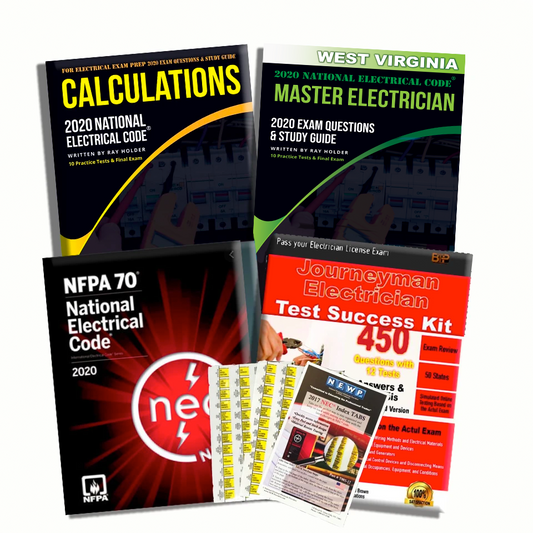
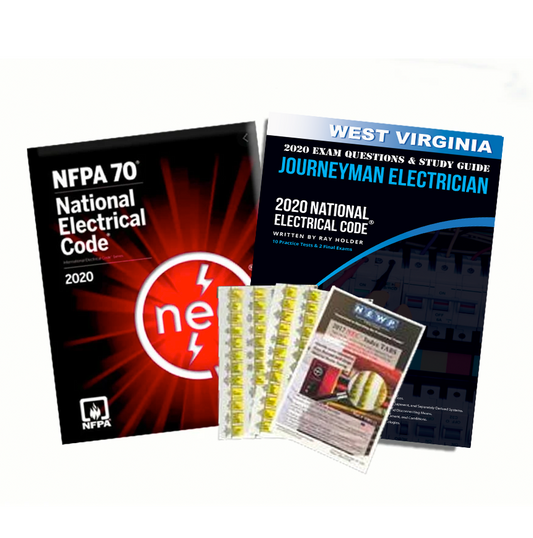
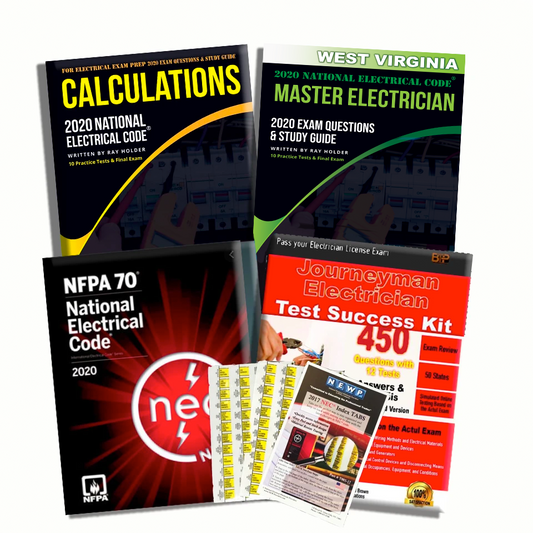
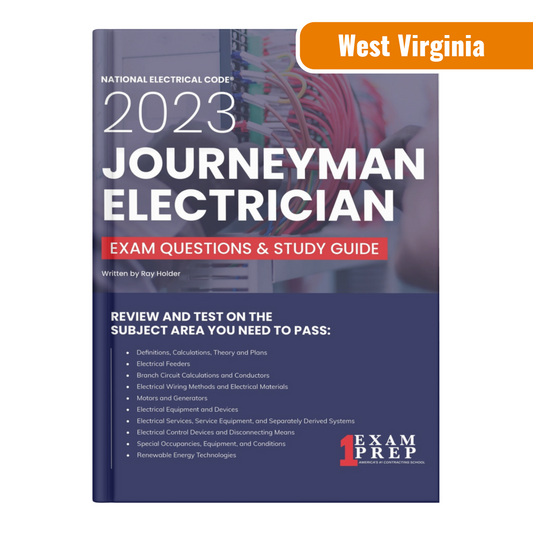
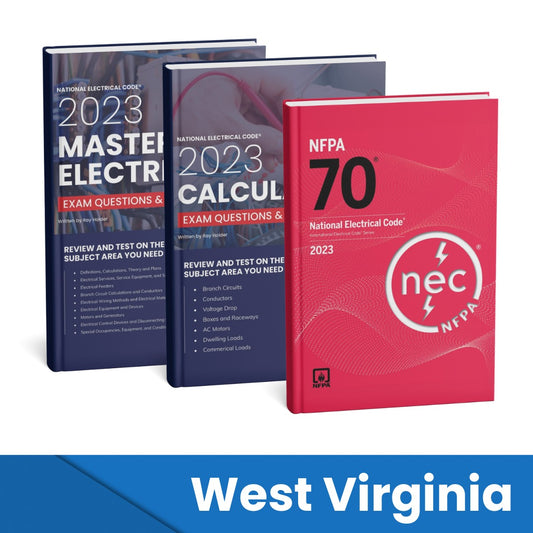
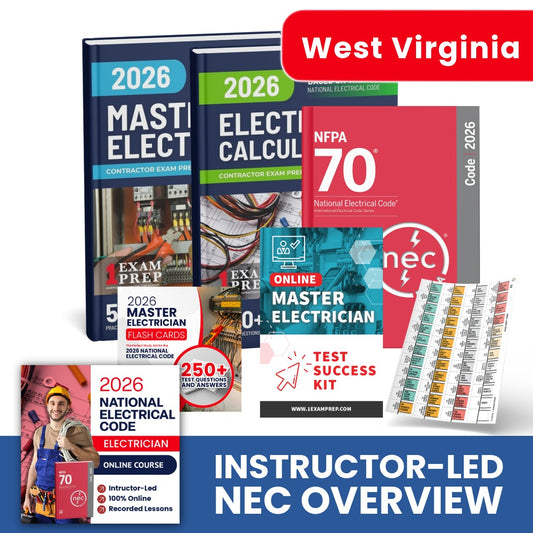
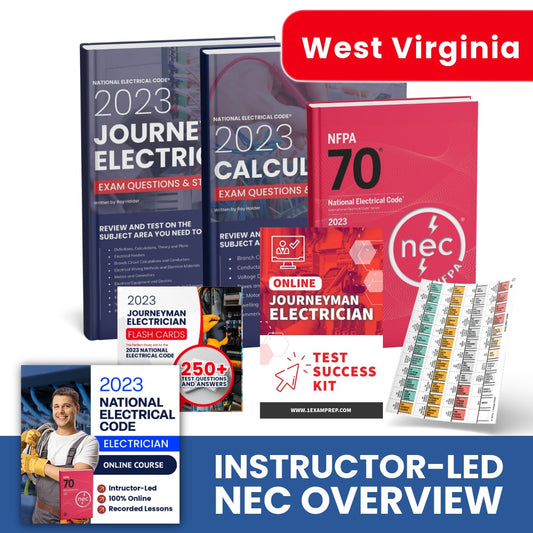
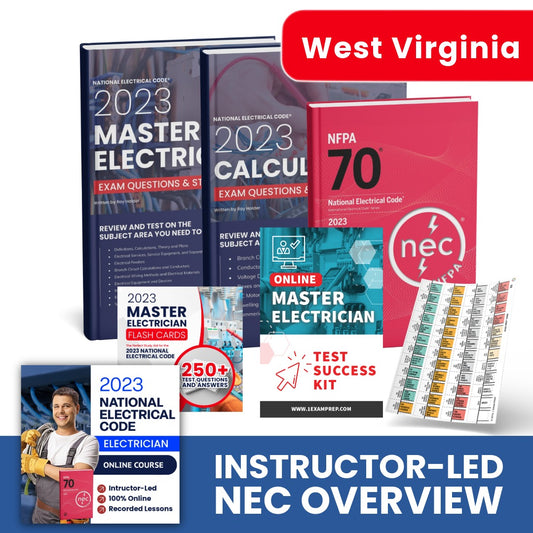
The West Virginia Electrician collection brings together relevant study resources. A 2023 NEC-focused journeyman guide is one example. Other products may refer to the 2026 NEC, live instruction, flash cards, or bundles, so inspect the exact contents carefully rather than assuming every package targets the same testing edition.
Ask whether the item is a guide, a course, a reference book, a rental, or a package with several components. Check the edition, access period, shipping, and any deposit or return terms. The best purchase is the one that matches your authorized test and fills a real gap in your preparation, not the one with the longest title.
Check allowable exam-room materials
Open-book testing is not an invitation to bring every notebook from the garage. Exam rules may specify exactly which NEC edition, tabs, calculators, or other aids are allowed. Older application documents may differ from current notices. Verify the list before you begin marking a codebook or preparing a binder of printed questions.
Practice with the same basic setup you plan to use on test day. Keep bookmarks or tabs compliant with the written instructions, and avoid study sheets that the exam rules prohibit. On your checklist, include identification, acceptance notice, location, arrival instructions, and permitted tools. A well-prepared candidate should not be surprised at the check-in desk.
Remember licensing and renewal after the test
Passing an exam is not identical to receiving a license. The State Fire Marshal must process the appropriate application and issue the credential. If your intended work involves supervising others or offering contractor services, confirm any additional responsibility that applies to your business. Do not advertise a credential simply because the exam went well.
Once issued, keep your license information and renewal notices organized. Verify the current renewal cycle and any local requirements rather than relying on a coworker's experience from years ago. The state licensing portal is the logical place to start. Keeping records current is less exciting than wiring a new panel, but it helps keep your career moving.
Know when to ask for clarification
A state rule, an outdated PDF, a product description, and an exam-day email can sometimes seem to disagree. The responsible agency is the right place to resolve official testing requirements. Contact the West Virginia State Fire Marshal with the exact exam, date, and document language in question. Record the answer alongside your study plan.
Similarly, ask a prep provider about included editions and materials before purchase. Clear questions save money: Will this course fit the exam I am authorized to take? Are the reference books mine to keep? Does the package include testing registration? Keeping these answers in writing avoids unpleasant discoveries later.
Follow a final action checklist
Start by choosing your license category and confirming eligibility. Then obtain the current testing notice, settle the approved NEC edition, and choose study materials that match it. Schedule regular code-navigation and calculation sessions, review your error log, and simulate the format that will appear on your test date. Finish by checking admission requirements and travel instructions.
After testing, retain your result notice and follow the State Fire Marshal's directions for issuance and renewal. You do not need to master everything at once. A realistic plan built around the correct references and frequent practice is much better than frantic highlighting the night before an examination.
Recommended Study Materials and Official Resources
Use these links to check the correct reference editions, current licensing instructions, and study-material descriptions. The licensing agency controls exam and license requirements; shopping links do not replace official approval.
Practical Action Checklist
- Write down the exact exam or learning goal.
- Confirm the official rules and reference editions for your date.
- Choose the resources that match the goal and your budget.
- Make a weekly practice plan with measurable targets.
- Use mixed questions and review all mistakes.
- Check test-day, session, and scheduling details.
- Complete any remaining licensing or business requirements.
Frequently Asked Questions
Conclusion
West Virginia electrician exam preparation begins with a simple but essential choice: which license are you actually pursuing? Journeyman, master, and specialty credentials cover different levels or kinds of electrical work. Your experience documents, exam authorization, study books, and final license application should all point to the same category. A polished workbook is helpful, but it cannot correct an application filed under the wrong license. Confirming the pathway first protects your time and money.
Next, settle the approved exam edition. In 2026, study-product descriptions refer to an exam update using the 2023 National Electrical Code, while older documents and some new commercial packages show other NEC years. Do not choose a reference based only on what is newest or easiest to buy. Read the newest examination notice from the State Fire Marshal and clarify any disagreement with the licensing office before your test. That verification is part of preparing responsibly, not an unnecessary administrative chore.
Once you have the right references, build skill in using them. NEC questions demand a combination of technical understanding and careful reading. You must recognize the system, locate the correct article or table, examine any qualifications, and apply the rule to the facts in front of you. A question about conductor ampacity may be changed by installation conditions. A grounding question may turn on a detail about the service or feeder. Small words matter. Practice with realistic scenarios rather than copying answers from a familiar page.
Electrical mathematics deserves its own repeated practice. Write down known values, select the appropriate relationship, and make units visible from the first step. Check the result before comparing it with multiple-choice options. A surprising number of missed answers come from a wrong table, missed adjustment, or simple arithmetic error rather than a total lack of electrical knowledge. Keep an error log so you can see which part of your method needs repair.
Experienced workers should also separate field habits from the examination rule. Your employer's preferred installation method might be excellent, but the exam asks about the conditions in a specific question and the published code. Resist the urge to add details from your last job. Read exactly what is given, confirm the governing requirement, and then select the best answer. Doing this repeatedly turns practical experience into more reliable test performance.
A realistic weekly calendar can make the preparation manageable even with a full work schedule. Alternate code navigation, diagrams, calculations, and timed mixed questions. Spend the final study days reviewing weak topics and the current exam-room instructions. Confirm identification, check-in procedures, permitted tools, and reference-book conditions before you leave home. Being prepared includes knowing the testing rules, not just the trade.
After the examination, complete the actual licensing process. Keep your eligibility notice and score records, follow the State Fire Marshal's issuance instructions, and verify renewal responsibilities. If your work also requires a business authorization, resolve that separately. The strongest next step today is to confirm your category and the approved NEC edition, choose matching resources, and solve one fresh problem from each major topic. Confidence comes from a repeatable method, not from hoping the easiest questions appear.
Key Takeaways
- Choose the correct West Virginia journeyman, master, or specialty license before studying.
- Confirm the NEC edition and current exam-day rules directly with the State Fire Marshal.
- Study code navigation, grounding, conductor sizing, branch circuits, motors, and calculations.
- Use a weekly calendar, timed practice, and a detailed log of missed questions.
- Complete state license issuance and renewal steps after testing.
Plain-Language Summary
Here is the West Virginia electrician exam guide in plain language. First, decide exactly what electrician license you want. The state has different paths for journeyman, master, and specialty work. They are not the same job title with different lettering. Each has qualifications and rules. You will need to show the right kind of work experience or accepted training and follow the State Fire Marshal's application process. Keep a folder with employment dates, supervisors, certificates, and any official correspondence.
Before you buy study materials, find out which National Electrical Code edition your examination uses. Current 2026 preparation information describes testing based on the 2023 NEC. However, some older state documents refer to the 2020 book, and some sellers offer newer editions. Those differences can be confusing. The safest move is to ask the State Fire Marshal or read the current examination notice for your scheduled test. Study with the edition that is actually required, not simply the one with the newest cover.
Many electrician exam questions ask you to apply the NEC to a specific situation. Learn how to find the right article, table, definition, or exception. Important areas include branch circuits, feeders, services, conductor sizing, grounding and bonding, wiring methods, overcurrent protection, motors, transformers, and special locations. You do not need to remember every sentence in the book. You do need to recognize the subject and check the correct rule carefully.
Practice electrical calculations as a separate skill. Write the facts down, choose the correct formula or table, keep the units visible, and check whether your result makes sense. Then practice under a clock, using only the tools that your examination permits. If you miss a question, do not just circle the right answer and move on. Find out whether you misread the problem, used the wrong code section, forgot an adjustment, or made an arithmetic mistake. Fix that part of your method.
Build a schedule that fits your real life. Short sessions spread across the week can work well for people already putting in long days on the job. Mix reading, diagrams, calculations, and practice tests. Review your weakest topics more often than the ones you already know. Before exam day, confirm the format, passing standard, testing location, identification, and allowed reference materials. Older guides may not match the rules for your date.
Finally, remember that passing the exam is not automatically the same as holding a license. The State Fire Marshal must issue the credential, and additional business requirements may apply to the work you plan to do. Save your records, complete the final steps, and keep track of renewal dates. Start with one clear action: check the license category and official exam edition today. Then use the West Virginia Electrician collection to compare suitable study resources and begin practicing steadily.
A useful last check is to compare the exact study package with your official exam instructions one final time. Look at the code year, question format, and rules for books. If they do not match, resolve the difference before exam day instead of guessing.