










HVAC Products Exam Prep Guide: Books, Courses, and Contractor Study Tools
HVAC work requires a special mix of practical skill and problem solving. One minute you are thinking about airflow, and the next you are checking refrigeration pressure or a wiring diagram. Licensing tests can combine those same ideas with code rules, safety, calculations, and business responsibilities. That is why preparing with the right materials matters.
The HVAC Products collection at 1 Exam Prep is a place to review options related to heating, ventilation, air conditioning, and refrigeration preparation. Depending on the specific product, resources can include reference books, rental packages, highlighted and tabbed materials, or online courses. Each listing has its own intended license and contents.
This guide explains how to compare HVAC products, recognize common examination subjects, and build a realistic study plan. The point is not to memorize every model number ever printed on a condensing unit. It is to understand the concepts, know your official exam outline, and practice applying what you have learned.
Start With the Exact HVAC License or Certification
There is no single nationwide HVAC contractor exam that covers every license. Some jurisdictions test residential air conditioning, others test commercial mechanical contracting, and some regulate heating, refrigeration, or journeyman work separately. One exam may emphasize installation, while another gives greater attention to service, business operations, or the mechanical code.
Before buying study products, identify the regulator, exam name, test administrator, and official content outline. Check whether the test is open-book or closed-book, what editions it recognizes, and whether you have separate business and trade exams. These details should shape your shopping list.
Do not let similar product names trick you. A course for a Maryland HVACR journeyman exam is not automatically suitable for a Florida Air B contractor test. They may teach overlapping fundamentals, but the allowed references and licensing rules can differ. Matching the exact examination is always step one.
HVAC Books and Courses Rental Packages
Rental packages can be useful when your examination uses several technical references and you do not want to purchase every volume. A books-and-courses rental option may combine temporary access to printed materials with online lessons, practice support, and tools for reference navigation.
The Maryland HVACR Journeyman Books & Courses Rental Package provides a real example of a state-specific bundle. Its listing includes a mechanical code, a refrigeration and air conditioning textbook, Manual J, OSHA construction safety, a ductulator, and a period of course access. That set is designed for the named Maryland examination, not for every HVAC license.
Examine rental terms before ordering. Look for required deposits, return timing, processing and shipping estimates, and book condition requirements. Keep a simple calendar with your test date and materials return date. A rental book is helpful when it is on your desk during study, not stuck in shipping while your exam gets closer.
Florida Air A and Air B Contractor Preparation
Florida Air Conditioning Class A and Class B are separate contractor license classifications. Their examination preparation can include HVAC trade references as well as Business and Finance materials. A product may support one class or allow the buyer to select either, so read each variant description carefully.
The Florida Air A and Air B Contractor Exam Complete Book Set is an example of a trade-reference package. For a broader format, the Florida Air A or Air B Ultimate Exam Prep Rental Package lists rental references, self-study, live and recorded lessons, flash cards, and application support.
Even when a product targets an open-book examination, the testing center controls what you may bring. Verify the current approved-reference list and marking rules independently. The purpose of a well-selected package is to practice with the right information before your exam, not to assume a large stack of books gives you permission to bring everything.
Refrigeration Cycle and Basic System Operation
The refrigeration cycle is a core HVAC concept. Candidates should understand the general roles of the compressor, condenser, metering device, and evaporator. They should also know how heat moves and why pressure, temperature, and refrigerant state matter to system performance.
A useful study habit is to draw the cycle from memory, label major parts, and explain what each component does. Then compare your diagram with a reliable textbook. This is more effective than reading the same description over and over, especially if troubleshooting questions ask what changes when a component fails.
Study the difference between normal operating conditions and signs of poor performance. Avoid reducing complicated diagnostic decisions to a single magic pressure number. Equipment type, load conditions, and manufacturer instructions can change the situation. For exam preparation, focus on the concepts and calculation methods required by your official outline.
Airflow, Duct Sizing, and Distribution Systems
Good heating and cooling performance depends on moving air where it needs to go. HVAC exams may cover supply and return ducts, friction losses, static pressure, equipment selection, filtration, ventilation, and distribution problems. These subjects become easier when you think of the duct system as a connected path.
Some packages include a ductulator or duct design standards. Those tools can help you understand airflow and duct sizing relationships, but only if you practice using them. Try an example, explain each assumption, and compare your result with the expected method. Pay attention to the difference between an exam calculation and real-world design review.
When reading a duct diagram, trace the path from the air handler through supply branches and back through the return. Note restrictions, fittings, and places where air leakage may affect performance. That simple exercise connects the drawing to the system a technician actually sees in the field.
Load Calculations and Comfort-System Design
Load calculations help determine the heating and cooling demands of a space. Test topics may include design conditions, insulation, windows, orientation, ventilation, and equipment selection. For residential preparation, a Manual J reference may appear in a listed exam book set, depending on the jurisdiction.
Do not treat equipment sizing as a guessing contest based on square footage alone. Learn which inputs affect the calculation and why incorrect sizing can lead to comfort problems, poor humidity control, or unnecessary cycling. You do not need to design a whole building to practice the logic behind a sample question.
Keep a dedicated notebook for calculations. Write the formula or method, define the units, work the numbers, and check whether the result is sensible. If you miss a problem, decide whether the mistake came from a concept, a conversion, or simple arithmetic. The repair method is different for each kind of mistake.
HVAC Electrical Fundamentals and Controls
HVAC professionals work with electrical controls, motors, contactors, relays, switches, transformers, and protective devices. Licensing preparation may include reading wiring diagrams, understanding voltage and current relationships, and recognizing safe procedures for testing and servicing systems.
Start with basic circuit behavior and control sequences. Learn how a thermostat call can lead to a series of expected actions and what a symptom may suggest about that sequence. Use labeled diagrams while studying. They help turn a jumble of wires into a pattern that makes sense.
Electrical safety is not a chapter to skim. Learn why equipment must be isolated and verified before servicing, and distinguish between safe theoretical exam study and physical work that should be performed only by trained, authorized people. Your study plan should help you make sound decisions, not encourage shortcuts around energized equipment.
Mechanical Code and Approved Reference Editions
Many HVAC contractor and journeyman exams refer to mechanical codes, fuel gas rules, energy codes, OSHA standards, or industry-specific publications. Exactly which editions apply depends on the exam. A mechanical-code reference accepted in one state may not match another state's code year or amendments.
Make a reference chart with four columns: exam subject, approved book, edition, and your confidence level. Use it to guide study and purchase decisions. If a listing contains a different edition, investigate before assuming it will be acceptable. There is no prize for bringing the wrong codebook in a beautifully organized binder.
During study, practice using indexes, chapter titles, definitions, and technical tables. For open-book tests, timed lookup drills are especially useful. For closed-book tests, focus more on understanding and recall. Always read the test provider's rules about allowed references, tabs, highlights, and calculators.
HVAC Safety, Refrigerants, and Responsible Work
HVAC safety involves electrical hazards, moving equipment, sharp sheet metal, ladders, lifting, pressure, and refrigerant handling. Different exams may also address jobsite protective measures, piping, combustion equipment, or confined working conditions. Safety knowledge should be part of every study week.
Refrigerant work can involve separate federal or other certification requirements. For example, handling regulated refrigerants may require EPA Section 608 certification in the United States. That credential is not the same thing as a state HVAC contractor license. Check the requirements for the work you plan to perform.
Use practice questions to explain why an option is safer or more compliant, not just which answer letter looks familiar. When your reasoning is clear, safety scenarios are easier to handle. The goal is to recognize risks before work begins, because a warning sign after an incident is not exactly great timing.
Business and Finance Materials for HVAC Contractors
Some contractor licensing paths have a Business and Finance component in addition to HVAC trade knowledge. Topics can include contracts, bidding, bookkeeping, insurance, project management, employment rules, and licensing duties. A technician with excellent diagnostics may still need dedicated study time for these subjects.
For example, the Florida Air B Contractor Books & Courses Rental lists both trade references and business-study support. That illustrates why it is important to check the contents of a package instead of assuming an HVAC title means only mechanical knowledge.
Make separate review sessions for business terms and trade concepts. Try explaining a simple estimate, what a contract clause does, or why records matter. If your official exam does not contain business topics, do not spend half your preparation time on an unrelated section. Keep your schedule tied to the published exam requirements.
Online HVAC Courses Versus Printed Reference Sets
Online instruction can make a large subject easier to digest. Short lessons, review questions, and guided explanations may help people who work long shifts. Printed references, on the other hand, are useful for studying code language and technical tables directly. The best format depends on the exam and how you learn.
A good comparison looks at the exact syllabus, book list, course access length, support options, and practice-question style. Do not assume every product includes live classes, recorded videos, or tutoring. These benefits should be stated clearly on the individual listing.
If possible, combine learning methods. Watch a lesson about duct sizing, read the relevant reference, and work a problem without help. Then review your mistakes. That cycle helps the information stick better than watching videos at double speed and hoping your brain catches every detail while making dinner.
Highlighted and Tabbed HVAC References
Highlighted and tabbed reference books can make study sessions more organized, especially when several standards are involved. Tabs speed movement to a chapter, and highlighting can draw attention to important language. Neither tool replaces the need to understand a rule or read the conditions around it.
The Florida Air A or Air B Highlighted and Tabbed Trade Book Set is one example of a prepared-reference option. It targets a particular Florida contractor trade examination. It is not a universal approval for marked books at other test centers.
Confirm the marking rules for your own exam before taking references into the testing room. Practice with the approved method so test day feels familiar. When working through questions, find the relevant table or paragraph, then check any exceptions. A fast lookup that overlooks a crucial note is still a wrong lookup.
Build a Six-Week HVAC Exam Study Routine
During week one, confirm your exam, code editions, and reference list. Use a baseline quiz to find weak spots. Week two can focus on refrigeration-cycle concepts and components. Use week three for airflow, ducts, load calculations, and system design as applicable.
In week four, review electrical controls, mechanical code, fuel gas or energy standards where tested, and safe work procedures. Week five can target weak topics and business or finance material if your license includes it. Week six should focus on timed practice, reference navigation for approved open-book exams, and careful review of missed questions.
You can extend this schedule if your work hours are demanding. Even twenty focused minutes can be valuable. Keep each session specific, such as five duct questions or one controls diagram, instead of writing “study HVAC” on your calendar and hoping something happens. Small targets make progress easier to measure.
Choosing HVAC Products That Match Your Goal
Start with a shortlist of products that name your exact exam. Check whether each one includes books you own, rental books you return, online access, practice questions, or instruction. Match every listed reference edition against the current exam bulletin. If something is unclear, confirm before buying.
Think about your budget and time, too. A large rental package can be useful for broad open-book preparation, but its return date matters. A small online course may fit a narrow knowledge gap better than a collection of books. A highlighted set can support lookup practice only when you know how the information is organized.
Explore the HVAC Products collection with those questions in mind. Choose study resources that help you understand heating, cooling, air distribution, safety, and your specific licensing rules. There is no shortcut that replaces practice, but the right materials can make your practice much easier to organize.
Frequently Asked Questions
Select a question to reveal its answer.
Conclusion: Your Next Step Toward Exam Readiness
Preparing for an HVAC license exam does not have to feel like learning every heating and cooling system at once. Begin with a simple question: which exact examination will you take? A residential HVAC test, an HVACR journeyman test, a commercial mechanical contractor examination, and a Florida Air B contractor exam can have very different rules. The correct reference editions, business requirements, exam formats, and subjects depend on the licensing authority. Getting that information early prevents one of the most frustrating study mistakes: spending weeks with materials meant for another test.
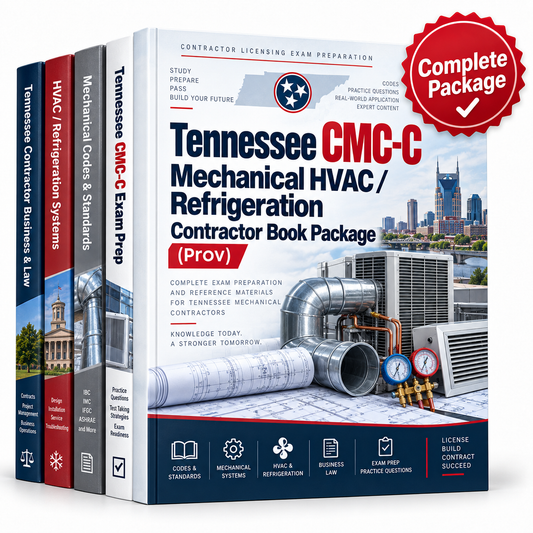
The HVAC Products collection can help you explore several ways to learn. Some candidates prefer books they can read and mark during study. Others benefit from online lessons that explain hard ideas in smaller parts. A rental package may make sense when several approved references are needed for a limited time. Highlighted and tabbed books can help with navigation practice where appropriate. Complete packages may bring course access and multiple tools together. Compare product contents instead of assuming a similar name means the same features. A little careful reading now can save money and confusion later.
Your technical study should build connections between topics. The refrigeration cycle explains how major components move heat. Airflow and duct sizing show how conditioned air reaches occupied spaces. Load calculations help you understand why equipment selection depends on the building, not a guess. Electrical controls determine how systems start, stop, and respond to demand. Mechanical codes and safety rules shape how work is performed. The topics may appear separately in the outline, but real equipment brings them together. Understanding those relationships makes scenario questions easier to reason through.
Practice is where those ideas become reliable. Draw a refrigeration cycle, label a duct layout, solve a load problem, or trace a simple control sequence. After each exercise, explain the answer in your own words. If you made a mistake, identify what happened. Was the concept unclear, the reference wrong, or the arithmetic rushed? An error log gives you a useful map for your next session. For open-book exams, also practice using the approved references under timed conditions. For closed-book exams, build recall without depending on pages you cannot bring.
The business side deserves its own attention whenever the license requires it. Some contractor exams cover contracts, estimating, accounting, or statutory obligations in addition to the trade. Study the official content outline and keep business sessions distinct enough that they do not disappear behind the technical topics. Likewise, check any separate refrigerant-handling credentials and safety requirements. A study course does not replace an EPA certification, state license, or another legally required approval.
A consistent six-week plan can help you organize the work, but it is not the only sensible timeline. Set small goals, such as finishing one controls diagram or ten duct questions. Review weaker subjects every week, and reserve time for test-day logistics. Before buying or testing, confirm current editions, product terms, allowed materials, and eligibility with the official authority. Browse the HVAC Products collection with those details in hand. Good preparation is not a pile of books or an endless video queue. It is a clear exam target, suitable tools, and steady practice that helps you make better decisions.
Key Takeaways
- Choose HVAC study products by your exact license classification, content outline, code editions, and exam format.
- Compare online lessons, purchased references, rental book sets, calculation tools, and highlighted or tabbed options carefully.
- Study refrigeration, airflow, ductwork, load calculations, controls, mechanical code, and safety as connected subjects.
- Use drawings, worked calculations, short quizzes, and an error log instead of passive reading alone.
- Check rental terms, separate business or refrigerant credentials, and the testing provider's approved-reference rules.
Plain-Language Summary
HVAC exam preparation starts with understanding which license or certification you want. Heating, ventilation, air conditioning, and refrigeration are related, but licensing rules differ by location and job type. A residential technician test is not automatically the same as a commercial mechanical contractor exam. Some licenses also require separate business and finance testing. Before buying materials, find the official exam name, topic outline, reference list, and book editions. Check whether the exam is open-book or closed-book. These details tell you how to prepare.
HVAC study products come in different forms. You may find reference books, online courses, practice questions, or complete packages with several kinds of support. Some packages include books you keep, while rental packages require you to return the materials under stated conditions. Highlighted and tabbed books can help you practice locating information. If a product includes online instruction, check the subjects it teaches and how long you have access. Do not assume all packages provide live classes, tutoring, or application services. Read the individual listing carefully.
Much of HVAC study involves learning how connected systems work. The refrigeration cycle is a good example. You should understand the basic roles of the compressor, condenser, metering device, and evaporator. Airflow topics explain how ducts, fans, filters, and returns affect system performance. Load calculations help you understand the heating and cooling needs of a building. Electrical controls show how equipment responds to calls for heating or cooling. Safety and mechanical code rules connect all these topics to responsible work.
Practice one idea at a time. Draw a refrigeration cycle and label the components. Trace air through a duct system. Work through a sample calculation and show the units. Read a simple wiring diagram and explain the control sequence. After each exercise, check your answer and write down why you missed anything. A mistake is useful when it tells you what to review next. If you have an approved open-book examination, learn to find information quickly in the correct reference. If your exam is closed-book, emphasize understanding and recall.
Safety deserves its own study time. Electrical hazards, moving parts, pressure, ladders, sheet metal, and refrigerant handling can all be important. Some refrigerant work requires separate EPA Section 608 certification in the United States. That is not the same as receiving a state HVAC contractor license. Your licensing agency can explain which qualifications apply to the work you intend to perform.
A six-week plan may begin with gathering the correct materials and testing your current knowledge. Then spend time on refrigeration, airflow, load calculations, controls, codes, and safety. Review business topics if your exam requires them. Finish with timed practice and a careful review of your weak areas. Extend the plan if you need more time. Before testing, confirm appointment details and the rules on approved materials. Browse the HVAC Products collection for study options, but always use official exam instructions to make the final decision. Good preparation is about consistent learning, not collecting the most books.